Table of Contents
Introduction
The customer insight that led to Naukri
Why jobs are a high-interest category
The hidden opportunity in recruitment
The real reason people start looking for new jobs
The research behind the Hari Sadu campaign
The 3 principles of memorable advertising
How the iconic Hari Sadu ad was created
Lessons for founders and marketers
Introduction
Some conversations stay with you because they are not just interviews. They become a masterclass.
My conversation with Padma Shri awardee Sanjeev Bikhchandani on Dilse Omni Talks was exactly that. Sanjeev is the founder of Info Edge, the company behind Naukri.com, 99acres, Jeevansathi, and Shiksha. He also backed companies like Zomato and Policybazaar early, and has shaped the Indian startup ecosystem in more ways than one.
What struck me most was not only how Naukri was built, but how carefully it was built. There was no rush to look clever. No desire to burn money just because a budget existed. There was patience, observation, and a deep respect for consumer insight.
And then came the story that every marketer in India remembers. The Hari Sadu ad.
But before that iconic campaign, there was a simple observation from print media that unlocked an entire category.
For anyone building a brand, a startup, or even a category, this is one of those stories worth revisiting. If you want a deeper look at Sanjeev’s journey building Naukri and backing category-defining companies, this conversation connects beautifully with The Father of Indian Startup Ecosystem.
The customer insight that led to Naukri
Sanjeev took me back to a very different media era. Monday had Education Times, Wednesday had Ascent for jobs, and Friday had Property Times. These newspaper supplements were not trivial side sections. They were habit-forming information products.
What he noticed was fascinating. People would often flip business magazines from the back because that was where the appointment ads were. In those days, a publication like Business India could carry 35 to 40 pages of recruitment ads at the back.
That behavior mattered more than the ad volume itself. It revealed intent.
One of the strongest ideas from the conversation was this:
Jobs are a high-interest category of information.
That sentence sounds obvious now. It was not obvious then.
Sanjeev observed that even people who were not planning to switch jobs would still look at job ads, discuss them, and think about them. That meant the category had a magnetic pull beyond active buyers. And once you identify a high-interest category, you are no longer dealing with cold demand. You are dealing with ambient curiosity.
Why jobs are a high-interest category
This part was one of my biggest takeaways.
Most information categories are narrow. Only a few people care at a given point in time. Jobs are different. They pull attention from multiple layers of people at once:
People actively looking for a role
People casually exploring the market
People comparing themselves to peers
People discussing opportunities with friends and family
That is why job information behaves differently from many other categories. A person may not be applying, but is still consuming. That consumption has value.
Sanjeev put it beautifully through observation. People were not always looking for jobs, but they were definitely looking at jobs.
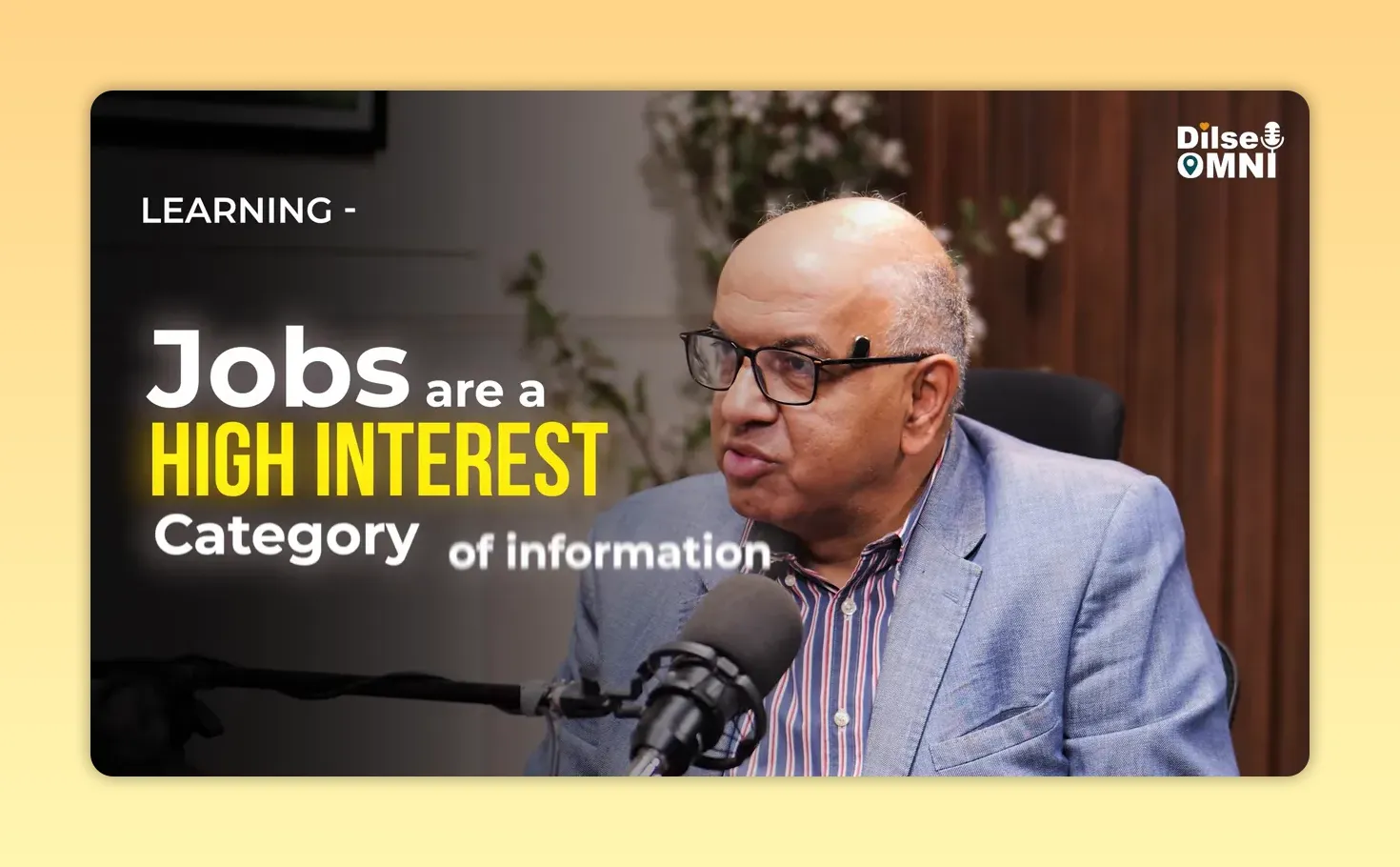
This is the core insight behind Naukri. Interest in jobs far exceeds immediate intent to apply.
That is a foundational brand lesson too. If your category naturally attracts attention, the real job is not creating interest from zero. It is organizing that interest better than anyone else.
The hidden opportunity in recruitment
The second insight was even more commercial.
Sanjeev realized the visible job ads in print were only the tip of the iceberg. Beneath those ads was a much larger, fragmented recruitment market run through headhunters and informal networks. Thousands of companies. Tens of thousands of jobs. Multiple intermediaries. Plenty of inefficiency.
That meant the newspaper was not the market. It was only the visible surface of the market.
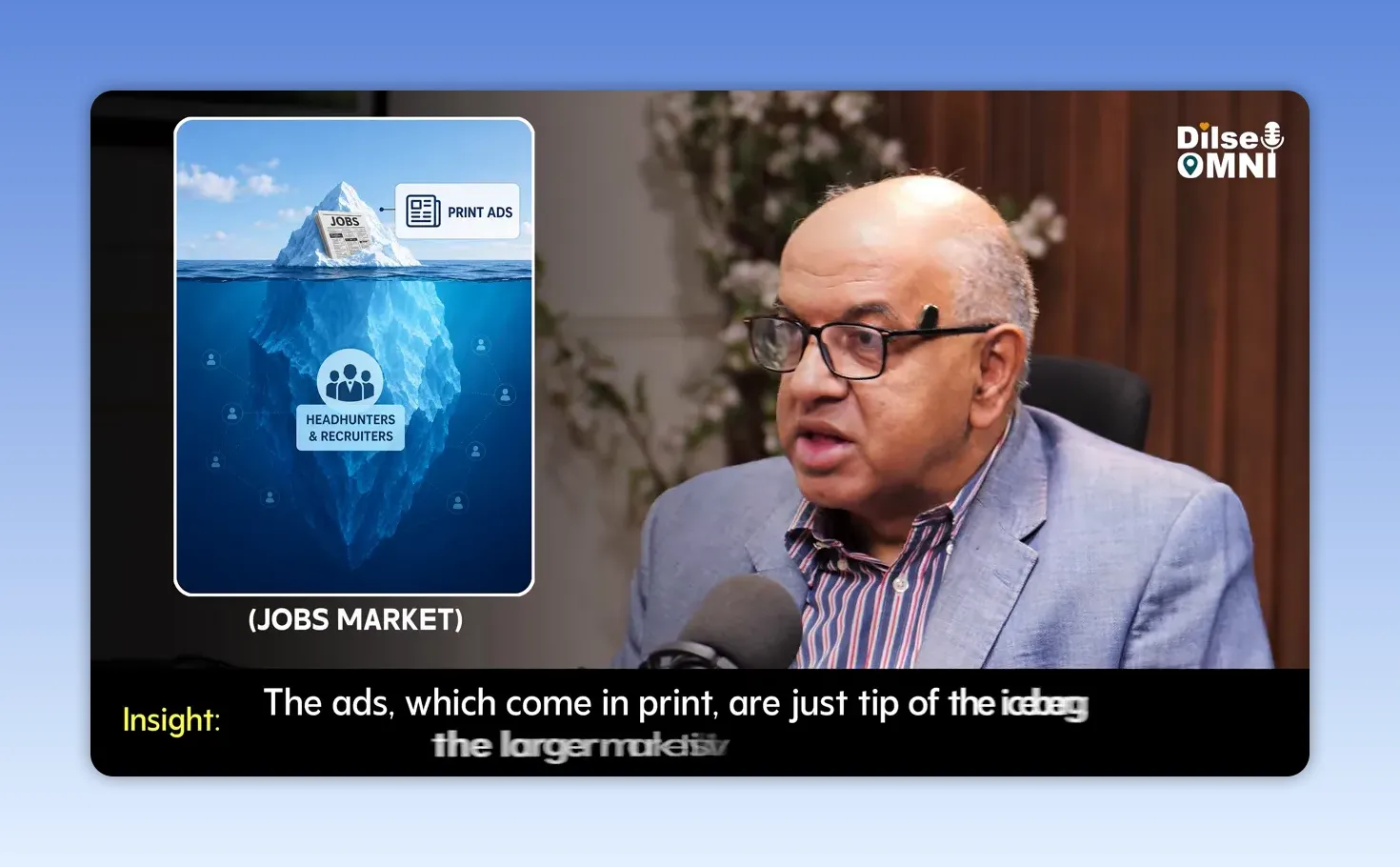
The real opportunity was not the ad pages everyone saw. It was the much larger hidden market beneath them.
When Sanjeev spoke about this, I kept thinking how many founders miss opportunities because they stop at the obvious layer. They see the storefront, not the supply chain. They see the ad, not the broken market behind the ad.
His insight can be turned into a simple founder framework:
Observe behavior and not just market size
Identify repeated friction in the system
Look below the visible layer for fragmentation and inefficiency
Wait for timing if the infrastructure is not ready yet
That last part matters. He had this insight by 1990. But there was no practical way to modernize the market yet. So the idea became what he called a file-and-forget kind of insight.
That takes discipline. Not every good idea is ready to be executed the moment you think of it.
In that phase, he started two modestly successful businesses from home with a friend: a trademark search service and a salary survey business. Sometimes the road to the big company goes through smaller experiments.
The real reason people start looking for new jobs
This is where the conversation moved from category insight to emotional truth.
Sanjeev referred to research that completely sharpened the Naukri proposition. People often say they switched jobs for money or title after the fact. But that is not what starts the search.
What starts the search is usually a bad boss or a bad team.
You join a company for the company, you leave a company for a lousy boss.
That line deserves to be framed in every HR office.

A lot of hiring strategy misses this. The trigger is often not compensation. It is the immediate working relationship.
This was not just useful research. It was powerful creative fuel. It gave Naukri a human truth that millions could instantly relate to.
And that is what separates average marketing from memorable marketing. A functional message says, we have jobs. A sharp message says, we understand why you are secretly thinking of leaving yours.
The research behind the Hari Sadu campaign
By the early 2000s, Naukri was profitable and had about ₹5 crore to spend on TV. A lot of companies would have rushed into media because budgets tend to create urgency. Sanjeev did the opposite.
He told the agency something unusual. We have one shot. This is all the money. We will not spend it until we find the right creative.
That patience is rare.
He also described how the agency kept asking for data and information, and the Naukri team kept sharing whatever they had. This was not a vanity-led campaign. It was a research-fed campaign.
The key research input came from a survey in The Economist. The insight was simple and brutal: people begin their job search because they have a bad boss.
Once that landed, the creative team knew they had something real.
If you enjoy unpacking how insight turns into communication strategy, there are similar founder and marketing lessons across other conversations on Dilse Omni Talks.
The 3 principles of memorable advertising
This section felt like a compact advertising playbook.
Sanjeev explained the agency’s view that the big job of a TV commercial is to stand out of clutter. Not to look expensive. Not to sound important. To stand out.
And how do you stand out? Through three principles:
Be memorable
Be humorous
Touch an emotional cord
I loved how practical this was. This was not theory from a textbook. This was operating philosophy from people who knew media money was limited and clutter was real.
Then came another culturally rooted layer. The agency argued that in India, there are three very big relationships:
Mother and son
Mother-in-law and daughter-in-law
Boss and employee
That third relationship became the emotional and comedic territory for Naukri.
How the iconic Hari Sadu ad was created
Now came the part I was most curious about.
The creative leap was clever. If people leave jobs to get away from a bad boss, could you show that truth in a funny way? Better still, could you show a subordinate getting back at a bad boss in a harmless, comic moment?
That is where Hari Sadu was born.
The ad used a phone call and a simple misunderstanding around the boss’s name to create an unforgettable scene. The subordinate spells out the boss’s name, but the way it sounds turns the moment into a sly rebellion. The boss is right there, but the employee still gets his tiny moment of revenge.
It worked because it did all three jobs at once:
It was memorable
It was funny
It touched a real emotional nerve
Every employee who had ever suffered under an unreasonable manager got the joke instantly.
Sanjeev was generous in assigning credit. He made it clear that the campaign was the work of the team and the agency, not a founder myth where one person magically invents everything. He even admitted that there was resistance and debate along the way. Early ideas were rejected. Budgets were questioned. Production costs felt high.
That honesty is important. Iconic work rarely emerges in one clean stroke. It survives scrutiny, disagreement, and iteration.
We have one shot. We will wait for the right creative before we spend that ₹5 crore.
That may be the most important line in the entire story.
Lessons for founders and marketers
I came away from this conversation with a few lessons that feel timeless.
1. Great businesses often begin with a behavioral observation.
Not with a spreadsheet. Not with a trend deck. Someone notices what people repeatedly do.
2. High-interest categories are gold, if you understand them deeply.
Jobs were not just a marketplace. They were a recurring source of attention, aspiration, and comparison.
3. The visible market is often much smaller than the real market.
The job ads in print were just the tip. The larger system was hidden, fragmented, and waiting to be organized.
4. Consumer truth beats clever copy.
Hari Sadu was funny because it was true before it was witty.
5. Don’t spend just because the budget exists.
This is perhaps the hardest lesson for modern brands. Patience is an underrated marketing advantage.
6. Memorable advertising is disciplined, not accidental.
Stand out. Be memorable. Use humor. Touch emotion. That is a real framework.
7. Credit the team.
The way Sanjeev spoke about the agency and internal team was a reminder that enduring brands are built collectively.
As a host, I also found this conversation a powerful reminder of what omnichannel leaders and founders can learn from old-school category builders. Long before growth hacks and dashboards, there were insights, patience, and creative conviction.
And maybe that is why this story has lasted. It is not really about one ad. It is about the discipline of waiting until insight and execution finally click.
I am Saurabh Agrawal and we come with a new episode on Dilse Omni Talks every fortnight and cover different aspect of omnichannel with amazing speakers.
This article was created from the learnings from the video Why Naukri Refused to Spend ₹5 Crore Until They Found the Perfect Ad | Sanjeev Bikhchandani.