Siddharth Gopalkrishnan
Siddharth Gopalkrishnan
Episode 19
Episode 19
90 min
90 min
The Agentic Marketing Playbook: How AI Is Redefining Modern Marketing
The Agentic Marketing Playbook: How AI Is Redefining Modern Marketing
The Agentic Marketing Playbook: How AI Is Redefining Modern Marketing
Why Does This Episode Matter?
Why Does This Episode Matter?
Every decade, marketing gets a new buzzword.
CRM. Marketing Automation. Personalization. Customer Data Platforms. AI.
Today, a new term is beginning to dominate conversations in boardrooms and marketing conferences alike—Agentic Marketing.
But unlike previous technology shifts, this isn't simply about adding another AI tool to your Martech stack. It's about changing how marketing decisions are made.
In my conversation with Siddharth Gopalakrishnan, COO of Netcore Cloud, we explored what Agentic Marketing actually means, why Netcore has spent the last few years building towards it, and how marketing teams can prepare for a future where AI doesn't just automate tasks—it collaborates with marketers to drive business outcomes.
Every decade, marketing gets a new buzzword.
CRM. Marketing Automation. Personalization. Customer Data Platforms. AI.
Today, a new term is beginning to dominate conversations in boardrooms and marketing conferences alike—Agentic Marketing.
But unlike previous technology shifts, this isn't simply about adding another AI tool to your Martech stack. It's about changing how marketing decisions are made.
In my conversation with Siddharth Gopalakrishnan, COO of Netcore Cloud, we explored what Agentic Marketing actually means, why Netcore has spent the last few years building towards it, and how marketing teams can prepare for a future where AI doesn't just automate tasks—it collaborates with marketers to drive business outcomes.

Siddharth Gopalkrishnan
COO @Netcore
We Have the Same Marketing Problems for 25 Years?
We Have the Same Marketing Problems for 25 Years?
When Netcore started over two decades ago, email was the only meaningful digital marketing channel.
Today, marketers have websites, mobile apps, WhatsApp, RCS, SMS, push notifications, social media, connected TV, retail media, and dozens of customer touchpoints.
Yet despite this explosion of channels, the fundamental questions remain exactly the same.
How do we reach the right customer?
How do we personalize communication?
How do we increase conversions?
How do we retain customers?
How do we improve profitability without endlessly increasing acquisition budgets?
According to Siddharth, marketers have spent years accepting some of these problems as impossible to solve..
That's where Agentic Marketing begins.
Playbook Lesson: Don't confuse changing technology with changing customer behavior. Customers still expect relevance, convenience, and value. AI simply gives marketers better tools to deliver them.
When Netcore started over two decades ago, email was the only meaningful digital marketing channel.
Today, marketers have websites, mobile apps, WhatsApp, RCS, SMS, push notifications, social media, connected TV, retail media, and dozens of customer touchpoints.
Yet despite this explosion of channels, the fundamental questions remain exactly the same.
How do we reach the right customer?
How do we personalize communication?
How do we increase conversions?
How do we retain customers?
How do we improve profitability without endlessly increasing acquisition budgets?
According to Siddharth, marketers have spent years accepting some of these problems as impossible to solve..
That's where Agentic Marketing begins.
Playbook Lesson: Don't confuse changing technology with changing customer behavior. Customers still expect relevance, convenience, and value. AI simply gives marketers better tools to deliver them.

The Five Layers of Agentic Marketing
Rather than thinking about AI as a collection of disconnected tools, he explained it as a five-layer operating system.
1. Data & Security: Every AI initiative begins with trusted first-party data.
Without clean, well-governed customer data, even the most advanced AI models produce poor recommendations.
With regulations like India's Digital Personal Data Protection (DPDP) Act, secure data architecture has become just as important as data quality.
2. Decision Intelligence: This is where AI agents create real value.
Instead of manually analyzing dashboards, marketers receive recommendations powered by AI.
The system identifies audience segments, predicts customer behavior, recommends campaign strategies, and even assists in generating creative briefs.
3. Activation: Once decisions are made, campaigns need execution across channels.
Whether customers interact through email, WhatsApp, SMS, websites, mobile apps, or physical stores, AI helps ensure that each interaction feels connected rather than isolated.
4. Continuous Feedback: Every customer interaction generates new data.
That information flows back into the system, improving future recommendations and making campaigns progressively smarter.
5. Outcomes: Perhaps the biggest mindset shift is measuring success differently.
Instead of celebrating higher open rates or click-through rates, Agentic Marketing focuses on metrics that business leaders actually care about:
Revenue
Customer Lifetime Value
Repeat Purchase Rate
Profitability
Retention
Because ultimately, businesses don't invest in marketing campaigns.
They invest in business outcomes.
Playbook Lesson: AI shouldn't optimize marketing activities. It should optimize business results.
The Five Layers of Agentic Marketing
Rather than thinking about AI as a collection of disconnected tools, he explained it as a five-layer operating system.
1. Data & Security: Every AI initiative begins with trusted first-party data.
Without clean, well-governed customer data, even the most advanced AI models produce poor recommendations.
With regulations like India's Digital Personal Data Protection (DPDP) Act, secure data architecture has become just as important as data quality.
2. Decision Intelligence: This is where AI agents create real value.
Instead of manually analyzing dashboards, marketers receive recommendations powered by AI.
The system identifies audience segments, predicts customer behavior, recommends campaign strategies, and even assists in generating creative briefs.
3. Activation: Once decisions are made, campaigns need execution across channels.
Whether customers interact through email, WhatsApp, SMS, websites, mobile apps, or physical stores, AI helps ensure that each interaction feels connected rather than isolated.
4. Continuous Feedback: Every customer interaction generates new data.
That information flows back into the system, improving future recommendations and making campaigns progressively smarter.
5. Outcomes: Perhaps the biggest mindset shift is measuring success differently.
Instead of celebrating higher open rates or click-through rates, Agentic Marketing focuses on metrics that business leaders actually care about:
Revenue
Customer Lifetime Value
Repeat Purchase Rate
Profitability
Retention
Because ultimately, businesses don't invest in marketing campaigns.
They invest in business outcomes.
Playbook Lesson: AI shouldn't optimize marketing activities. It should optimize business results.
The Five Layers of Agentic Marketing
Rather than thinking about AI as a collection of disconnected tools, he explained it as a five-layer operating system.
1. Data & Security: Every AI initiative begins with trusted first-party data.
Without clean, well-governed customer data, even the most advanced AI models produce poor recommendations.
With regulations like India's Digital Personal Data Protection (DPDP) Act, secure data architecture has become just as important as data quality.
2. Decision Intelligence: This is where AI agents create real value.
Instead of manually analyzing dashboards, marketers receive recommendations powered by AI.
The system identifies audience segments, predicts customer behavior, recommends campaign strategies, and even assists in generating creative briefs.
3. Activation: Once decisions are made, campaigns need execution across channels.
Whether customers interact through email, WhatsApp, SMS, websites, mobile apps, or physical stores, AI helps ensure that each interaction feels connected rather than isolated.
4. Continuous Feedback: Every customer interaction generates new data.
That information flows back into the system, improving future recommendations and making campaigns progressively smarter.
5. Outcomes: Perhaps the biggest mindset shift is measuring success differently.
Instead of celebrating higher open rates or click-through rates, Agentic Marketing focuses on metrics that business leaders actually care about:
Revenue
Customer Lifetime Value
Repeat Purchase Rate
Profitability
Retention
Because ultimately, businesses don't invest in marketing campaigns.
They invest in business outcomes.
Playbook Lesson: AI shouldn't optimize marketing activities. It should optimize business results.

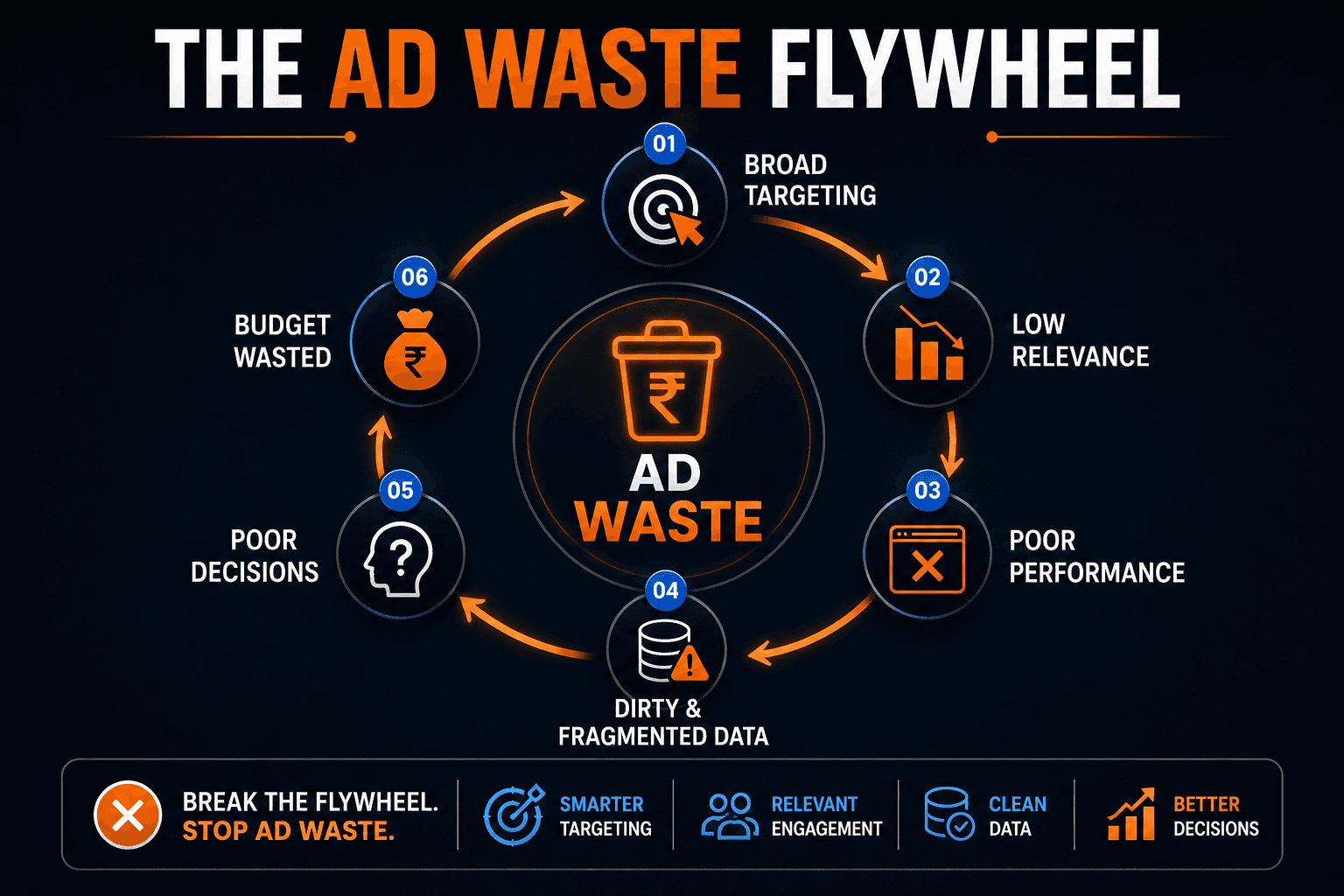
The Hidden Cost of Ad Waste
For years, marketing teams have been obsessed with customer acquisition. Performance marketing budgets have grown exponentially, with brands pouring millions into Meta, Google, marketplaces, and influencer campaigns to acquire new customers.
Many brands are spending significant amounts of money to reacquire customers they already have. Think about it.
A customer purchases once, becomes inactive for six months, and slowly slips into the "dormant" segment. Instead of nurturing that relationship through owned channels like email, WhatsApp, SMS, or app notifications, the customer often re-enters the funnel through paid advertisements.
The brand ends up paying to acquire the same customer twice. Netcore calls this Ad Waste.
According to Siddharth, a substantial portion of acquisition budgets could be better utilized if brands invested more aggressively in identifying dormant customers and reactivating them through personalized retention campaigns.
Growth doesn't always come from finding new customers.
Sometimes it comes from reconnecting with the ones who already know and trust your brand.
Playbook Lesson: Before increasing your acquisition budget, ask a harder question—how many existing customers could return with the right message at the right time?
The Hidden Cost of Ad Waste
For years, marketing teams have been obsessed with customer acquisition. Performance marketing budgets have grown exponentially, with brands pouring millions into Meta, Google, marketplaces, and influencer campaigns to acquire new customers.
Many brands are spending significant amounts of money to reacquire customers they already have. Think about it.
A customer purchases once, becomes inactive for six months, and slowly slips into the "dormant" segment. Instead of nurturing that relationship through owned channels like email, WhatsApp, SMS, or app notifications, the customer often re-enters the funnel through paid advertisements.
The brand ends up paying to acquire the same customer twice. Netcore calls this Ad Waste.
According to Siddharth, a substantial portion of acquisition budgets could be better utilized if brands invested more aggressively in identifying dormant customers and reactivating them through personalized retention campaigns.
Growth doesn't always come from finding new customers.
Sometimes it comes from reconnecting with the ones who already know and trust your brand.
Playbook Lesson: Before increasing your acquisition budget, ask a harder question—how many existing customers could return with the right message at the right time?
Omnichannel Isn't About Channels, It's About Customers
One of my favourite parts of the discussion was Siddharth's perspective on omnichannel marketing.
Many brands still think omnichannel means simply being present across multiple platforms.
Website.
App.
Store.
WhatsApp.
Email.
Social media.
But that's only the surface.
The real challenge is ensuring every interaction feels connected. That's what omnichannel really means.
As Siddharth put it, brands shouldn't obsess over which channel performs best. Customers choose channels based on convenience. A marketer's job is to meet them where they are while maintaining context throughout the journey.
This shift becomes even more important as customer journeys grow increasingly fragmented.
Discovery might happen on YouTube. Research on Google. Comparison on Instagram. Purchase inside a store. Loyalty through email. No single channel owns the customer anymore.
Brands that succeed will be the ones that make every transition feel effortless.
Playbook Lesson: Customers don't think in channels. They think in experiences.
Omnichannel Isn't About Channels, It's About Customers
One of my favourite parts of the discussion was Siddharth's perspective on omnichannel marketing.
Many brands still think omnichannel means simply being present across multiple platforms.
Website.
App.
Store.
WhatsApp.
Email.
Social media.
But that's only the surface.
The real challenge is ensuring every interaction feels connected. That's what omnichannel really means.
As Siddharth put it, brands shouldn't obsess over which channel performs best. Customers choose channels based on convenience. A marketer's job is to meet them where they are while maintaining context throughout the journey.
This shift becomes even more important as customer journeys grow increasingly fragmented.
Discovery might happen on YouTube. Research on Google. Comparison on Instagram. Purchase inside a store. Loyalty through email. No single channel owns the customer anymore.
Brands that succeed will be the ones that make every transition feel effortless.
Playbook Lesson: Customers don't think in channels. They think in experiences.
Omnichannel Isn't About Channels, It's About Customers
One of my favourite parts of the discussion was Siddharth's perspective on omnichannel marketing.
Many brands still think omnichannel means simply being present across multiple platforms.
Website.
App.
Store.
WhatsApp.
Email.
Social media.
But that's only the surface.
The real challenge is ensuring every interaction feels connected. That's what omnichannel really means.
As Siddharth put it, brands shouldn't obsess over which channel performs best. Customers choose channels based on convenience. A marketer's job is to meet them where they are while maintaining context throughout the journey.
This shift becomes even more important as customer journeys grow increasingly fragmented.
Discovery might happen on YouTube. Research on Google. Comparison on Instagram. Purchase inside a store. Loyalty through email. No single channel owns the customer anymore.
Brands that succeed will be the ones that make every transition feel effortless.
Playbook Lesson: Customers don't think in channels. They think in experiences.

Why Email Is Far From Dead?
Why Email Is Far From Dead?
Few marketing channels have been declared "dead" as many times as email. Yet email continues to quietly outperform expectations. Siddharth explained that the problem isn't the channel—it's how brands use it.
With technologies like AMP for Email, customers can browse products, submit forms, provide feedback, book appointments, and even complete certain transactions without leaving the inbox.
Every additional click removed from the journey reduces friction. That directly improves conversions.
Equally important is the depth of analytics available through email.
Unlike many channels, email provides rich first-party behavioural data. Marketers can understand engagement patterns, distinguish between bot-generated and genuine opens, and measure meaningful customer interactions—not just vanity metrics.
In a privacy-first world where first-party data is becoming increasingly valuable, email remains one of the strongest owned channels for customer engagement.
Rather than replacing email, AI is making it smarter. Messages become more contextual. Recommendations become more relevant. Content becomes increasingly personalized. The inbox evolves from a communication channel into a conversion channel.
Playbook Lesson: Don't ask whether email still works. Ask whether your emails create enough value for customers to engage with them.
Few marketing channels have been declared "dead" as many times as email. Yet email continues to quietly outperform expectations. Siddharth explained that the problem isn't the channel—it's how brands use it.
With technologies like AMP for Email, customers can browse products, submit forms, provide feedback, book appointments, and even complete certain transactions without leaving the inbox.
Every additional click removed from the journey reduces friction. That directly improves conversions.
Equally important is the depth of analytics available through email.
Unlike many channels, email provides rich first-party behavioural data. Marketers can understand engagement patterns, distinguish between bot-generated and genuine opens, and measure meaningful customer interactions—not just vanity metrics.
In a privacy-first world where first-party data is becoming increasingly valuable, email remains one of the strongest owned channels for customer engagement.
Rather than replacing email, AI is making it smarter. Messages become more contextual. Recommendations become more relevant. Content becomes increasingly personalized. The inbox evolves from a communication channel into a conversion channel.
Playbook Lesson: Don't ask whether email still works. Ask whether your emails create enough value for customers to engage with them.
The Rise of the 10X Marketer
The Rise of the 10X Marketer
Will AI replace marketers? According to Siddharth, it won't—it will redefine what great marketers do.
As AI automates repetitive tasks like reporting, segmentation, and campaign execution, marketers can focus on strategy, creativity, and customer understanding.
The biggest winners won't be those who know AI tools, but those who know how to combine technology with business thinking. In the years ahead, the gap between average and exceptional marketers will grow wider, making the 10× marketer the new benchmark for success.
Will AI replace marketers? According to Siddharth, it won't—it will redefine what great marketers do.
As AI automates repetitive tasks like reporting, segmentation, and campaign execution, marketers can focus on strategy, creativity, and customer understanding.
The biggest winners won't be those who know AI tools, but those who know how to combine technology with business thinking. In the years ahead, the gap between average and exceptional marketers will grow wider, making the 10× marketer the new benchmark for success.
On whether AI will cause job losses, Sanjeev gives his most honest answer: "I don't know.”
When PCs arrived at IIM Ahmedabad in 1986, Sanjeev was among the first two batches to use them. When he joined HMM, he was the only person in the marketing department who knew how to use a PC. That became his superpower. He would have been the last person to be let go.
His advice to young people: learn two or three AI platforms every month, every quarter. By the end of the year, know ten of them. Because the people who adapt fastest will not lose their jobs — they will become indispensable.
On India building foundational AI models: the cost is enormous, the risk is real, and VC funds are too small to fund it. The leadership must come from the government and large corporate groups. India has the data and the talent. The question is whether implementation can match intent.
The biggest takeaway from this episode?
The biggest takeaway from this episode?
Prioritize business outcomes over vanity metrics.
Prioritize business outcomes over vanity metrics.
Use AI to amplify marketers, not replace them.
Use AI to amplify marketers, not replace them.
Experiment early to stay ahead in the Agentic AI era.
Experiment early to stay ahead in the Agentic AI era.
This is just the beginning. If you’re ready to understand how AI and Omnichannel thinking work together, and hear real stories from people building the future
This is just the beginning. If you’re ready to understand how AI and Omnichannel thinking work together, and hear real stories from people building the future




Talks with Saurabh Agrawal
Latest Episodes

Future of Marketing is Conversational
Gupshup founder Beerud Sheth on why the click is dying, how conversational AI is rewriting marketing, and why context, not intelligence, is the real moat.

Inside Arjun Vaidya's D2C Playbook
Arjun Vaidya on building, exiting, teaching, and investing, when to go offline, founder branding, and life as an operator turned VC.

Growth Playbook by Sanjeev Bikhchandani
There are very few people who have genuinely shaped the way India works, loves, and learns — all from one desk, one insight, and one stubborn belief that the internet would change everything before most people even knew what a server was. Sanjeev Bikhchandani is one of those people.

Scaling Omnichannel Fast Fashion Brand | Sumit Jasoria
Most fashion brands start with a mood board. NEWME started with a data pipeline. In a candid conversation on DilSe Omni, Sumit Jasoria, co-founder and CEO of NEWME, which is a brand that didn't exist three years ago, is now one of India's fastest-growing Gen Z fashion labels, jumping from ₹3.4 crore in FY23 to ₹180 crore in FY25. A 52x revenue jump. In under three years.

Is Agentic the future of Marketing? | Siddharth Gopalkrishnan
Discover how Netcore COO Siddharth Gopalakrishnan explains Agentic Marketing, AI-powered customer engagement, retention, omnichannel strategy, and the future of Martech.
View More
Latest Episodes
Future of Marketing is Conversational
Gupshup founder Beerud Sheth on why the click is dying, how conversational AI is rewriting marketing, and why context, not intelligence, is the real moat.
Inside Arjun Vaidya's D2C Playbook
Arjun Vaidya on building, exiting, teaching, and investing, when to go offline, founder branding, and life as an operator turned VC.
Growth Playbook by Sanjeev Bikhchandani
There are very few people who have genuinely shaped the way India works, loves, and learns — all from one desk, one insight, and one stubborn belief that the internet would change everything before most people even knew what a server was. Sanjeev Bikhchandani is one of those people.
Scaling Omnichannel Fast Fashion Brand | Sumit Jasoria
Most fashion brands start with a mood board. NEWME started with a data pipeline. In a candid conversation on DilSe Omni, Sumit Jasoria, co-founder and CEO of NEWME, which is a brand that didn't exist three years ago, is now one of India's fastest-growing Gen Z fashion labels, jumping from ₹3.4 crore in FY23 to ₹180 crore in FY25. A 52x revenue jump. In under three years.
Is Agentic the future of Marketing? | Siddharth Gopalkrishnan
Discover how Netcore COO Siddharth Gopalakrishnan explains Agentic Marketing, AI-powered customer engagement, retention, omnichannel strategy, and the future of Martech.
View More
Latest Episodes
Future of Marketing is Conversational
Gupshup founder Beerud Sheth on why the click is dying, how conversational AI is rewriting marketing, and why context, not intelligence, is the real moat.
Inside Arjun Vaidya's D2C Playbook
Arjun Vaidya on building, exiting, teaching, and investing, when to go offline, founder branding, and life as an operator turned VC.
Growth Playbook by Sanjeev Bikhchandani
There are very few people who have genuinely shaped the way India works, loves, and learns — all from one desk, one insight, and one stubborn belief that the internet would change everything before most people even knew what a server was. Sanjeev Bikhchandani is one of those people.
Scaling Omnichannel Fast Fashion Brand | Sumit Jasoria
Most fashion brands start with a mood board. NEWME started with a data pipeline. In a candid conversation on DilSe Omni, Sumit Jasoria, co-founder and CEO of NEWME, which is a brand that didn't exist three years ago, is now one of India's fastest-growing Gen Z fashion labels, jumping from ₹3.4 crore in FY23 to ₹180 crore in FY25. A 52x revenue jump. In under three years.
Is Agentic the future of Marketing? | Siddharth Gopalkrishnan
Discover how Netcore COO Siddharth Gopalakrishnan explains Agentic Marketing, AI-powered customer engagement, retention, omnichannel strategy, and the future of Martech.
View More
Subscribe on your favourite platform




Subscribe on your favourite platform



Subscribe on your favourite platform

Subscribe for
insider insights
Subscribe for
insider insights
Subscribe
for insider insights