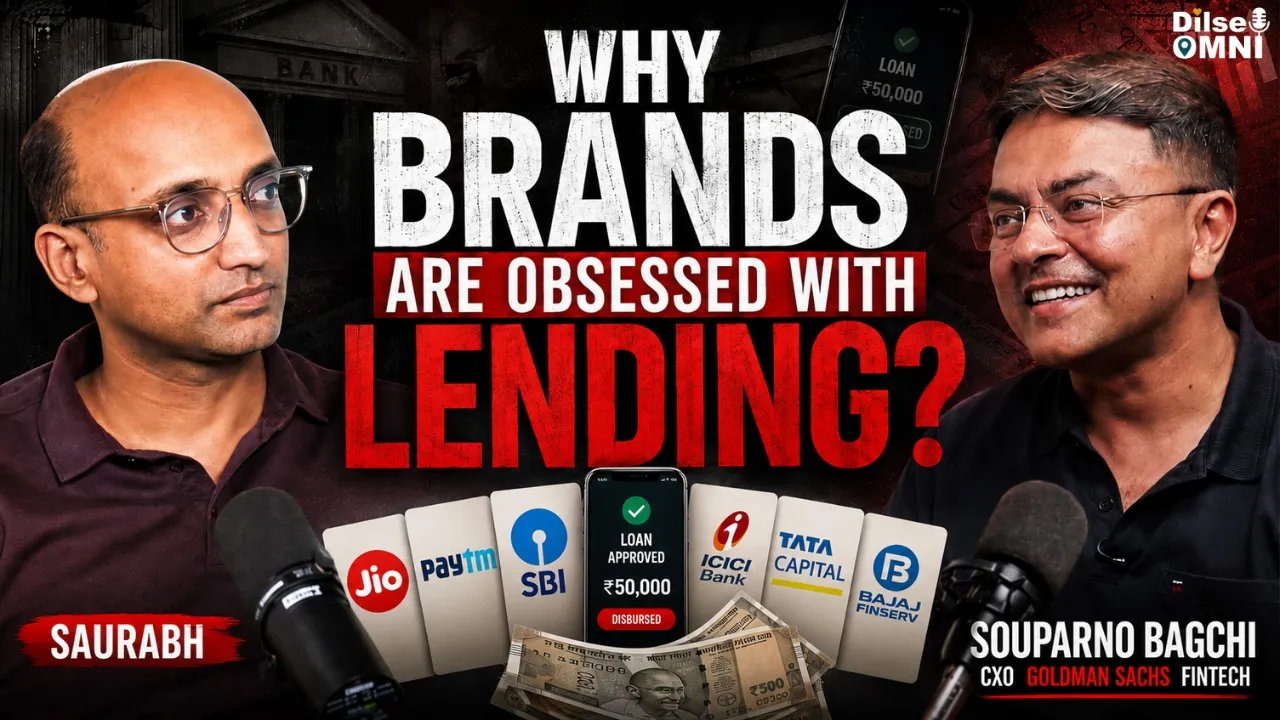
Souparno Bagchi
Souparno Bagchi
Episode 21
Episode 21
80 min
80 min
Why Everyone in India Wants to Lend You Money?
Why Everyone in India Wants to Lend You Money?
Why Everyone in India Wants to Lend You Money?
Why Does This Episode Matter?
Why Does This Episode Matter?
Most conversations about Indian fintech stay at the surface, funding rounds, app downloads, UPI transaction counts. This one goes underneath, to the mechanics that actually decide who gets credit in this country and who doesn't.
Souparno Bagchi has seen the system from angles very few people have. Nine years at TCS, six at Goldman Sachs, time in consulting, and then more than five years building micro-lending businesses from the operator's seat.
If you work anywhere near financial services, consumer brands, or omnichannel growth, this episode gives you frameworks you'll actually use: the India 1-2-3 lens, the three demand drivers behind India's credit boom, and a blunt diagnosis of why banking still feels impersonal despite two decades of digital investment. The answer, as he puts it, is no longer capital or capability. It's culture.
Most conversations about Indian fintech stay at the surface, funding rounds, app downloads, UPI transaction counts. This one goes underneath, to the mechanics that actually decide who gets credit in this country and who doesn't.
Souparno Bagchi has seen the system from angles very few people have. Nine years at TCS, six at Goldman Sachs, time in consulting, and then more than five years building micro-lending businesses from the operator's seat.
If you work anywhere near financial services, consumer brands, or omnichannel growth, this episode gives you frameworks you'll actually use: the India 1-2-3 lens, the three demand drivers behind India's credit boom, and a blunt diagnosis of why banking still feels impersonal despite two decades of digital investment. The answer, as he puts it, is no longer capital or capability. It's culture.

Souparno Bagchi
CXO | Founder | Goldman Sachs | Deloitte
Fintech vs. Financial Services: The Distinction Nobody Makes
Fintech vs. Financial Services: The Distinction Nobody Makes
The terms get used interchangeably. Souparno draws a clean line.
BFSI: banking, financial services and insurance - is the umbrella. Fintech is one genre within it. The real question is what separates a bank from a fintech, and his answer is one word:
Banks are techfin. Technology enables business.
Fintechs are fintech. Technology drives the business.
The test is simple. Remove the technology. If there is no business proposition left, it is a fintech. Digital lenders exist as a category only because of alternate-data underwriting, 24x7 availability, and accessibility, none of which survive without the tech layer.
The terms get used interchangeably. Souparno draws a clean line.
BFSI: banking, financial services and insurance - is the umbrella. Fintech is one genre within it. The real question is what separates a bank from a fintech, and his answer is one word:
Banks are techfin. Technology enables business.
Fintechs are fintech. Technology drives the business.
The test is simple. Remove the technology. If there is no business proposition left, it is a fintech. Digital lenders exist as a category only because of alternate-data underwriting, 24x7 availability, and accessibility, none of which survive without the tech layer.

India 1, India 2, India 3
One of the most useful frameworks in the conversation. Unlike the old tier-1/tier-2 model, this one drops geography entirely and sorts by economic reality — which matters enormously for digital businesses serving 19,000 pin codes.
Souparno's view is that India 2 is where the real opportunity sits. It is aspirational, it has grown fastest over the last decade, and its financial needs are tied to building something — a business, a profession, a better outcome for the next generation.
The numbers around access are equally instructive. Roughly 90% of India now has a bank account thanks to Jan Dhan. But smartphone users sit closer to 650–700 million out of over a billion mobile users, and only 25–30 out of every 100 adults have any formal credit history.
That last figure sounds low until you reframe it. Formal lending in India is a first-generation story. Credit bureaus are barely twenty years old. Before that, borrowing was informal, and even bank lending was largely relationship-driven.
India 1, India 2, India 3
One of the most useful frameworks in the conversation. Unlike the old tier-1/tier-2 model, this one drops geography entirely and sorts by economic reality — which matters enormously for digital businesses serving 19,000 pin codes.
Souparno's view is that India 2 is where the real opportunity sits. It is aspirational, it has grown fastest over the last decade, and its financial needs are tied to building something — a business, a profession, a better outcome for the next generation.
The numbers around access are equally instructive. Roughly 90% of India now has a bank account thanks to Jan Dhan. But smartphone users sit closer to 650–700 million out of over a billion mobile users, and only 25–30 out of every 100 adults have any formal credit history.
That last figure sounds low until you reframe it. Formal lending in India is a first-generation story. Credit bureaus are barely twenty years old. Before that, borrowing was informal, and even bank lending was largely relationship-driven.
India 1, India 2, India 3
One of the most useful frameworks in the conversation. Unlike the old tier-1/tier-2 model, this one drops geography entirely and sorts by economic reality — which matters enormously for digital businesses serving 19,000 pin codes.
Souparno's view is that India 2 is where the real opportunity sits. It is aspirational, it has grown fastest over the last decade, and its financial needs are tied to building something — a business, a profession, a better outcome for the next generation.
The numbers around access are equally instructive. Roughly 90% of India now has a bank account thanks to Jan Dhan. But smartphone users sit closer to 650–700 million out of over a billion mobile users, and only 25–30 out of every 100 adults have any formal credit history.
That last figure sounds low until you reframe it. Formal lending in India is a first-generation story. Credit bureaus are barely twenty years old. Before that, borrowing was informal, and even bank lending was largely relationship-driven.

The Three Ds Driving Demand
Souparno's framework for why India's credit demand keeps compounding:
Development: per capita GDP has grown roughly 70–75% over ten years
Demography: around 22–26 million people enter adulthood every year
Digital: the layer that made serviceability possible at all
Each one alone is meaningful. Stacked, they compound.
What Digital Public Infrastructure Actually Unlocked?
His analogy is worth borrowing. Telecom is the road. DPI: Aadhaar, UPI, account aggregator, is the vehicle. The apps built on top are the cargo, because there is no joy in an empty truck.
UPI's real achievement was not convenience for people like us. It was taking the payment vehicle from a truck down to a two-wheeler. That micro-scale is what pulled India 3 from a dormant bank account into active financial participation — the vendor selling coconut water now receives money digitally.
The Three Ds Driving Demand
Souparno's framework for why India's credit demand keeps compounding:
Development: per capita GDP has grown roughly 70–75% over ten years
Demography: around 22–26 million people enter adulthood every year
Digital: the layer that made serviceability possible at all
Each one alone is meaningful. Stacked, they compound.
What Digital Public Infrastructure Actually Unlocked?
His analogy is worth borrowing. Telecom is the road. DPI: Aadhaar, UPI, account aggregator, is the vehicle. The apps built on top are the cargo, because there is no joy in an empty truck.
UPI's real achievement was not convenience for people like us. It was taking the payment vehicle from a truck down to a two-wheeler. That micro-scale is what pulled India 3 from a dormant bank account into active financial participation — the vendor selling coconut water now receives money digitally.

Account Aggregator
Account aggregator may prove equally significant. One consent-driven golden source of financial identity, owned by the individual. The impact on onboarding is dramatic: costs potentially falling to a fifth, and a serious dent in the 30–40% funnel drop that happens between app install and KYC completion.
The result of all this compression? Small personal loans have moved from sub-₹1 lakh to sub-₹10,000 and still remain unit-economics positive. For a repeat customer, as Souparno puts it, the money can land before your noodles are ready.
Account Aggregator
Account aggregator may prove equally significant. One consent-driven golden source of financial identity, owned by the individual. The impact on onboarding is dramatic: costs potentially falling to a fifth, and a serious dent in the 30–40% funnel drop that happens between app install and KYC completion.
The result of all this compression? Small personal loans have moved from sub-₹1 lakh to sub-₹10,000 and still remain unit-economics positive. For a repeat customer, as Souparno puts it, the money can land before your noodles are ready.
Account Aggregator
Account aggregator may prove equally significant. One consent-driven golden source of financial identity, owned by the individual. The impact on onboarding is dramatic: costs potentially falling to a fifth, and a serious dent in the 30–40% funnel drop that happens between app install and KYC completion.
The result of all this compression? Small personal loans have moved from sub-₹1 lakh to sub-₹10,000 and still remain unit-economics positive. For a repeat customer, as Souparno puts it, the money can land before your noodles are ready.

The Experience Problem
The Experience Problem
This is where the conversation turns critical, and it is the part every brand should sit with.
We haven't graduated from a product-centric view to a customer-centric view. That's the fundamental problem.
Both Saurabh and Souparno share their own banking experiences, three customer IDs at one bank, three branch visits for a single cross-border transaction, a relationship manager annoyed that a customer created an FD without a referral code, endless credit card calls from a bank that already issued them one.
The message that reaches the customer is blunt: my bank doesn't know me, forget understanding me.
His diagnosis is that when digital arrived, the industry equated it with distribution. Reach expanded, the base of the pyramid widened, and genuine inclusion happened. But the experience layer got lost along the way.
And the constraint today is not capital or capability. It is culture. Nothing regulatory stops a bank from delivering a coherent experience. The pillars he names are accessibility, availability, and affordability, where affordability means serviceability, the ability to profitably serve a ₹5,000 loan, not just a ₹5 lakh one.
His Indigo-versus-Emirates analogy makes the point that experience is not a luxury reserved for India 1. Different expectations, same principle: deliver what you promised, consistently.
This is where the conversation turns critical, and it is the part every brand should sit with.
We haven't graduated from a product-centric view to a customer-centric view. That's the fundamental problem.
Both Saurabh and Souparno share their own banking experiences, three customer IDs at one bank, three branch visits for a single cross-border transaction, a relationship manager annoyed that a customer created an FD without a referral code, endless credit card calls from a bank that already issued them one.
The message that reaches the customer is blunt: my bank doesn't know me, forget understanding me.
His diagnosis is that when digital arrived, the industry equated it with distribution. Reach expanded, the base of the pyramid widened, and genuine inclusion happened. But the experience layer got lost along the way.
And the constraint today is not capital or capability. It is culture. Nothing regulatory stops a bank from delivering a coherent experience. The pillars he names are accessibility, availability, and affordability, where affordability means serviceability, the ability to profitably serve a ₹5,000 loan, not just a ₹5 lakh one.
His Indigo-versus-Emirates analogy makes the point that experience is not a luxury reserved for India 1. Different expectations, same principle: deliver what you promised, consistently.
The biggest takeaway from this episode?
The biggest takeaway from this episode?
Banks aren't going anywhere, but the branch has to become an experience centre, not a transaction counter.
Banks aren't going anywhere, but the branch has to become an experience centre, not a transaction counter.
The next fintech wave is convergence, not consolidation: fewer apps, more coherence, and no single winner.
The next fintech wave is convergence, not consolidation: fewer apps, more coherence, and no single winner.
Every bank is sitting on data; the ones that win will be the ones that connect it.
Every bank is sitting on data; the ones that win will be the ones that connect it.
This is just the beginning. If you’re ready to understand how AI and Omnichannel thinking work together, and hear real stories from people building the future
This is just the beginning. If you’re ready to understand how AI and Omnichannel thinking work together, and hear real stories from people building the future


Talks with Saurabh Agrawal


Latest Episodes

Future of Marketing is Conversational
Gupshup founder Beerud Sheth on why the click is dying, how conversational AI is rewriting marketing, and why context, not intelligence, is the real moat.

Inside Arjun Vaidya's D2C Playbook
Arjun Vaidya on building, exiting, teaching, and investing, when to go offline, founder branding, and life as an operator turned VC.

Growth Playbook by Sanjeev Bikhchandani
There are very few people who have genuinely shaped the way India works, loves, and learns — all from one desk, one insight, and one stubborn belief that the internet would change everything before most people even knew what a server was. Sanjeev Bikhchandani is one of those people.

Scaling Omnichannel Fast Fashion Brand | Sumit Jasoria
Most fashion brands start with a mood board. NEWME started with a data pipeline. In a candid conversation on DilSe Omni, Sumit Jasoria, co-founder and CEO of NEWME, which is a brand that didn't exist three years ago, is now one of India's fastest-growing Gen Z fashion labels, jumping from ₹3.4 crore in FY23 to ₹180 crore in FY25. A 52x revenue jump. In under three years.

Is Agentic the future of Marketing? | Siddharth Gopalkrishnan
Discover how Netcore COO Siddharth Gopalakrishnan explains Agentic Marketing, AI-powered customer engagement, retention, omnichannel strategy, and the future of Martech.
View More
Latest Episodes
Future of Marketing is Conversational
Gupshup founder Beerud Sheth on why the click is dying, how conversational AI is rewriting marketing, and why context, not intelligence, is the real moat.
Inside Arjun Vaidya's D2C Playbook
Arjun Vaidya on building, exiting, teaching, and investing, when to go offline, founder branding, and life as an operator turned VC.
Growth Playbook by Sanjeev Bikhchandani
There are very few people who have genuinely shaped the way India works, loves, and learns — all from one desk, one insight, and one stubborn belief that the internet would change everything before most people even knew what a server was. Sanjeev Bikhchandani is one of those people.
Scaling Omnichannel Fast Fashion Brand | Sumit Jasoria
Most fashion brands start with a mood board. NEWME started with a data pipeline. In a candid conversation on DilSe Omni, Sumit Jasoria, co-founder and CEO of NEWME, which is a brand that didn't exist three years ago, is now one of India's fastest-growing Gen Z fashion labels, jumping from ₹3.4 crore in FY23 to ₹180 crore in FY25. A 52x revenue jump. In under three years.
Is Agentic the future of Marketing? | Siddharth Gopalkrishnan
Discover how Netcore COO Siddharth Gopalakrishnan explains Agentic Marketing, AI-powered customer engagement, retention, omnichannel strategy, and the future of Martech.
View More
Latest Episodes
Future of Marketing is Conversational
Gupshup founder Beerud Sheth on why the click is dying, how conversational AI is rewriting marketing, and why context, not intelligence, is the real moat.
Inside Arjun Vaidya's D2C Playbook
Arjun Vaidya on building, exiting, teaching, and investing, when to go offline, founder branding, and life as an operator turned VC.
Growth Playbook by Sanjeev Bikhchandani
There are very few people who have genuinely shaped the way India works, loves, and learns — all from one desk, one insight, and one stubborn belief that the internet would change everything before most people even knew what a server was. Sanjeev Bikhchandani is one of those people.
Scaling Omnichannel Fast Fashion Brand | Sumit Jasoria
Most fashion brands start with a mood board. NEWME started with a data pipeline. In a candid conversation on DilSe Omni, Sumit Jasoria, co-founder and CEO of NEWME, which is a brand that didn't exist three years ago, is now one of India's fastest-growing Gen Z fashion labels, jumping from ₹3.4 crore in FY23 to ₹180 crore in FY25. A 52x revenue jump. In under three years.
Is Agentic the future of Marketing? | Siddharth Gopalkrishnan
Discover how Netcore COO Siddharth Gopalakrishnan explains Agentic Marketing, AI-powered customer engagement, retention, omnichannel strategy, and the future of Martech.
View More
Subscribe on your favourite platform




Subscribe on your favourite platform



Subscribe on your favourite platform

Subscribe for
insider insights
Subscribe for
insider insights
Subscribe
for insider insights