Arjun Vaidya
Arjun Vaidya
Episode 23
Episode 23
85 min
85 min
Inside Arjun Vaidya's D2C Playbook
Inside Arjun Vaidya's D2C Playbook
Inside Arjun Vaidya's D2C Playbook
Why Does This Episode Matter?
Why Does This Episode Matter?
Most conversations with D2C founders stop at the exit story. This one goes further, because Arjun Vaidya has actually lived every stage that founders, marketers, and investors in this space keep asking about separately: building a brand from a failed offline launch, exiting at the right moment instead of the biggest moment, teaching over a thousand entrepreneurs the lessons he learned the hard way, and now sitting on the other side of the table as a VC who has to live with his own misses.
If you're trying to figure out when to go offline, how to think about founder branding, or what actually changes when you move from operator to investor, this episode answers all three from someone who has done each one, not just theorized about it.
Most conversations with D2C founders stop at the exit story. This one goes further, because Arjun Vaidya has actually lived every stage that founders, marketers, and investors in this space keep asking about separately: building a brand from a failed offline launch, exiting at the right moment instead of the biggest moment, teaching over a thousand entrepreneurs the lessons he learned the hard way, and now sitting on the other side of the table as a VC who has to live with his own misses.
If you're trying to figure out when to go offline, how to think about founder branding, or what actually changes when you move from operator to investor, this episode answers all three from someone who has done each one, not just theorized about it.

Arjun Vaidya
Arjun Vaidya is an Indian entrepreneur and early-stage consumer investor, founded modern Ayurvedic brand Dr. Vaidya's and co-founding V3 Ventures.
Arjun Vaidya
Arjun Vaidya is an Indian entrepreneur and early-stage consumer investor, founded modern Ayurvedic brand Dr. Vaidya's and co-founding V3 Ventures.
The General Trade Disaster That Redefined "Omni"
The General Trade Disaster That Redefined "Omni"
Arjun opens by explaining how his understanding of "omnichannel" has shifted over the years. It used to mean e-commerce brands adding an offline layer, the "last frontier" that legacy players had already solved. Today, with D2C brands at scale, omni cuts both ways: offline brands moving online, online brands moving offline, and marketplace-first businesses expanding into their own channels. His working definition now is simple, once a brand operates across more than two channels, it's genuinely omni.
That definition was forged the hard way. When Dr. Vaidya's launched in October 2016 and pushed ten lakh rupees of stock into general trade, chemist shops, grocery stores, the whole traditional beat system. Three months later, he collected payment for only one lakh. Nine lakh rupees came back as unsold returns. The product never moved because there was no discovery happening on the shelf, customers weren't walking in and picking it up, no matter how good the social media campaigns behind it were. Distributors, looking at his marketing decks, told him plainly: this needs newspaper and TV, not Instagram.
That failure led to what he calls the best decision of his career: giving up on offline entirely, with no backup plan. His then-girlfriend, now wife, Trisha, who was on Nykaa's founding team, pushed him toward e-commerce. They launched a single-brand Ayurvedic website in November 2017, skipping marketplaces first because long-term treatment products meant one bad outcome could sink trust in the brand permanently. Their real innovation was assisted sales, free consultations with an Ayurvedic doctor before any purchase, which built trust the same way his grandfather's free clinic consultations once did, just delivered digitally to customers in towns like Muzaffarnagar who had no easy access to a quality doctor otherwise.
Arjun opens by explaining how his understanding of "omnichannel" has shifted over the years. It used to mean e-commerce brands adding an offline layer, the "last frontier" that legacy players had already solved. Today, with D2C brands at scale, omni cuts both ways: offline brands moving online, online brands moving offline, and marketplace-first businesses expanding into their own channels. His working definition now is simple, once a brand operates across more than two channels, it's genuinely omni.
That definition was forged the hard way. When Dr. Vaidya's launched in October 2016 and pushed ten lakh rupees of stock into general trade, chemist shops, grocery stores, the whole traditional beat system. Three months later, he collected payment for only one lakh. Nine lakh rupees came back as unsold returns. The product never moved because there was no discovery happening on the shelf, customers weren't walking in and picking it up, no matter how good the social media campaigns behind it were. Distributors, looking at his marketing decks, told him plainly: this needs newspaper and TV, not Instagram.
That failure led to what he calls the best decision of his career: giving up on offline entirely, with no backup plan. His then-girlfriend, now wife, Trisha, who was on Nykaa's founding team, pushed him toward e-commerce. They launched a single-brand Ayurvedic website in November 2017, skipping marketplaces first because long-term treatment products meant one bad outcome could sink trust in the brand permanently. Their real innovation was assisted sales, free consultations with an Ayurvedic doctor before any purchase, which built trust the same way his grandfather's free clinic consultations once did, just delivered digitally to customers in towns like Muzaffarnagar who had no easy access to a quality doctor otherwise.

Why He Sold Instead of Scaling Offline?
By the time Dr. Vaidya's was doing meaningful revenue, Arjun assumed 150–200 crores was the ceiling without an offline push. But the acquirers already had massive offline distribution and understood that world better than he did. Rather than build a competing offline capability from scratch, he chose to sell and let a stronger operator take the brand into that channel.
Why He Sold Instead of Scaling Offline?
By the time Dr. Vaidya's was doing meaningful revenue, Arjun assumed 150–200 crores was the ceiling without an offline push. But the acquirers already had massive offline distribution and understood that world better than he did. Rather than build a competing offline capability from scratch, he chose to sell and let a stronger operator take the brand into that channel.
Why He Sold Instead of Scaling Offline?
By the time Dr. Vaidya's was doing meaningful revenue, Arjun assumed 150–200 crores was the ceiling without an offline push. But the acquirers already had massive offline distribution and understood that world better than he did. Rather than build a competing offline capability from scratch, he chose to sell and let a stronger operator take the brand into that channel.
From Founders for Founders to National Television
After exiting at 29, with no real plan, Arjun and Trisha ended up giving free 25-minute office hours to entrepreneurs from their beach house in Alibaug, "Founders for Founders." That grew into structured GrowthSchool cohorts, more than 1,500 entrepreneurs taught, over 100 of whom later appeared on Shark Tank India.
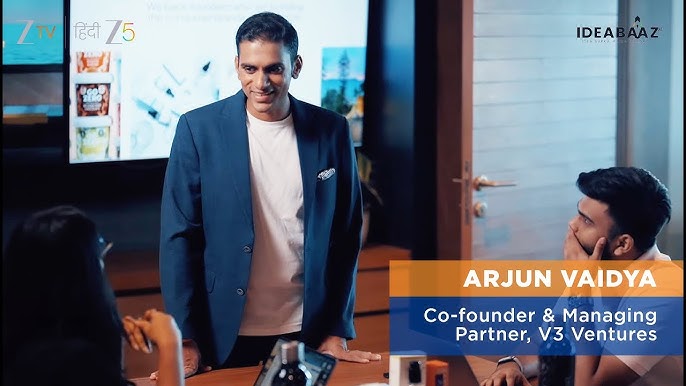
That visibility led to judging on Idea Baaz, which he describes as genuinely exhausting: 7 AM starts, no phone breaks, six to eight cameras running constantly. But it gave founders a rare platform, and led to investment for different sets of brands.
From Founders for Founders to National Television
After exiting at 29, with no real plan, Arjun and Trisha ended up giving free 25-minute office hours to entrepreneurs from their beach house in Alibaug, "Founders for Founders." That grew into structured GrowthSchool cohorts, more than 1,500 entrepreneurs taught, over 100 of whom later appeared on Shark Tank India.
That visibility led to judging on Idea Baaz, which he describes as genuinely exhausting: 7 AM starts, no phone breaks, six to eight cameras running constantly. But it gave founders a rare platform, and led to investment for different sets of brands.
From Founders for Founders to National Television
After exiting at 29, with no real plan, Arjun and Trisha ended up giving free 25-minute office hours to entrepreneurs from their beach house in Alibaug, "Founders for Founders." That grew into structured GrowthSchool cohorts, more than 1,500 entrepreneurs taught, over 100 of whom later appeared on Shark Tank India.
That visibility led to judging on Idea Baaz, which he describes as genuinely exhausting: 7 AM starts, no phone breaks, six to eight cameras running constantly. But it gave founders a rare platform, and led to investment for different sets of brands.
Reading the Signs: When Should a Brand Go Offline?
The conversation turns practical here. Categories like fragrance struggled online until Bellavita pioneered scent testers, solving the "you can't smell it through a screen" problem. High-touch, high-trust categories, jewelry above ₹30,000, plants, bridal wear, tend to convert through online discovery but need offline presence at scale. Even legacy electronics retailers like Vijay Sales now openly price-match Flipkart on in-store stickers, an acknowledgment of how thoroughly online discovery has reshaped even the most traditional retail categories.
His signal for when a D2C brand should consider going offline: saturation of scale and diminishing marginal returns on ad spend. He also touches on quick commerce's three evolving stages, essentials-first horizontal platforms, category-specific verticals competing on delivery speed, and early-stage hyper-convenience services like on-demand beauty or repair at home.
Reading the Signs: When Should a Brand Go Offline?
The conversation turns practical here. Categories like fragrance struggled online until Bellavita pioneered scent testers, solving the "you can't smell it through a screen" problem. High-touch, high-trust categories, jewelry above ₹30,000, plants, bridal wear, tend to convert through online discovery but need offline presence at scale. Even legacy electronics retailers like Vijay Sales now openly price-match Flipkart on in-store stickers, an acknowledgment of how thoroughly online discovery has reshaped even the most traditional retail categories.
His signal for when a D2C brand should consider going offline: saturation of scale and diminishing marginal returns on ad spend. He also touches on quick commerce's three evolving stages, essentials-first horizontal platforms, category-specific verticals competing on delivery speed, and early-stage hyper-convenience services like on-demand beauty or repair at home.

Distribution, Content, and the "Not Every Founder" Insight
Distribution, in Arjun's framing, simply means being wherever the customer wants to buy. Rather than debating D2C versus marketplace philosophically, he tells founders to list everywhere, then let sales velocity and RoAS reveal where the customer actually wants them.
The sharpest idea in the episode follows: not every founder should be the face of their brand, but every founder should invest in owned content. He points to the logic: an influencer's page will always outperform a brand's page because a brand is visibly selling, so smart brands build IP that doesn't look like it's selling at all.
He's also candid about the shift in influencer marketing, away from follower count and toward genuine resonance, citing a running coach with under 10,000 followers who outsold macro-influencers for Dr. Vaidya's. And on transparency, he credits FoodPharmer for teaching Indian consumers to read labels rather than trust front-of-pack marketing, citing Beco's willingness to publicly compare lab results against far larger competitors as a sign of how far the ecosystem has matured.
Distribution, Content, and the "Not Every Founder" Insight
Distribution, in Arjun's framing, simply means being wherever the customer wants to buy. Rather than debating D2C versus marketplace philosophically, he tells founders to list everywhere, then let sales velocity and RoAS reveal where the customer actually wants them.
The sharpest idea in the episode follows: not every founder should be the face of their brand, but every founder should invest in owned content. He points to the logic: an influencer's page will always outperform a brand's page because a brand is visibly selling, so smart brands build IP that doesn't look like it's selling at all.
He's also candid about the shift in influencer marketing, away from follower count and toward genuine resonance, citing a running coach with under 10,000 followers who outsold macro-influencers for Dr. Vaidya's. And on transparency, he credits FoodPharmer for teaching Indian consumers to read labels rather than trust front-of-pack marketing, citing Beco's willingness to publicly compare lab results against far larger competitors as a sign of how far the ecosystem has matured.
Distribution, Content, and the "Not Every Founder" Insight
Distribution, in Arjun's framing, simply means being wherever the customer wants to buy. Rather than debating D2C versus marketplace philosophically, he tells founders to list everywhere, then let sales velocity and RoAS reveal where the customer actually wants them.
The sharpest idea in the episode follows: not every founder should be the face of their brand, but every founder should invest in owned content. He points to the logic: an influencer's page will always outperform a brand's page because a brand is visibly selling, so smart brands build IP that doesn't look like it's selling at all.
He's also candid about the shift in influencer marketing, away from follower count and toward genuine resonance, citing a running coach with under 10,000 followers who outsold macro-influencers for Dr. Vaidya's. And on transparency, he credits FoodPharmer for teaching Indian consumers to read labels rather than trust front-of-pack marketing, citing Beco's willingness to publicly compare lab results against far larger competitors as a sign of how far the ecosystem has matured.
Life as a VC: Misses, Mentors, and a Real Framework
The back half shifts to his current role as an investor at V3 Ventures. He's disarmingly honest about the deals he missed, Zepto's first round, Pilgrim, Foxtail, and others, framing misses as simply the cost of doing venture. Two pieces of mentor advice shaped how he invests: don't chase "the next Flipkart" just because you missed the first one, and never raise a fund larger than $50–70 million, since scale changes the nimbleness venture investing depends on.
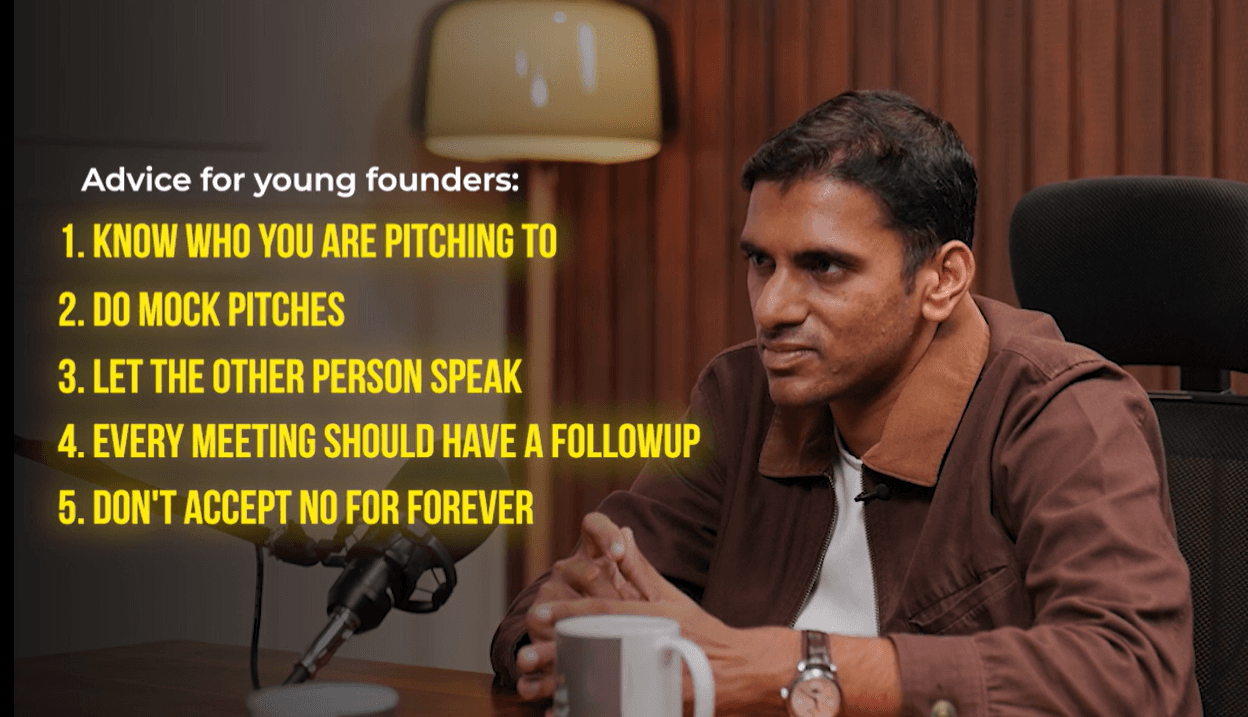
His investment framework breaks down as 50% founder, 20% market size and growth potential, and 30% the actual numbers, revenue, margins, repeat rate, lifetime value. For founders pitching him, his advice is blunt: personalize your outreach, rehearse before the real pitch, let it be a dialogue rather than a monologue, always propose a follow-up, and don't treat a single no as permanent.
Life as a VC: Misses, Mentors, and a Real Framework
The back half shifts to his current role as an investor at V3 Ventures. He's disarmingly honest about the deals he missed, Zepto's first round, Pilgrim, Foxtail, and others, framing misses as simply the cost of doing venture. Two pieces of mentor advice shaped how he invests: don't chase "the next Flipkart" just because you missed the first one, and never raise a fund larger than $50–70 million, since scale changes the nimbleness venture investing depends on.
His investment framework breaks down as 50% founder, 20% market size and growth potential, and 30% the actual numbers, revenue, margins, repeat rate, lifetime value. For founders pitching him, his advice is blunt: personalize your outreach, rehearse before the real pitch, let it be a dialogue rather than a monologue, always propose a follow-up, and don't treat a single no as permanent.
Life as a VC: Misses, Mentors, and a Real Framework
The back half shifts to his current role as an investor at V3 Ventures. He's disarmingly honest about the deals he missed, Zepto's first round, Pilgrim, Foxtail, and others, framing misses as simply the cost of doing venture. Two pieces of mentor advice shaped how he invests: don't chase "the next Flipkart" just because you missed the first one, and never raise a fund larger than $50–70 million, since scale changes the nimbleness venture investing depends on.
His investment framework breaks down as 50% founder, 20% market size and growth potential, and 30% the actual numbers, revenue, margins, repeat rate, lifetime value. For founders pitching him, his advice is blunt: personalize your outreach, rehearse before the real pitch, let it be a dialogue rather than a monologue, always propose a follow-up, and don't treat a single no as permanent.

What's Next, and Advice for Legacy Brands
What's Next, and Advice for Legacy Brands
He closes on the sectors he's excited about: sports and wellness (citing Decathlon's growth and his investment in a cricket video game), increasingly specialized beauty categories over generalist players, men's grooming as an underdeveloped white space, and the humanization of pets as a real, durable consumer trend.
For legacy brands trying to go digital, his advice is simple but often ignored: respect that general trade, modern trade, e-commerce, and quick commerce each require entirely different teams and skill sets, and trying to run all four with one team is usually where these transitions fail.
He closes on the sectors he's excited about: sports and wellness (citing Decathlon's growth and his investment in a cricket video game), increasingly specialized beauty categories over generalist players, men's grooming as an underdeveloped white space, and the humanization of pets as a real, durable consumer trend.
For legacy brands trying to go digital, his advice is simple but often ignored: respect that general trade, modern trade, e-commerce, and quick commerce each require entirely different teams and skill sets, and trying to run all four with one team is usually where these transitions fail.
The biggest takeaway from this episode?
The biggest takeaway from this episode?
Giving up on a channel entirely can be a better decision than half-committing to it forever.
Giving up on a channel entirely can be a better decision than half-committing to it forever.
Not every founder should be the brand's face, but every founder should own their content.
Not every founder should be the brand's face, but every founder should own their content.
The mistakes you make chasing a deal you missed are often costlier than the miss itself.
The mistakes you make chasing a deal you missed are often costlier than the miss itself.
This is just the beginning. If you’re ready to understand how AI and Omnichannel thinking work together, and hear real stories from people building the future
This is just the beginning. If you’re ready to understand how AI and Omnichannel thinking work together, and hear real stories from people building the future
Arjun Vaidya
Arjun Vaidya is an Indian entrepreneur and early-stage consumer investor, founded modern Ayurvedic brand Dr. Vaidya's and co-founding V3 Ventures.


Talks with Saurabh Agrawal
Latest Episodes

Decoding Personal AI Agents
On this episode of Dilse Omni Talks, Saurabh sat down with Swapnika to talk about what happens when you stop treating WhatsApp as a messaging app and start treating it as the operating system your entire business already runs on.
Funding The Next Unicorns
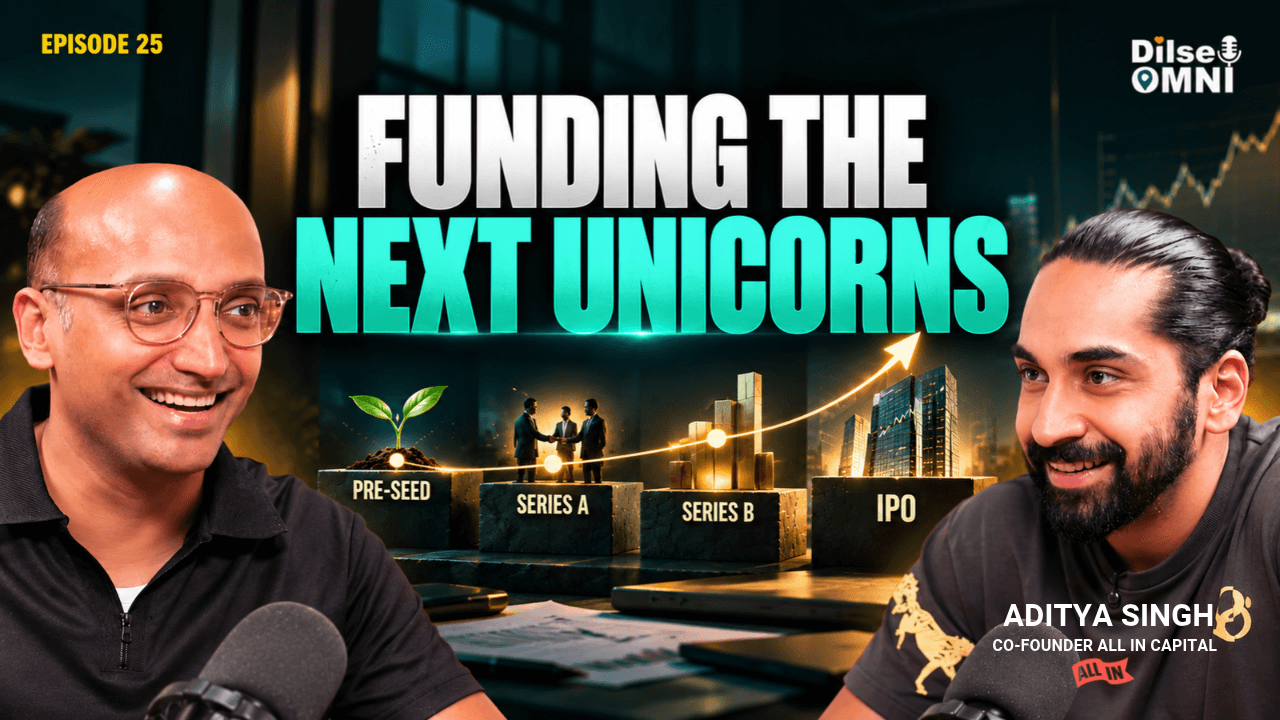
On this episode of Dilse Omni Talks, we covered how to read India's consumer market, what actually happens in a pre-seed pitch room, and why networking is the one compounding skill most founders radically underinvest in.

Future of Marketing is Conversational
Gupshup founder Beerud Sheth on why the click is dying, how conversational AI is rewriting marketing, and why context, not intelligence, is the real moat.

Inside Arjun Vaidya's D2C Playbook
Arjun Vaidya on building, exiting, teaching, and investing, when to go offline, founder branding, and life as an operator turned VC.

Growth Playbook by Sanjeev Bikhchandani
There are very few people who have genuinely shaped the way India works, loves, and learns — all from one desk, one insight, and one stubborn belief that the internet would change everything before most people even knew what a server was. Sanjeev Bikhchandani is one of those people.
View More
Latest Episodes
Decoding Personal AI Agents
On this episode of Dilse Omni Talks, Saurabh sat down with Swapnika to talk about what happens when you stop treating WhatsApp as a messaging app and start treating it as the operating system your entire business already runs on.
Funding The Next Unicorns
On this episode of Dilse Omni Talks, we covered how to read India's consumer market, what actually happens in a pre-seed pitch room, and why networking is the one compounding skill most founders radically underinvest in.
Future of Marketing is Conversational
Gupshup founder Beerud Sheth on why the click is dying, how conversational AI is rewriting marketing, and why context, not intelligence, is the real moat.
Inside Arjun Vaidya's D2C Playbook
Arjun Vaidya on building, exiting, teaching, and investing, when to go offline, founder branding, and life as an operator turned VC.
Growth Playbook by Sanjeev Bikhchandani
There are very few people who have genuinely shaped the way India works, loves, and learns — all from one desk, one insight, and one stubborn belief that the internet would change everything before most people even knew what a server was. Sanjeev Bikhchandani is one of those people.
View More
Latest Episodes
Decoding Personal AI Agents
On this episode of Dilse Omni Talks, Saurabh sat down with Swapnika to talk about what happens when you stop treating WhatsApp as a messaging app and start treating it as the operating system your entire business already runs on.
Funding The Next Unicorns
On this episode of Dilse Omni Talks, we covered how to read India's consumer market, what actually happens in a pre-seed pitch room, and why networking is the one compounding skill most founders radically underinvest in.
Future of Marketing is Conversational
Gupshup founder Beerud Sheth on why the click is dying, how conversational AI is rewriting marketing, and why context, not intelligence, is the real moat.
Inside Arjun Vaidya's D2C Playbook
Arjun Vaidya on building, exiting, teaching, and investing, when to go offline, founder branding, and life as an operator turned VC.
Growth Playbook by Sanjeev Bikhchandani
There are very few people who have genuinely shaped the way India works, loves, and learns — all from one desk, one insight, and one stubborn belief that the internet would change everything before most people even knew what a server was. Sanjeev Bikhchandani is one of those people.
View More
Subscribe on your favourite platform




Subscribe on your favourite platform



Subscribe on your favourite platform

Subscribe for
insider insights
Subscribe for
insider insights
Subscribe
for insider insights



Nitin is a Design Entrepreneur and the founder of Indibni® Group. His mission is to foster a self-reliant India through exceptional Indigenous products that impact individuals worldwide.