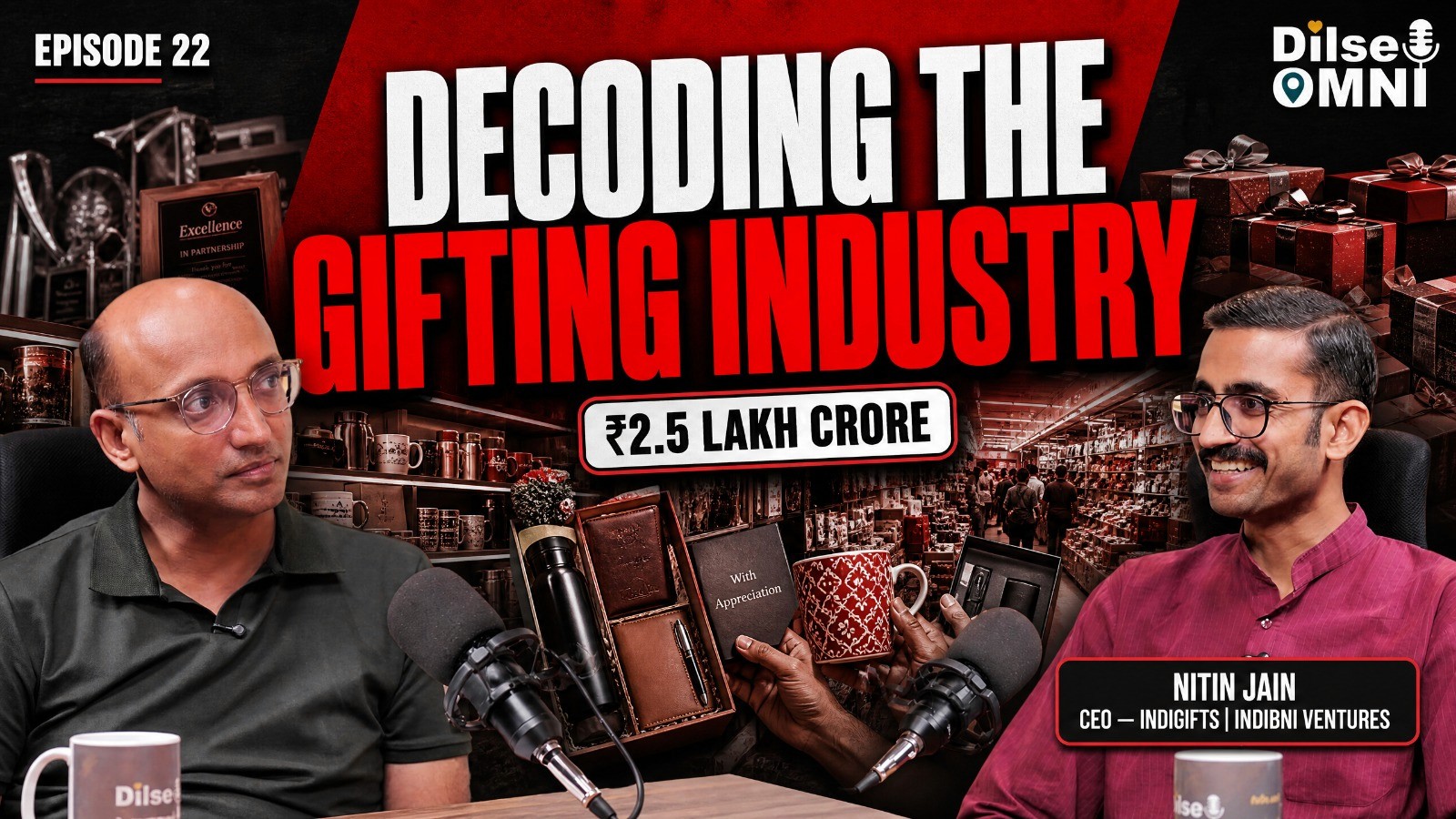
For years, we have spoken about India’s talent, scale, technology capability, and entrepreneurial energy. But in my conversation with Nitin Jain on Dilse Omni Talks, a different question came alive: what happens when India’s creativity and culture are treated not only as expression, but as economic infrastructure?
Nitin is an animator, creator, entrepreneur, Founder of Indibni Ventures, and CEO of IndiGifts. Across two decades, he has built at the intersection of creativity, technology, culture, commerce, gifting, indigenous products, and creator enablement. His journey from a small town in Rajasthan to building a gifting brand and a venture studio is a practical masterclass in how creative people can keep evolving their role.
The larger idea behind our conversation was the Orange Economy. It is about the possibility of turning culture, creativity, and intellectual property into sustainable value, businesses, jobs, and global influence.
Table of Contents
The Orange Economy: Creativity and Culture Becoming Capital
Why India Must Move From Job Work to IP Ownership
Soft Power Is an Economic Asset
Indian Cinema, AVGC-XR, and the New Creative Infrastructure
Nitin Jain’s Five-Phase Journey: A Masterclass in Reinvention
IndiGifts: Building Commerce Around Emotion
Why the Co-Pilot Model Matters Now
The Real Opportunity Ahead
The Orange Economy: Creativity and Culture Becoming Capital
Nitin explained the Orange Economy in one powerful line:
“Something which uses creativity and culture and translates them into capital.”
That is the crux. India has population, creativity, intellect, craft traditions, stories, heritage, and human capability at a remarkable scale. Yet much of our economic identity has been built around doing work for someone else, whether in manufacturing, services, software, or outsourcing.
There is nothing wrong with being excellent at execution. But the Orange Economy asks a more ambitious question: can we build and own the ideas, characters, stories, designs, products, and cultural worlds that others engage with?
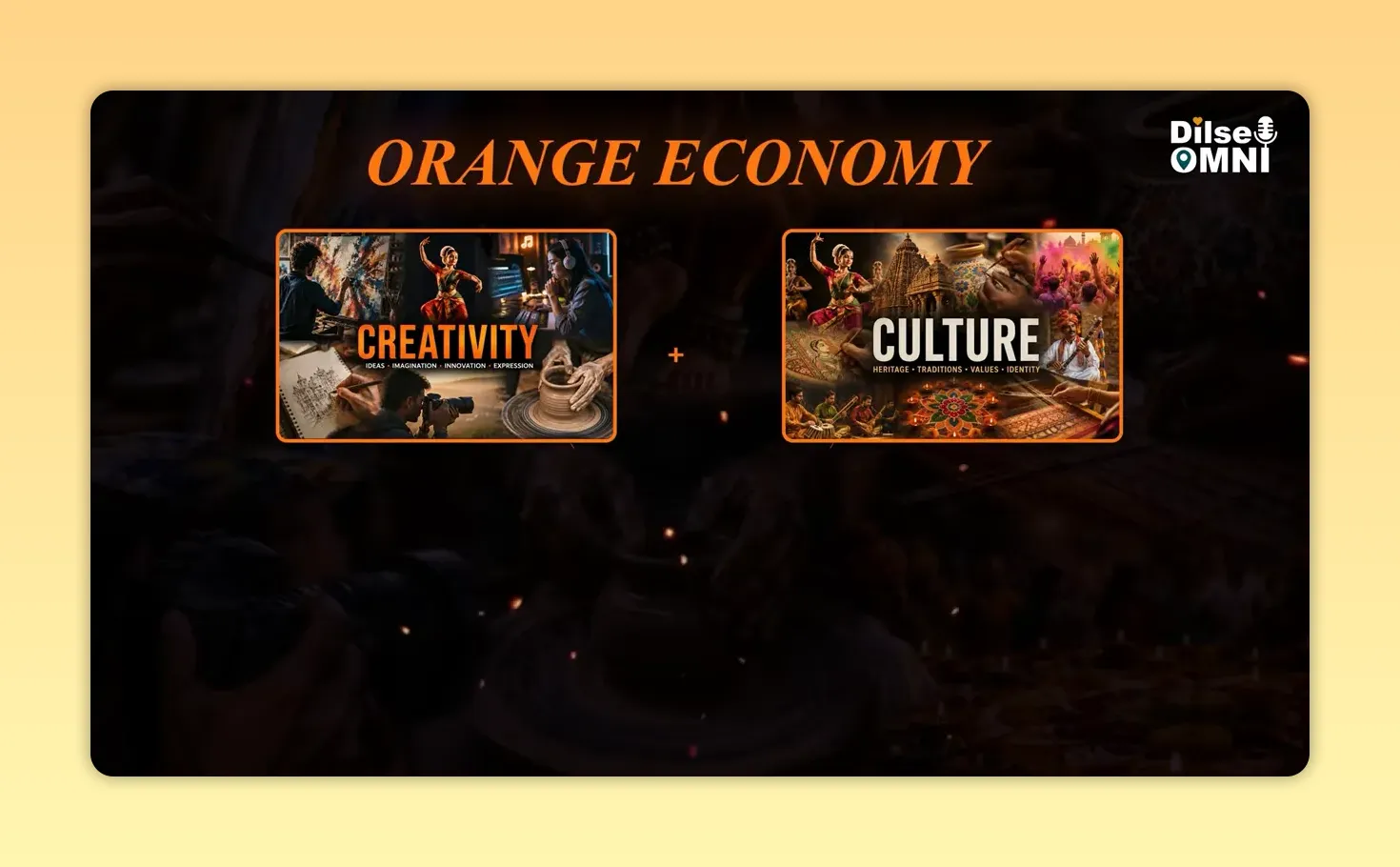
The Orange Economy turns creative and cultural inputs into enduring economic value.
The opportunity is not limited to artists. It extends to founders, designers, marketers, retailers, filmmakers, craftspeople, game creators, product builders, and technology teams. A local craft can become a global product. A story can become a franchise. A design language can become a category. A creator can develop intellectual property that compounds over time.
A simple Orange Economy framework
Creative input: Start with a craft, story, visual language, emotion, community insight, or cultural expression.
IP creation: Shape it into something distinct that can be recognised, protected, and repeatedly built upon.
Product and experience: Translate that IP into content, merchandise, entertainment, services, or commerce.
Distribution: Use digital platforms, retail, partnerships, communities, and omnichannel systems to take it to market.
Economic value: Build revenue, livelihoods, influence, and long-term ownership.
This is where creativity stops being treated as a soft, optional layer of business. It becomes the source of differentiation.
Why India Must Move From Job Work to IP Ownership
The key shift Nitin pointed to is from being only a service provider to becoming an owner. India has enormous capability in production, creative services, animation, VFX, and technology. The next leap comes when our talent is attached to intellectual property that we own.
“We should also own the IP, rather than just putting the job first.”
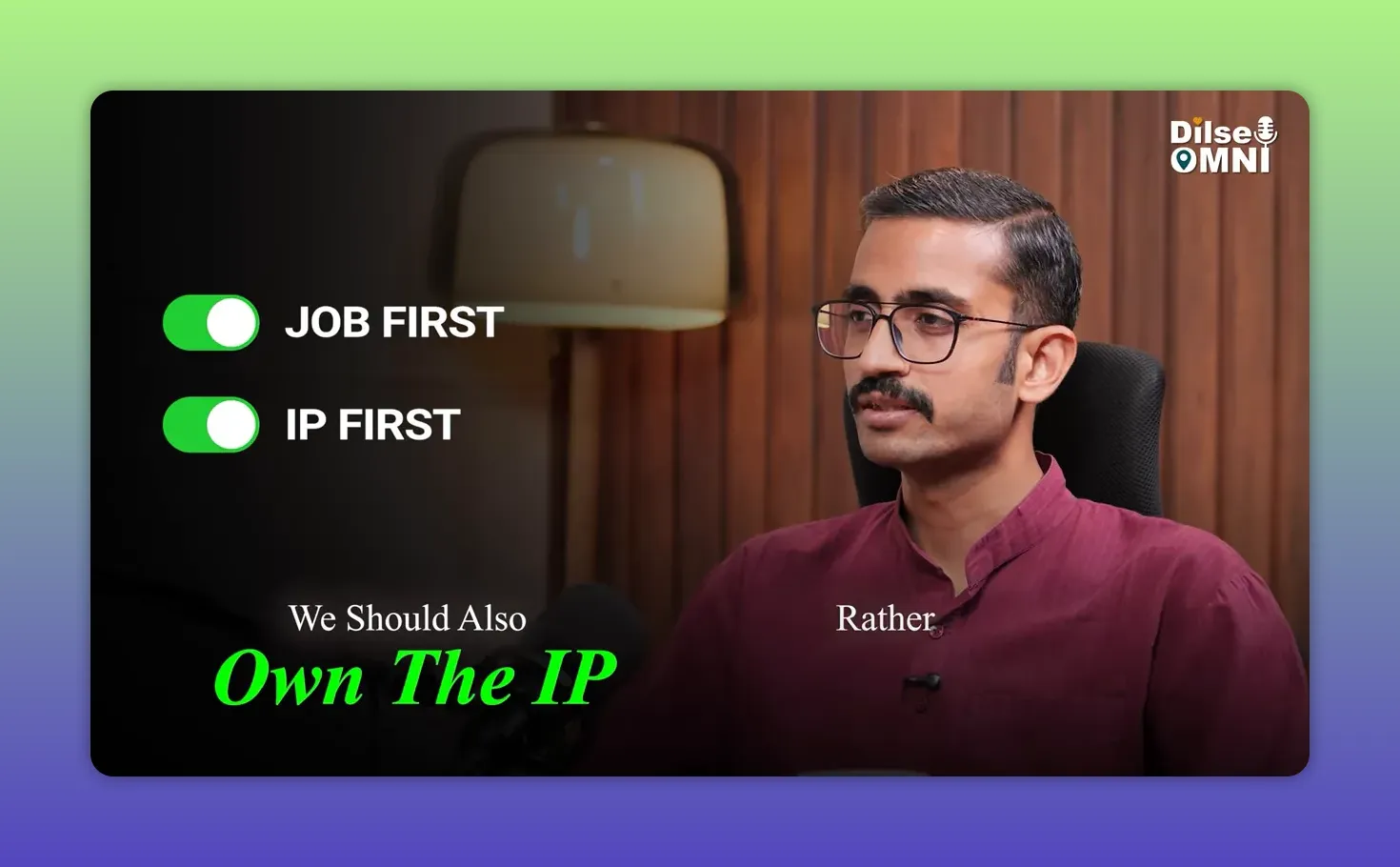
The opportunity is not limited to artists. It extends to founders, designers, marketers, retailers, filmmakers, craftspeople, game creators, product builders, and technology teams. A local craft can become a global product. A story can become a franchise. A design language can become a category. A creator can develop intellectual property that compounds over time. A simple Orange Economy framework Creative input: Start with a craft, story, visual language, emotion, community insight, or cultural expression. IP creation: Shape it into something distinct that can be recognised, protected, and repeatedly built upon. Product and experience: Translate that IP into content, merchandise, entertainment, services, or commerce. Distribution: Use digital platforms, retail, partnerships, communities, and omnichannel systems to take it to market. Economic value: Build revenue, livelihoods, influence, and long-term ownership. This is where creativity stops being treated as a soft, optional layer of business. It becomes the source of differentiation. Why India Must Move From Job Work to IP Ownership The key shift Nitin pointed to is from being only a service provider to becoming an owner. India has enormous capability in production, creative services, animation, VFX, and technology. The next leap comes when our talent is attached to intellectual property that we own. “We should also own the IP, rather than just putting the job first.”
IP can take many forms: a character, a design system, a brand universe, a cultural product, a storytelling format, a game concept, a distinctive gifting range, or a community-powered platform. The underlying principle is simple. If all value comes from hours worked, growth has a ceiling. If value comes from an owned asset that can travel across formats and markets, the potential becomes much larger.
India already has the raw material. Our crafts, regional identities, festivals, family relationships, mythology, cinema, food, languages, and visual traditions are incredibly rich. The challenge is to identify the right format, product, technology, and distribution engine to make these assets relevant at scale.
This is deeply connected to the omnichannel conversation as well. Creativity generates attention and meaning, but distribution makes it commercially viable. Brands seeking that operating discipline can learn from this Omnichannel Guide by DAiOM, which explores the systems behind integrated growth.
Soft Power Is an Economic Asset
One of the most compelling parts of our discussion was India’s soft power. Around the world, cultural products influence what people wear, listen to, watch, buy, aspire to, and identify with. Pop music, comics, animation, cinema, and entertainment have created huge global commercial ecosystems in other markets.
Nitin made the point that many young people know global superheroes, comic universes, and pop culture icons extremely well. India needs to create equally resonant cultural properties rooted in its own imagination.
This does not mean copying anyone else’s model. India’s advantage is its own diversity. We have a depth of stories and aesthetics that can become contemporary, premium, entertaining, interactive, and globally relevant.
Consider the journey from local to global. A GI-tagged product is not merely an object from a place. It carries provenance, heritage, craftsmanship, and a story. With the right brand building and access to distribution, it can become part of a global cultural economy.

Cultural products gain power when their local roots are paired with strong storytelling and market access.
Indian Cinema, AVGC-XR, and the New Creative Infrastructure
The Orange Economy is already unfolding across music, films, craft, gaming, animation, and digital media. Nitin particularly highlighted the role of AVGC-XR: animation, visual effects, gaming, comics, and extended reality.
These are not isolated creative disciplines anymore. They are a technology-powered medium. Like artificial intelligence, AVGC-XR is a toolset that can make media immersive and interactive, with applications across entertainment and beyond.
Nitin referenced the ambition behind Indian cinema and VFX, including the example of Ramayana as a culturally rooted world that can be imagined on a much bigger visual canvas. The broader lesson is not about one film. It is about building world-class creative execution around stories that belong to us.
When we create cultural IP with strong production quality, we do more than entertain. We create careers, exports, products, fan communities, and a stronger global identity for India.
Nitin Jain’s Five-Phase Journey: A Masterclass in Reinvention
Nitin’s personal story makes this philosophy tangible. He grew up in Vijaynagar, a small town in Rajasthan, and after completing higher secondary education with physics, chemistry, mathematics, and fine arts, he found an advertisement that spoke directly to him: if you are creative, imaginative, and ambitious, animate your career.
That led him to animation at BIT Mesra’s Jaipur campus. It was a decisive moment. He moved to Jaipur in 2006, supported himself while studying, and worked relentlessly across graphics, cartoons, songs, films, and photography. He remembers taking more than twelve lakh photographs during his college years.
His first freelance logo project earned ₹500. Later, he realised that when the work moved into services, the same capability could be valued at a hundred times more. That is an important entrepreneurial insight. Skill matters, but positioning, packaging, and business model determine how that skill creates value.
The creator to co-pilot framework
Phase 1: Creator. Nitin began by learning through output: graphics, cartoons, films, and photography.
Phase 2: Service provider. He started Indibni as a design house at a time when Rajasthan had limited digital and interactive media infrastructure.
Phase 3: Brand founder. As e-commerce took shape in India, he saw that gifting is fundamentally about love, emotion, and expression. This led to IndiGifts.
Phase 4: Venture studio. The focus expanded from building one brand to identifying promising ideas, assembling teams, and helping them scale.
Phase 5: Co-pilot. The mission became enabling creators, experts, and entrepreneurs to turn ideas into stronger businesses and IP.
This is not a rigid career ladder. It is a framework for asking a better question at every stage: what is the highest value I can create with what I have learned so far?
IndiGifts: Building Commerce Around Emotion
IndiGifts began as one of the early e-commerce adopters in India. Its core insight was simple and human: people need ways to express affection, gratitude, relationships, and emotion. Gifting was the natural category where creativity and commerce could meet.
The company built around indigenous products rather than sourcing generic products from China. It worked with self-help groups and artisans, innovated across products, and created offerings around relationships such as mothers, fathers, and other meaningful occasions.
The result was not just an online catalogue. It was a business built around helping people express what they feel.
Over time, IndiGifts scaled from zero to more than 10,000 orders in a single day. For me, this is a powerful reminder that the strongest commerce brands often begin with a human truth. Technology, operations, merchandising, and distribution are essential, but the emotional insight gives the brand its reason to exist.
For a deeper exploration of this category and Nitin’s larger approach, read how the next generation of gifting will be built.
Why the Co-Pilot Model Matters Now
The final evolution in Nitin’s journey is perhaps the most relevant for the next generation of founders and creators. He is now building through a venture studio and co-pilot model.
A co-pilot does not merely deliver a service. A co-pilot helps identify the right idea, brings the right people together, contributes experience, and supports scale. It is a move from transactional work to shared problem-solving.
“Our responsibility changed from a creator to a service provider to a brand founder, now becoming a co-pilot.”
Nitin’s intent is to create several IPs every year by bringing together creators, coaches, subject matter experts, and capable teams. This is co-preneurship in action. The value lies in the power of co, where good ideas receive the structure, network, creative thinking, and operational support required to become real ventures.
That is where Nitin’s story becomes bigger than a career journey. It becomes a vision for India. A creator can build a platform. A platform can enable many creators. Those creators can build IP. And that IP can strengthen India’s cultural and economic standing in the world.
The Real Opportunity Ahead
My biggest takeaway from this conversation is that creativity does not have to sit on the sidelines of business. It can be the engine of business.
For creators, the opportunity is to think beyond the next project and ask what can be owned. For brands, it is to build meaningful cultural relevance rather than chasing only performance metrics. For entrepreneurs, it is to find overlooked emotional and cultural insights that can become scalable ventures. For India, it is to convert its exceptional creative richness into globally recognised intellectual property.
The Orange Economy will not be built by creativity alone. It will need technology, capital, distribution, brand building, policy support, and communities willing to back original ideas. But creativity is where the story begins.
I am Saurabh Agrawal and we come with a new episode on Dilse omni talks every fortnight and cover different aspect of omnichannel with amazing speakers.