Can one AI model update wipe out the reason your startup exists? That was the question I put to Swapnika Nag on Dilse Omni Talks. Her answer shifted our conversation from building better technology to building a business that remains relevant.
Swapnika is the Founder and CEO of Periskope and Perisclaw. Periskope automates WhatsApp operations for more than 5,000 businesses across 100 countries, while Perisclaw is an AI executive assistant that runs on your own WhatsApp number. An IIT alumna and former McKinsey consultant, she builds both companies with her husband and co-founder, Bharat.
What made this conversation valuable was her willingness to connect strategy with experience. We explored five AI business moats, unpacked a simple WhatsApp workflow, and went back to a Web3 venture that taught her what not to build.
My biggest learning: defensibility begins with understanding why a customer would genuinely miss you.
Table of Contents
Building Fast Is No Longer Enough
The Five AI Moats: A Founder’s Strategy Map
What a Vertical Moat Looks Like Inside WhatsApp
The Web3 Detour That Clarified the Business
The Vitamin Versus Painkiller Test
Will Web3 Find Its Breakthrough Moment?
Build Around a Need That Lasts
Building Fast Is No Longer Enough
For a long time, building a good product quickly was a meaningful advantage. Swapnika’s argument is that AI has changed that equation. When many teams can build useful products rapidly, speed alone becomes less distinctive.
“Relevance can no longer be achieved by building a good product fast.”
Swapnika Nag
This does not mean execution stops mattering. It means execution needs somewhere defensible to accumulate: customer access, domain understanding, local requirements, unique data, or infrastructure that others depend on.
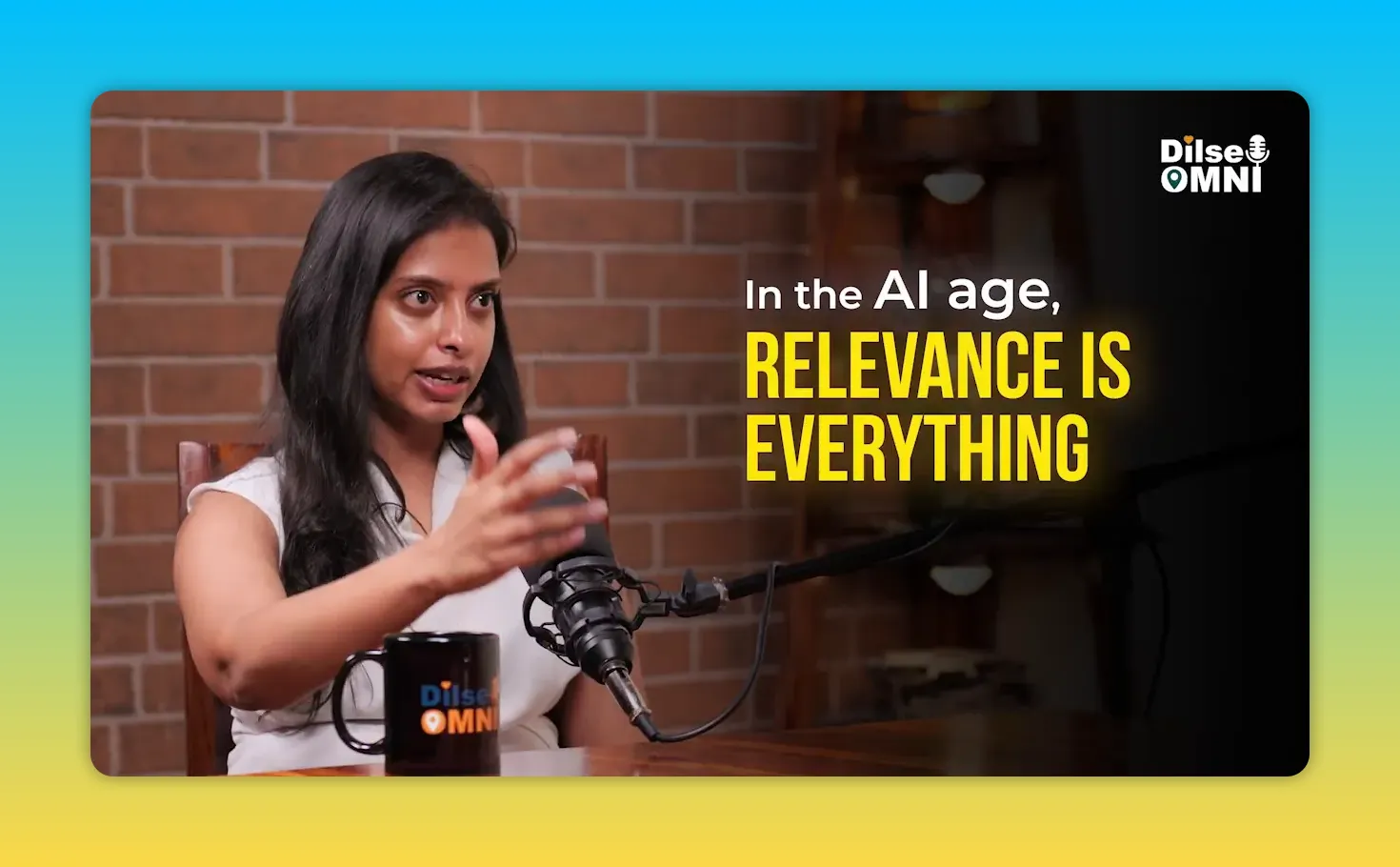
Swapnika shared a five-moat framework that emerged from a discussion at a Google event. I found it useful because it moves the founder’s question from “What can we build?” to “Why will we continue to matter?”
The Five AI Moats: A Founder’s Strategy Map
Think of these as five possible sources of staying power, not five boxes every startup must tick.
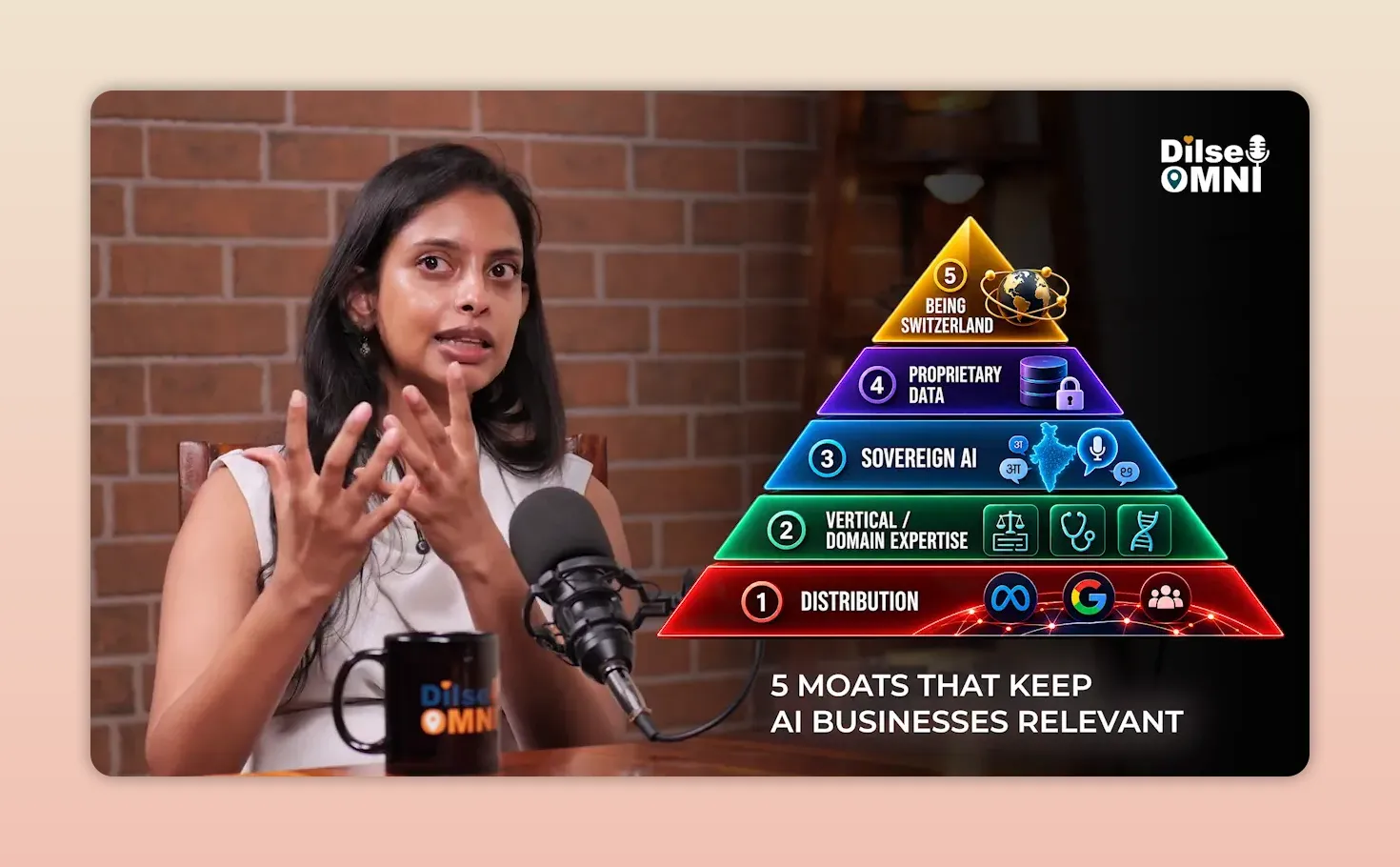
Distribution → Access: Can you reach customers in a way competitors cannot easily replicate?
Vertical expertise → Depth: Do you understand a domain or workflow better than a general-purpose product?
Sovereign AI → Local fit: Are you solving country-specific needs that global products may overlook?
Proprietary data → Distinctive knowledge: Do you have valuable, specific datasets others do not?
Switzerland → Neutrality: Can you remain useful regardless of which AI provider wins?
1. Distribution: A Better Product Still Needs a Route to Market
Distribution is the familiar moat that has survived the AI shift. Google and Meta can introduce products to enormous existing audiences. A startup cannot assume that a technically impressive alternative automatically overcomes that advantage.
My takeaway was straightforward: a product advantage and a customer-access advantage are different things. Founders need to understand both. Building something useful does not, by itself, answer how it will reach the people who need it.
2. Vertical Expertise: Go Deep Where General Tools Stay Broad
Swapnika sees vertical and domain-specific understanding as an important path for her companies. The key is that this understanding compounds.
She pointed to Harvey and Legora in legal AI. Contracts and law require specialised understanding. Biotech offers another example of a field where domain depth matters.
But vertical expertise is not only about choosing an industry label. It can also mean understanding a particular operating environment deeply enough to solve its real workflows. That distinction became clearer when we discussed WhatsApp operations.
3. Sovereign AI: Local Context Can Be the Opportunity
A globally available AI product does not necessarily solve every country’s requirements.
Swapnika used India to explain the gap: payments are heavily shaped by UPI, language needs span many dialects, and voice is an important interface. She also highlighted requirements to keep data within national borders.
These are not merely translation problems. They affect how a product works. A country-specific opportunity may involve payment behaviour, voice interaction, language coverage, or data residency. She mentioned Sarvam as an example in the model space.
For me, the lesson was to treat local context as a product-design requirement, not something added after the global product is complete.
4. Proprietary Data: Specificity Matters
The data moat is easy to describe but worth being precise about. Swapnika emphasised valuable, specific datasets that other companies do not have, including their potential usefulness for model training.
The important question is not simply whether a business has accumulated data. It is whether that data contains something distinctive and useful.
“We have data” is a starting point for investigation, not a complete explanation of defensibility.
5. Switzerland: Stay Valuable Whoever Wins
This was my favourite metaphor in the discussion. Being “Switzerland” means becoming a neutral layer that serves the ecosystem without depending on one model company winning.
Swapnika cited Supabase for database, authentication, and infrastructure needs; OpenRouter for access to different models; and Resend for email infrastructure.
“Becoming that sort of neutral party that is valuable regardless of who wins.”
Swapnika Nag
The strategic idea is powerful: instead of betting everything on whether OpenAI or Anthropic comes out ahead, build something that remains useful across those outcomes. This connects closely with our discussion of AI model updates, startup risk, and vertical SaaS.
What a Vertical Moat Looks Like Inside WhatsApp
I asked Swapnika to make vertical moats more concrete. Her Periskope example brought the discussion down from strategy to everyday business operations.
WhatsApp and WhatsApp Web enable communication. Businesses, however, often need a sequence of actions around that communication.

Consider a company receiving incoming leads every day. People contact it for several different reasons. The business needs to ask qualifying questions, interpret the answers, and send each enquiry down the appropriate path.
Here is the workflow she described, simplified into an operating map:
Receive: A lead arrives through WhatsApp.
Qualify: Ask the relevant two, three, or four questions.
Decide: Determine whether the enquiry fits the business.
Route: Send suitable information to Google Sheets or explain that the request is not relevant.
The example is deliberately simple. Actual workflows can become more complex and stretch across multiple systems.
What I took from it is the difference between generating an answer and completing an operational process. Swapnika’s bet is on understanding those processes deeply, rather than relying only on general-purpose agent capabilities.
She was also clear that this is an evolving strategy. Vertical depth is their current approach, not a claim that other moats will never matter. We explore the broader product context in our conversation about personal AI agents and WhatsApp.
The Web3 Detour That Clarified the Business
To understand how Swapnika arrived at that focus, I wanted to revisit her earlier Web3 experience. First, I asked her to explain Web3 without the jargon.
Her explanation used a simple progression:
Web1: Read. Consume information on largely static websites.
Web2: Read + write. Interact, place orders, and publish your own content.
Web3: Read + write + own. Add digitally recorded ownership through blockchain-based systems.
Within that ecosystem, Swapnika and Bharat built Hashmail. Many participants operated under pseudonyms and used wallets as their identity rather than sharing personal details.
Hashmail’s idea was email-like communication through that wallet identity. Someone could connect using a wallet such as MetaMask and communicate without exposing a conventional personal email identity.
They also experimented with support on Discord, where much of the ecosystem’s communication happened. But the experience revealed a more fundamental problem than product design.
The Vitamin Versus Painkiller Test
Swapnika described their Web3 solution as a vitamin rather than a painkiller. It was useful, but not essential. If it disappeared, customers could move on without much disruption.
That is an uncomfortable realisation for any founder, and an important one.
I added that the underlying ecosystem was itself still figuring out its identity. Their product sat on top of that uncertainty. Swapnika agreed, pointing to the difficult conditions in 2022, including the FTX scandal.
Her experience suggests a practical test. This is my synthesis of her lessons, rather than a separate framework she named:
Need: Is the customer’s problem deep, or merely interesting?
Absence: Would losing the product materially inconvenience the customer?
Market: Are you solving a clear problem within the ecosystem?
Founder fit: Do you want to serve these customers for years?
The last question mattered personally. Swapnika and Bharat did not enjoy parts of the pseudonymous selling environment. They wanted a market they understood and customers they enjoyed building for.
“These are decadal journeys.”
Swapnika Nag
The combination of deeper need and stronger founder fit helped lead them towards WhatsApp operations.
Will Web3 Find Its Breakthrough Moment?
I brought up two themes I had encountered at the Global Fintech Festival in Mumbai: conversational commerce and tokenisation of assets such as bonds, shares, and gold. Could Web3 return in another form?
Swapnika was open to the possibility but sceptical about an imminent breakthrough. She contrasted Web3’s long search for broad adoption with the immediate enthusiasm around ChatGPT.
Importantly, she also acknowledged the limitation of that comparison: AI existed for a long time before generative AI made its value intuitive to many people. Web3 might eventually find a similarly simple, useful expression.
That leaves founders with a better question than whether a technology category will return: does this particular product make someone’s life meaningfully easier today?
Build Around a Need That Lasts
I began by asking how to protect a startup from a model update. I left with a broader answer: choose an important problem, understand the customer’s operations, and be deliberate about where your advantage will accumulate.
No framework makes a startup literally impossible to replace. But Swapnika’s five moats offer a useful discipline for building beyond the next impressive feature.
I am Saurabh Agrawal and we come with a new episode on Dilse omni talks every fortnight and cover different aspect of omnichannel with amazing speakers.