I have been following Beerud Sheth’s journey for years, first as a customer, then while working with Gupshup, and now as someone trying to decode where omnichannel growth is headed. In this conversation, I found myself going beyond marketing tools and campaign dashboards into a much larger question: what happens when the primary interface between a brand and its customer becomes a conversation?
Beerud is the Co-Founder and CEO of Gupshup, a global conversational AI platform for marketing, commerce, and customer support. An IIT Bombay alumnus and MIT Media Lab graduate, he worked on autonomous learning agents nearly three decades ago. He also co-founded Elance in 1998, a company that later became Upwork.
Today, Gupshup serves more than 50,000 customers across over 100 countries. But the scale is not the most important part of Beerud’s story. The important part is that he has seen a pattern before: an idea can seem early, even impractical, until technology and behavior finally catch up.
Table of Contents
The Full Circle Moment of AI Agents
From Messaging to Omni Conversational Channels
The New Front Door for Brands
The Masterclass Framework: Intelligence + Context + Orchestration
Build, Buy, or Experiment?
From Broadcast Marketing to Conversation Marketing
Why AI Creates Superhuman Campaigns
The Framework for the Next Level of Marketing Work
What Entrepreneurs Must Build in the AI Era
The Real Shift: From Clicks to Relationships
The Full Circle Moment of AI Agents
At MIT, Beerud’s research focused on agents that could create a personalized news feed based on a person’s interests, then keep evolving as those interests changed. The concept was clear even then: software should learn what matters to a human being and become more useful over time.
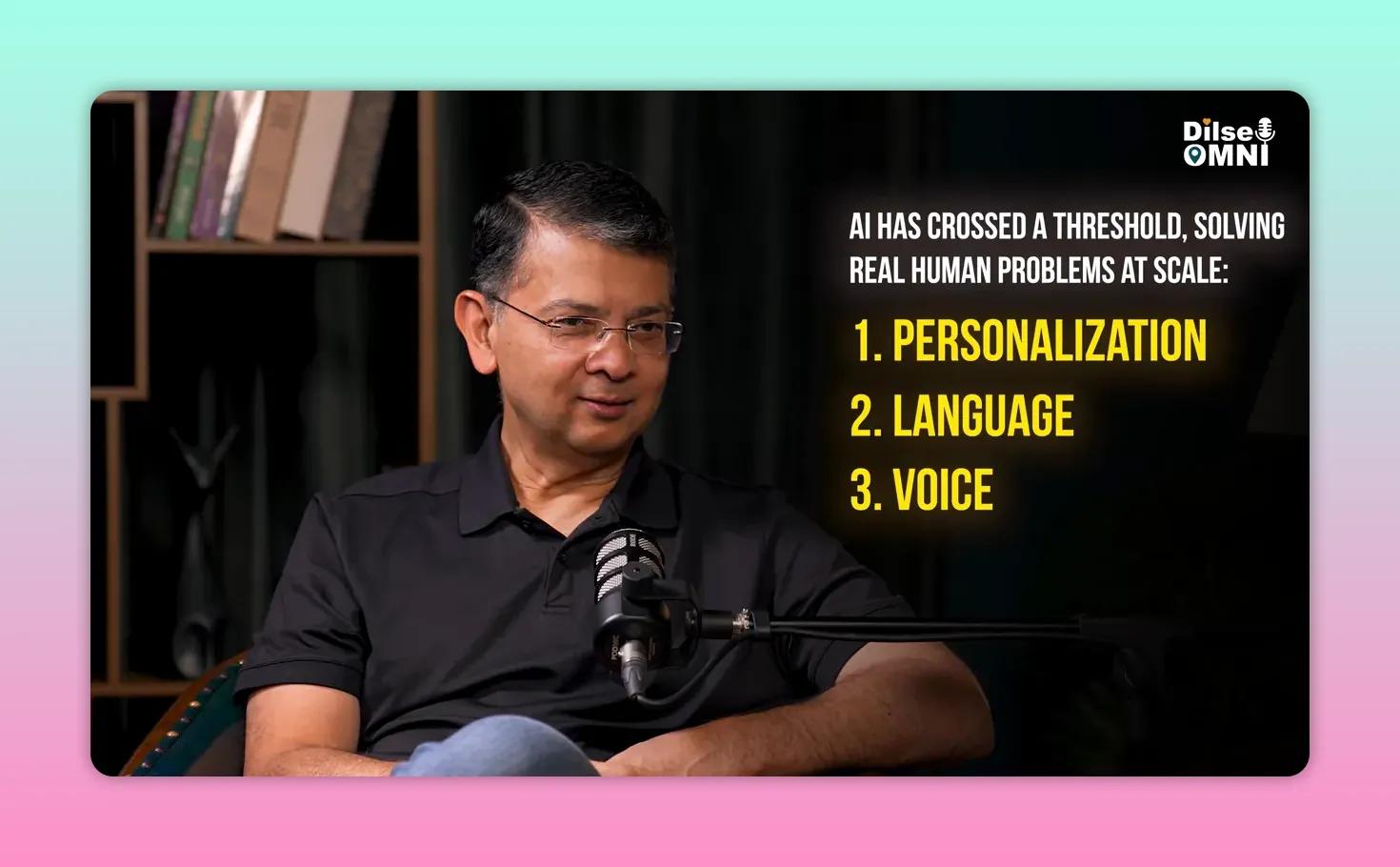
The limitation was not imagination. It was technology. The computing power, models, data availability, and interfaces simply were not ready. Today, personalized recommendations, natural language, voice, and generative AI have taken us across a major threshold.
“We have certainly crossed a threshold of really solving a lot of human problems.”
Beerud’s earlier company, Elance, faced a similar timing challenge. At the time, people asked how anyone could trust a freelancer they had never met, perhaps from another country, speaking another language. It took almost two decades and a pandemic for remote work to become conventional wisdom.
That is an important founder lesson. Being early is not the same as being wrong. But being early means you need patience, product market fit, and the ability to survive long enough for the market to mature.
From Messaging to Omni Conversational Channels
Gupshup itself was born from a simple observation during the rise of feature phones in India. The next billion digital users were not primarily on web browsers and email. They were reachable through SMS and voice.
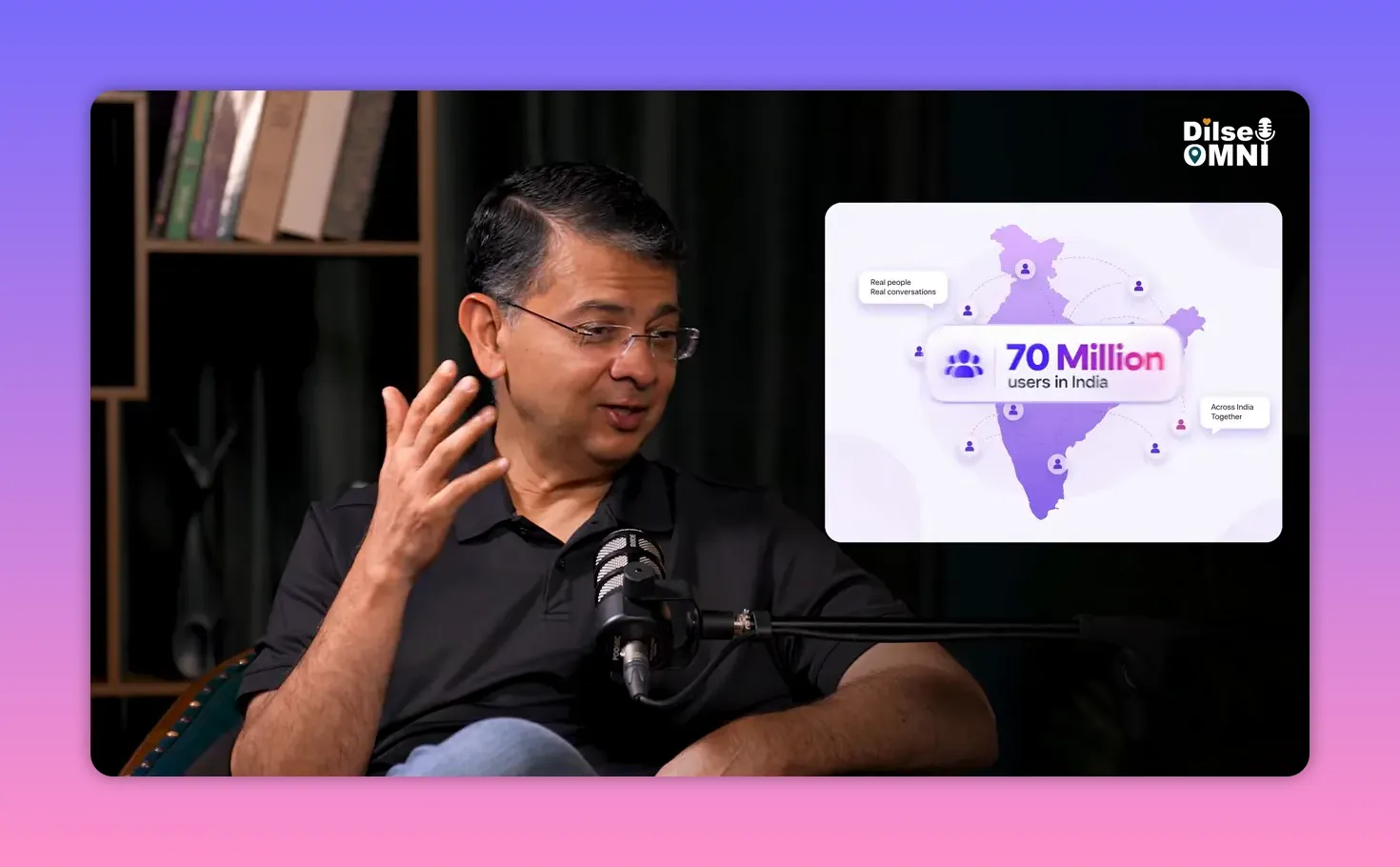
Gupshup, which means conversation or chitchat in Hindi, began with an SMS based social network. It grew to roughly 70 million users in India at a time when Facebook and Twitter had much smaller user bases. The underlying belief was always the same: messaging and voice can become powerful interfaces between consumers and digital services.
That belief now has a new engine in conversational AI.
When I asked Beerud what omnichannel means to him, his answer reframed the entire idea. Omnichannel should not merely mean being present across many touchpoints. It should mean being available across every conversational surface.
Messaging platforms such as WhatsApp, RCS, SMS, Instagram, Line, and Kakao
Voice channels such as regular calls, WhatsApp voice, and regional calling platforms
Video interactions through video calls and emerging AI interfaces
New ambient surfaces such as smart glasses and future AI hardware
The brand should not create a disconnected personality for each channel. There should be one intelligence at the center, with the ability to adapt its expression for text, voice, video, or another surface.
“You build an AI agent. It is the brain of the experience. The experience is rendered on different surfaces.”
This is the clearest way I have heard the omnichannel problem explained. The AI agent is the brain. WhatsApp, voice, RCS, and video are the body parts through which that brain engages.
For more thinking around connected customer experiences beyond individual channels, explore the Omnichannel Guide by DAiOM.
The New Front Door for Brands
For decades, brands asked customers to learn how to use technology. Open the website. Find the menu. Click a tab. Fill a form. Download an app. Navigate categories. Search through filters.
Beerud’s argument is that these structured interfaces forced humans to behave like computers. AI changes the equation because computers can now behave more like humans.
“You do not need to point and click. You can just have a conversation.”
That is why conversational AI may become the new front door for brands, more important than a website, app, or even a physical store. This transition may appear gradual, but major platform shifts are often gradual until suddenly they are not. The web, mobile apps, and now AI each create a new expectation that businesses cannot ignore.
Consumers no longer want ten blue links, fifty product tiles, or a complicated FAQ tree when they can simply ask: “My sister is 19, I have a budget of ₹10,000, what is a good Rakhi gift?”
A good AI agent can understand the request, ask qualifying questions, use product context, compare options, and guide the customer toward a decision. That is not just search. It is a conversation.
The Masterclass Framework: Intelligence + Context + Orchestration
One of the most practical parts of my conversation with Beerud was his point about context. Marketers often obsess over which model is best. Should we use one model for copywriting, another for analysis, and another for support?
But models, however intelligent, cannot know what they cannot see.
They do not automatically know a company’s policies, product catalog, pricing, booking availability, customer history, operating processes, tone of voice, campaign performance, or commercial rules. A very smart model without this proprietary context is like hiring Einstein and sending him into a sales meeting without telling him anything about the product, pricing, or customer.
This leads to a simple framework for building AI customer engagement.
The Conversational AI Operating System
Intelligence: Use capable AI models to understand language, reason, generate responses, and act.
Context: Connect the agent to policies, product data, CRM, catalogs, past conversations, pricing, and workflow knowledge.
Orchestration: Give the agent the ability to plan tasks, use the right tools, follow sequences, and recover when one step fails.
Channels: Deliver the same intelligence through messaging, voice, video, and other customer surfaces.
Guardrails: Define where the agent can operate, what it should not discuss, and when to hand over to a human.
Beerud describes the orchestration layer as a harness. The model is the brain, while the harness is the central nervous system that coordinates actions. It can break down a complex request into steps, send each step to the right tool or model, check results, and continue.
At Gupshup, this idea is reflected in SuperAgent, which can connect internal systems such as HR, CRM, finance, campaign data, policies, and customer information. A question that previously required people to search across multiple systems can be answered in minutes.
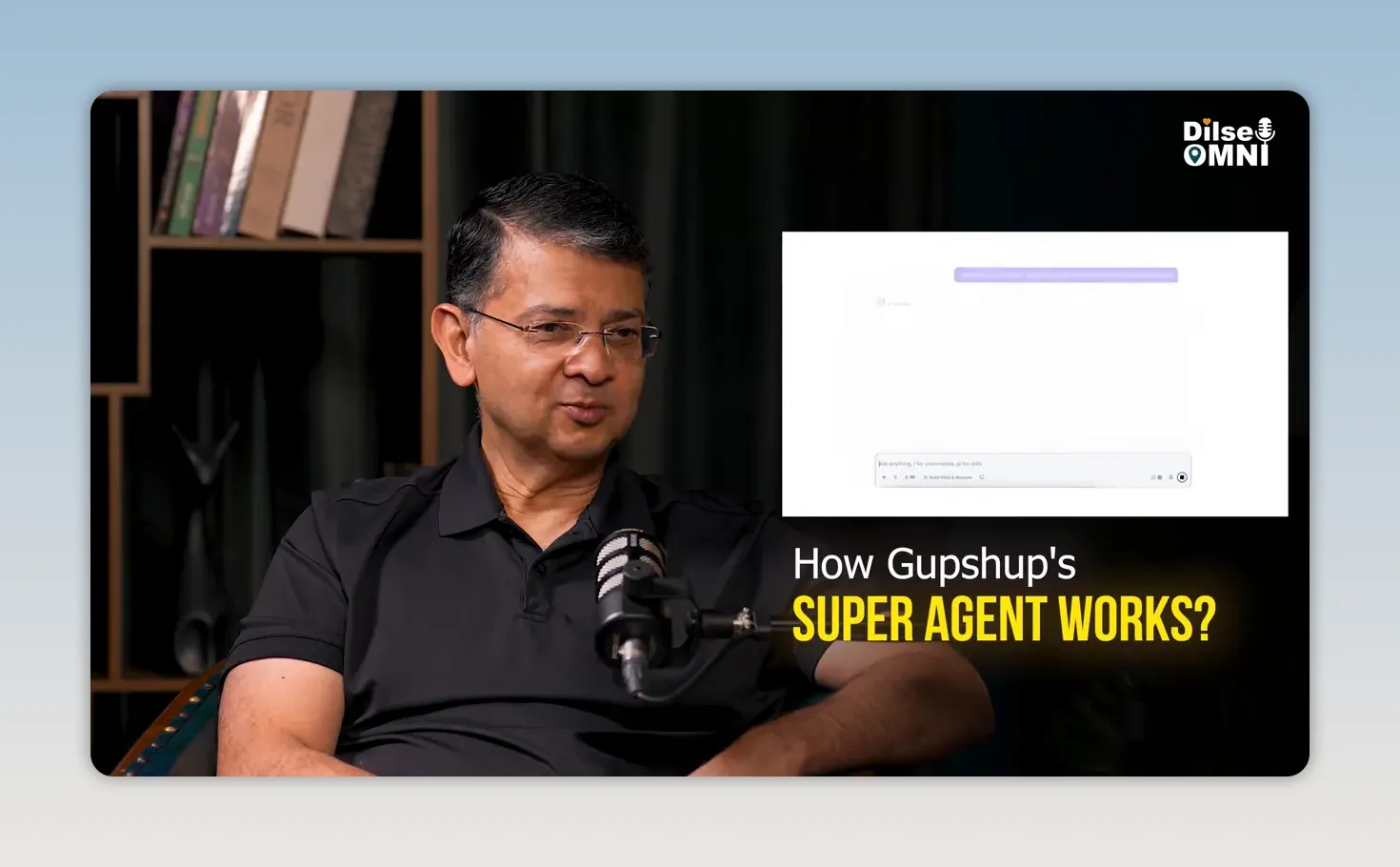
The same logic applies outside the company. A brand agent must not only reply intelligently. It must be able to retrieve data, trigger a campaign, update a journey, escalate an issue, and maintain a coherent experience across the entire lifecycle.
Build, Buy, or Experiment?
The AI world is exciting, but it is also disorienting. Every week there is a new model, agent, feature, or tool claiming that a complex business problem can be solved in two hours.
Beerud’s advice was balanced. Experiment rapidly, but do not confuse a prototype with a production system. Creating the first version is often easy. Maintaining it, improving it, integrating it, measuring it, and ensuring it does not damage the brand is the real work.
A complete conversational AI platform may need:
Campaign management for outbound communication
Customer journeys for different segments and moments
Human escalation for difficult or sensitive cases
Advertising and acquisition integrations
Conversation analytics rather than only click path analysis
Connections across messaging, voice, and video channels
Integration with core systems such as banking, catalog, booking, or CRM platforms
The principle is simple: build your differentiated customer experience, segments, objectives, and journeys. Use platforms and tools wherever they help you move faster without creating fragmented systems.
Do not build one AI agent for WhatsApp, another for RCS, another for Instagram, and a fourth for voice. That is equivalent to having four different versions of the same salesperson with inconsistent knowledge. You need one core brain, continuously updated and consistently governed.
From Broadcast Marketing to Conversation Marketing
One quote from Beerud stayed with me because it captures the urgency for every marketer.
“The era of broadcast marketing is over.”
Message costs are rising. Consumers are blocking brands, opting out, and tuning out irrelevant communication. This means each message needs to work harder. The old spray and pray model is becoming economically and behaviorally unsustainable.
The transition is from sending a message to starting and supporting a conversation. A message may promote a new product. A conversation should anticipate the questions that follow:
What colors are available?
Is this product right for me?
Can I compare options?
What is the price history?
Can I get a refund, exchange, upgrade, or appointment?
That is why reply rate and quality of conversation should become important marketing metrics, alongside opens and clicks. In categories with medium or high ticket sizes, purchases are often made through questions, reassurance, and qualification. Marketing cannot simply generate interest and walk away.
Marketing, sales, and support are converging into one customer experience. The consumer does not care which department owns the next step. They are talking to the brand.
The best analogy Beerud shared was the neighborhood storekeeper. Unlike a giant store with endless aisles, the shopkeeper asks what you need, understands your context, recommends a few products, adjusts based on your response, and helps after the purchase as well. That is conversational commerce at its best.
Why AI Creates Superhuman Campaigns
A human marketer may define ten segments, build three journeys, run a campaign, and optimize results daily. An AI system can create thousands or even millions of microsegments, tailor content at an individual level, manage many journeys at once, and run continuous testing much more frequently.
This does not make the marketer less important. It makes the thinking part more important.
“The execution part has become a lot simpler. The thinking part is going to be far more critical.”
The difference between a good marketer and a great marketer may become even bigger. AI removes a large share of manual execution. What remains is judgment: who to serve, what value to communicate, how to earn trust, when to intervene, and how to create a meaningful relationship.
This is closely connected to the themes in our discussion on agentic marketing and the future of customer engagement. The future is not AI performing random tasks. It is AI operating toward commercial and customer outcomes.
The Framework for the Next Level of Marketing Work
Beerud shared a framework that I think every marketer, product manager, and founder should keep in mind. It describes how work evolves through increasing levels of abstraction.
Humans → Prompts → Loops → Graphs
Humans: People manually create campaigns, landing pages, code, reports, and customer journeys.
Prompts: People tell AI what to create.
Loops: AI repeatedly creates, tests, measures, and improves against a defined objective.
Graphs: Connected context, memory, workflows, and goals coordinate multiple loops across an entire business process.
For example, a product launch may require landing pages, email copy, campaign templates, website updates, analysis, and follow-up journeys. Instead of managing each task separately, a graph can coordinate the full workflow around a goal.
This is where marketing becomes more strategic. The opportunity is not merely to generate a campaign faster. It is to create systems that continuously learn and improve.
What Entrepreneurs Must Build in the AI Era
For young founders, Beerud offered a necessary caution. Building has become easier for everyone. That also means a lightweight wrapper around a general AI model can be quickly overtaken by the next release of that model.
The question is not only, “Can I build this?” The more important question is, “Why will this still matter when the next model becomes much better?”
The answer often lies in proprietary context. Durable AI products are built around company-specific data, integrations, workflows, policies, industry knowledge, and systems that are not publicly available. A generic capability may become a feature. A deeply embedded, context-rich solution can become infrastructure.
Beerud’s larger message was optimistic. AI will reach every part of the economy, across industries, countries, and use cases. The opportunities are enormous. But the winners will not just add AI to an existing process. They will combine intelligence, context, and real outcomes.
The Real Shift: From Clicks to Relationships
We are moving from clicks to messages, from click paths to conversation logs, from broad segments to a segment of one, and from campaign output to customer outcomes.
In the earlier digital era, brands had to infer what customers wanted from behavior. In the conversational era, customers can state their intent directly. A message contains nuance, sentiment, objections, needs, and preferences. If a brand can understand that context and respond well, it can create something previously reserved for premium customers: a personal relationship at scale.
A bank can give every customer access to the knowledge of its best relationship manager. A retailer can provide every person with a shopping assistant. A hotel can offer every guest a concierge. That is the real promise of conversational AI.
It is not about replacing human relationships with cold automation. It is about making useful, responsive, contextual service available to far more people.
I am Saurabh Agrawal and we come with a new episode on Dilse omni talks every fortnight and cover different aspect of omnichannel with amazing speakers.