Beerud Sheth
Beerud Sheth
Episode 24
Episode 24
100 min
100 min
Future of Marketing is Conversational
Future of Marketing is Conversational
Future of Marketing is Conversational
Why Does This Episode Matter?
Why Does This Episode Matter?
If you're a marketer, founder, or CX leader still measuring success through open rates and click-through rates, this conversation should unsettle you a little.
Beerud Sheth has spent nearly 30 years watching three separate revolutions unfold up close, autonomous agents at MIT, the gig economy through Elance, and now conversational engagement at scale through Gupshup, and his argument here isn't that AI simply makes marketing more efficient.
It's that AI is quietly changing the atomic unit marketing is built on, from a click to a message, and that shift rewrites everything downstream of it: the metrics you track, the segments you build, and even what a brand is actually for.
If you're a marketer, founder, or CX leader still measuring success through open rates and click-through rates, this conversation should unsettle you a little.
Beerud Sheth has spent nearly 30 years watching three separate revolutions unfold up close, autonomous agents at MIT, the gig economy through Elance, and now conversational engagement at scale through Gupshup, and his argument here isn't that AI simply makes marketing more efficient.
It's that AI is quietly changing the atomic unit marketing is built on, from a click to a message, and that shift rewrites everything downstream of it: the metrics you track, the segments you build, and even what a brand is actually for.

Beerud Sheth
CEO of Gupshup
Arjun Vaidya is an Indian entrepreneur and early-stage consumer investor, founded modern Ayurvedic brand Dr. Vaidya's and co-founding V3 Ventures.
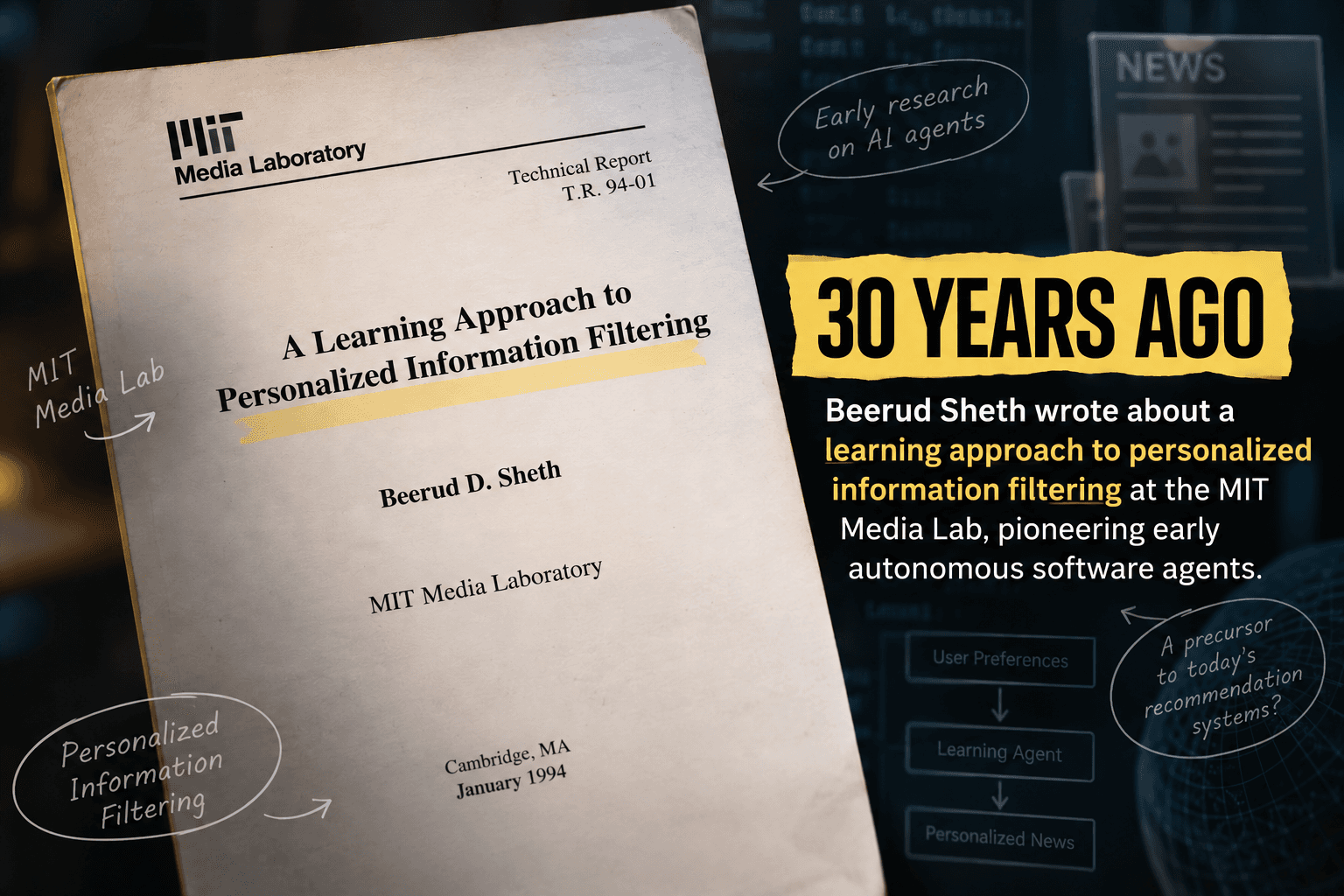
From Personalised Newspapers to Personalised Everything
From Personalised Newspapers to Personalised Everything
Beerud calls his MIT research a full circle moment. "I guess we were way ahead of our time," he told me, "because the technology at that time was obviously more primitive compared to today." The vision, an agent that understands you individually and adapts over time, took thirty years to become technically possible at scale. He sees the same pattern in his own career: Elance pioneered the gig economy in 1998, and it took almost two decades, and a pandemic, for remote work to become mainstream conventional wisdom.
That pattern of being early, and eventually being proven right, is worth sitting with. It is also, I suspect, why he is unusually calm about how fast conversational AI is moving now. He has already watched one impossible idea become boring infrastructure.
Beerud calls his MIT research a full circle moment. "I guess we were way ahead of our time," he told me, "because the technology at that time was obviously more primitive compared to today." The vision, an agent that understands you individually and adapts over time, took thirty years to become technically possible at scale. He sees the same pattern in his own career: Elance pioneered the gig economy in 1998, and it took almost two decades, and a pandemic, for remote work to become mainstream conventional wisdom.
That pattern of being early, and eventually being proven right, is worth sitting with. It is also, I suspect, why he is unusually calm about how fast conversational AI is moving now. He has already watched one impossible idea become boring infrastructure.
The Atomic Unit of Marketing Has Changed
Here is the idea from our conversation that I have not stopped thinking about.
In every earlier era of the internet, desktop, web, mobile, the basic unit of interaction was a click. A user clicked on a button or a screen, something happened, and marketers ran click path analysis to guess what the customer was actually thinking. As Beerud put it, you were essentially trying to read minds from behavioural breadcrumbs.
In the conversational era, the basic unit becomes a message. A message carries nuance, sentiment, and intent. The customer tells you directly what they want, so you no longer have to guess.
"Now you no longer have to guess what the user is asking for, because they're asking you right there, explicitly," Beerud said. The moment you move from click path analysis to conversational log analysis, the entire discipline of segmentation changes too. You stop building inferred customer segments and start treating every customer as a segment of one.
The Atomic Unit of Marketing Has Changed
Here is the idea from our conversation that I have not stopped thinking about.
In every earlier era of the internet, desktop, web, mobile, the basic unit of interaction was a click. A user clicked on a button or a screen, something happened, and marketers ran click path analysis to guess what the customer was actually thinking. As Beerud put it, you were essentially trying to read minds from behavioural breadcrumbs.
In the conversational era, the basic unit becomes a message. A message carries nuance, sentiment, and intent. The customer tells you directly what they want, so you no longer have to guess.
"Now you no longer have to guess what the user is asking for, because they're asking you right there, explicitly," Beerud said. The moment you move from click path analysis to conversational log analysis, the entire discipline of segmentation changes too. You stop building inferred customer segments and start treating every customer as a segment of one.
The Atomic Unit of Marketing Has Changed
Here is the idea from our conversation that I have not stopped thinking about.
In every earlier era of the internet, desktop, web, mobile, the basic unit of interaction was a click. A user clicked on a button or a screen, something happened, and marketers ran click path analysis to guess what the customer was actually thinking. As Beerud put it, you were essentially trying to read minds from behavioural breadcrumbs.
In the conversational era, the basic unit becomes a message. A message carries nuance, sentiment, and intent. The customer tells you directly what they want, so you no longer have to guess.
"Now you no longer have to guess what the user is asking for, because they're asking you right there, explicitly," Beerud said. The moment you move from click path analysis to conversational log analysis, the entire discipline of segmentation changes too. You stop building inferred customer segments and start treating every customer as a segment of one.

Stop Counting Opens. Start Counting Replies.
This is the part of the conversation every marketer in the audience should sit up for.
I pointed this out to Beerud as we spoke: when we measure the effectiveness of a campaign, we obsess over open rates and click rates, and almost never look at reply rates. Beerud's response was that a reply is a fundamentally different signal. It means the customer is inviting you into a conversation, opening their door, and asking for a response. Those conversations, he said, are both lower cost and more effective, because someone replying to you is showing far higher intent than someone who merely opened an email.
I will admit this landed personally. I have run campaigns where all the energy went into the copy, the creative, and the send, and none of it went into anticipating what the customer might ask back. Real sales, especially for mid-ticket and high-ticket categories, happen in the questions that follow the first message: do you have this in other colours, what is the quality like, can you show me more designs. If you are not designing for that second message, you are optimising for the wrong outcome entirely.
Stop Counting Opens. Start Counting Replies.
This is the part of the conversation every marketer in the audience should sit up for.
I pointed this out to Beerud as we spoke: when we measure the effectiveness of a campaign, we obsess over open rates and click rates, and almost never look at reply rates. Beerud's response was that a reply is a fundamentally different signal. It means the customer is inviting you into a conversation, opening their door, and asking for a response. Those conversations, he said, are both lower cost and more effective, because someone replying to you is showing far higher intent than someone who merely opened an email.
I will admit this landed personally. I have run campaigns where all the energy went into the copy, the creative, and the send, and none of it went into anticipating what the customer might ask back. Real sales, especially for mid-ticket and high-ticket categories, happen in the questions that follow the first message: do you have this in other colours, what is the quality like, can you show me more designs. If you are not designing for that second message, you are optimising for the wrong outcome entirely.
Context Is the Moat, Not the Model
As AI models get commoditised, Beerud's central piece of advice for anyone building on top of them is this: intelligence alone cannot solve your problems, context can.
He offered an analogy I found genuinely useful. Imagine you could hire Einstein into your company. Would you send him on a sales call on day one? Of course not, not without teaching him the product, the pricing, the negotiation strategy, and the processes. A brilliant model with no context about your business is exactly that Einstein, capable but useless in the room that matters.
The uncomfortable part, as Beerud noted, is that most of this context is undocumented. It lives in people's heads, in institutional habits, in norms nobody wrote down, not in a database an AI can query. Businesses that win with AI will be the ones that do the unglamorous work of digitising that tribal knowledge, not the ones with access to the newest model.
A Tale of Two Bots: Rufus and the Azure Loop
Beerud gave me both a cautionary tale and a model to aspire to, from his own experience as a customer.
The bad example came from Microsoft Azure. When he got logged out of his account and forgot his password, the only support available was through the bot. "I went into a huge loop for a month," he told me. "It'll say okay, download the key, this bot, that bot, go this way." Eventually, he gave up on the Microsoft platform entirely. His lesson: an AI support system without a clear human exit is not efficient, it is a trap.
The good example was Amazon's Rufus. Because it sits inside Amazon's own e-commerce platform, it has full context, product listings, trusted reviews, pricing history, and vendor data. Beerud's favourite use case is asking Rufus for the price history on something like an iPhone before buying it, a question the platform can answer instantly because the intelligence is built into the catalogue, not bolted on top of it.
The difference between the two bots was never the underlying technology. It was context, and whether a human being was ever more than one step away.
Context Is the Moat, Not the Model
As AI models get commoditised, Beerud's central piece of advice for anyone building on top of them is this: intelligence alone cannot solve your problems, context can.
He offered an analogy I found genuinely useful. Imagine you could hire Einstein into your company. Would you send him on a sales call on day one? Of course not, not without teaching him the product, the pricing, the negotiation strategy, and the processes. A brilliant model with no context about your business is exactly that Einstein, capable but useless in the room that matters.
The uncomfortable part, as Beerud noted, is that most of this context is undocumented. It lives in people's heads, in institutional habits, in norms nobody wrote down, not in a database an AI can query. Businesses that win with AI will be the ones that do the unglamorous work of digitising that tribal knowledge, not the ones with access to the newest model.
A Tale of Two Bots: Rufus and the Azure Loop
Beerud gave me both a cautionary tale and a model to aspire to, from his own experience as a customer.
The bad example came from Microsoft Azure. When he got logged out of his account and forgot his password, the only support available was through the bot. "I went into a huge loop for a month," he told me. "It'll say okay, download the key, this bot, that bot, go this way." Eventually, he gave up on the Microsoft platform entirely. His lesson: an AI support system without a clear human exit is not efficient, it is a trap.
The good example was Amazon's Rufus. Because it sits inside Amazon's own e-commerce platform, it has full context, product listings, trusted reviews, pricing history, and vendor data. Beerud's favourite use case is asking Rufus for the price history on something like an iPhone before buying it, a question the platform can answer instantly because the intelligence is built into the catalogue, not bolted on top of it.
The difference between the two bots was never the underlying technology. It was context, and whether a human being was ever more than one step away.

The Shopkeeper Down the Street
One more idea from the episode is worth carrying into your next planning meeting. Brands are used to thinking in funnel stages, awareness, interest, decision, and then handing customers off between marketing, sales, and support as if they were separate departments.
But as Beerud pointed out, the shopkeeper down the street never thinks this way. He is the same person upselling you, cross-selling you, servicing you, and fixing the problem when something goes wrong. Conversational AI is quietly collapsing the funnel back into that single, continuous relationship, which is also why marketers are increasingly being held accountable for outcomes that used to belong to sales.
The Shopkeeper Down the Street
One more idea from the episode is worth carrying into your next planning meeting. Brands are used to thinking in funnel stages, awareness, interest, decision, and then handing customers off between marketing, sales, and support as if they were separate departments.
But as Beerud pointed out, the shopkeeper down the street never thinks this way. He is the same person upselling you, cross-selling you, servicing you, and fixing the problem when something goes wrong. Conversational AI is quietly collapsing the funnel back into that single, continuous relationship, which is also why marketers are increasingly being held accountable for outcomes that used to belong to sales.
The Shopkeeper Down the Street
One more idea from the episode is worth carrying into your next planning meeting. Brands are used to thinking in funnel stages, awareness, interest, decision, and then handing customers off between marketing, sales, and support as if they were separate departments.
But as Beerud pointed out, the shopkeeper down the street never thinks this way. He is the same person upselling you, cross-selling you, servicing you, and fixing the problem when something goes wrong. Conversational AI is quietly collapsing the funnel back into that single, continuous relationship, which is also why marketers are increasingly being held accountable for outcomes that used to belong to sales.
Conclusion
Beerud has spent three decades being early: on agents, on the gig economy, and now on conversational commerce. Listening to him, it is hard not to conclude he is early again, and that the brands paying attention now will be the ones with a head start once everyone else catches up.
Watch the full episode of Dilse Omni Talks with Beerud Sheth, Co-founder & CEO of Gupshup, to hear the complete conversation.
Life as a VC: Misses, Mentors, and a Real Framework
The back half shifts to his current role as an investor at V3 Ventures. He's disarmingly honest about the deals he missed, Zepto's first round, Pilgrim, Foxtail, and others, framing misses as simply the cost of doing venture. Two pieces of mentor advice shaped how he invests: don't chase "the next Flipkart" just because you missed the first one, and never raise a fund larger than $50–70 million, since scale changes the nimbleness venture investing depends on.
His investment framework breaks down as 50% founder, 20% market size and growth potential, and 30% the actual numbers, revenue, margins, repeat rate, lifetime value. For founders pitching him, his advice is blunt: personalize your outreach, rehearse before the real pitch, let it be a dialogue rather than a monologue, always propose a follow-up, and don't treat a single no as permanent.
The biggest takeaway from this episode?
The biggest takeaway from this episode?
Stop optimising for opens and start designing for the conversation that follows a reply.
Stop optimising for opens and start designing for the conversation that follows a reply.
An AI system without a clear human exit is not customer service. It is a liability waiting to cost you a customer for good.
An AI system without a clear human exit is not customer service. It is a liability waiting to cost you a customer for good.
The businesses that win will be the ones that document and digitise what their best people already know, not the ones chasing the newest model.
The businesses that win will be the ones that document and digitise what their best people already know, not the ones chasing the newest model.
This is just the beginning. If you’re ready to understand how AI and Omnichannel thinking work together, and hear real stories from people building the future
This is just the beginning. If you’re ready to understand how AI and Omnichannel thinking work together, and hear real stories from people building the future
Arjun Vaidya is an Indian entrepreneur and early-stage consumer investor, founded modern Ayurvedic brand Dr. Vaidya's and co-founding V3 Ventures.


Talks with Saurabh Agrawal
Latest Episodes

Future of Marketing is Conversational
Gupshup founder Beerud Sheth on why the click is dying, how conversational AI is rewriting marketing, and why context, not intelligence, is the real moat.

Inside Arjun Vaidya's D2C Playbook
Arjun Vaidya on building, exiting, teaching, and investing, when to go offline, founder branding, and life as an operator turned VC.

Growth Playbook by Sanjeev Bikhchandani
There are very few people who have genuinely shaped the way India works, loves, and learns — all from one desk, one insight, and one stubborn belief that the internet would change everything before most people even knew what a server was. Sanjeev Bikhchandani is one of those people.

Scaling Omnichannel Fast Fashion Brand | Sumit Jasoria
Most fashion brands start with a mood board. NEWME started with a data pipeline. In a candid conversation on DilSe Omni, Sumit Jasoria, co-founder and CEO of NEWME, which is a brand that didn't exist three years ago, is now one of India's fastest-growing Gen Z fashion labels, jumping from ₹3.4 crore in FY23 to ₹180 crore in FY25. A 52x revenue jump. In under three years.

Is Agentic the future of Marketing? | Siddharth Gopalkrishnan
Discover how Netcore COO Siddharth Gopalakrishnan explains Agentic Marketing, AI-powered customer engagement, retention, omnichannel strategy, and the future of Martech.
View More
Latest Episodes
Future of Marketing is Conversational
Gupshup founder Beerud Sheth on why the click is dying, how conversational AI is rewriting marketing, and why context, not intelligence, is the real moat.
Inside Arjun Vaidya's D2C Playbook
Arjun Vaidya on building, exiting, teaching, and investing, when to go offline, founder branding, and life as an operator turned VC.
Growth Playbook by Sanjeev Bikhchandani
There are very few people who have genuinely shaped the way India works, loves, and learns — all from one desk, one insight, and one stubborn belief that the internet would change everything before most people even knew what a server was. Sanjeev Bikhchandani is one of those people.
Scaling Omnichannel Fast Fashion Brand | Sumit Jasoria
Most fashion brands start with a mood board. NEWME started with a data pipeline. In a candid conversation on DilSe Omni, Sumit Jasoria, co-founder and CEO of NEWME, which is a brand that didn't exist three years ago, is now one of India's fastest-growing Gen Z fashion labels, jumping from ₹3.4 crore in FY23 to ₹180 crore in FY25. A 52x revenue jump. In under three years.
Is Agentic the future of Marketing? | Siddharth Gopalkrishnan
Discover how Netcore COO Siddharth Gopalakrishnan explains Agentic Marketing, AI-powered customer engagement, retention, omnichannel strategy, and the future of Martech.
View More
Latest Episodes
Future of Marketing is Conversational
Gupshup founder Beerud Sheth on why the click is dying, how conversational AI is rewriting marketing, and why context, not intelligence, is the real moat.
Inside Arjun Vaidya's D2C Playbook
Arjun Vaidya on building, exiting, teaching, and investing, when to go offline, founder branding, and life as an operator turned VC.
Growth Playbook by Sanjeev Bikhchandani
There are very few people who have genuinely shaped the way India works, loves, and learns — all from one desk, one insight, and one stubborn belief that the internet would change everything before most people even knew what a server was. Sanjeev Bikhchandani is one of those people.
Scaling Omnichannel Fast Fashion Brand | Sumit Jasoria
Most fashion brands start with a mood board. NEWME started with a data pipeline. In a candid conversation on DilSe Omni, Sumit Jasoria, co-founder and CEO of NEWME, which is a brand that didn't exist three years ago, is now one of India's fastest-growing Gen Z fashion labels, jumping from ₹3.4 crore in FY23 to ₹180 crore in FY25. A 52x revenue jump. In under three years.
Is Agentic the future of Marketing? | Siddharth Gopalkrishnan
Discover how Netcore COO Siddharth Gopalakrishnan explains Agentic Marketing, AI-powered customer engagement, retention, omnichannel strategy, and the future of Martech.
View More
Subscribe on your favourite platform




Subscribe on your favourite platform



Subscribe on your favourite platform

Subscribe for
insider insights
Get monthly newsletter right in your inbox
Subscribe for
insider insights
Get monthly newsletter right in your inbox
Subscribe
for insider insights
Get monthly newsletter right in your inbox



Nitin is a Design Entrepreneur and the founder of Indibni® Group. His mission is to foster a self-reliant India through exceptional Indigenous products that impact individuals worldwide.