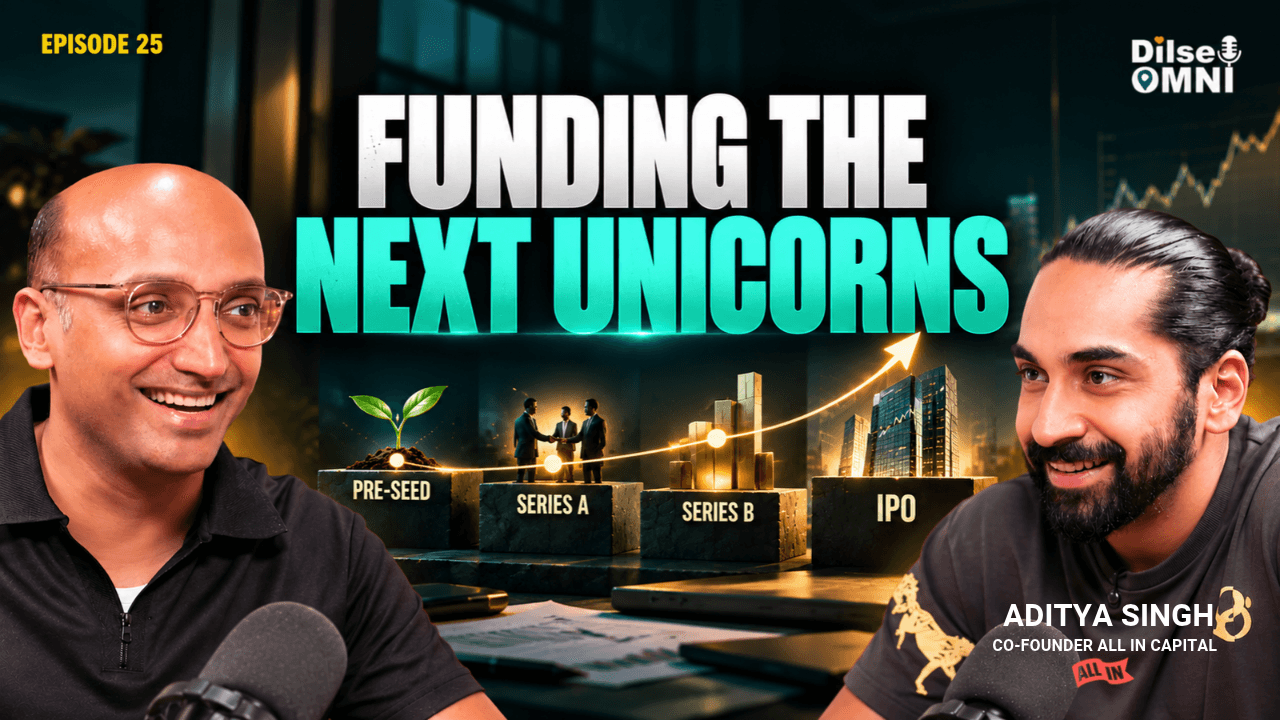
Can the channel that accelerates your brand also become the channel that squeezes it? That question stayed with me after my conversation with Aditya Singh on Dilse Omni Talks.
Aditya is the Co-Founder and Founding Partner of All In Capital, an early-stage venture capital fund investing in Indian startups. He previously built BookMyForex, worked with AWS and Stride Ventures, and backed more than 50 early-stage companies as an angel investor. He brings both the founder’s experience of building a business and the investor’s perspective on what makes one durable.
I began by asking him about premiumization. Why were so many premium consumer brands finding momentum? His answer took us beyond product positioning into distribution, marketplace economics and the uncomfortable difference between growing revenue and building a brand.
My biggest takeaway: quick commerce can solve your access problem without solving your long-term distribution strategy.
Table of Contents
1. Recognize the Wave Before Taking Credit for the Growth
2. Understand the Distribution Gap Quick Commerce Filled
3. Use the Discovery Advantage Intelligently
4. Remember That Quick Commerce Is Still a Marketplace
5. Look Beyond Sales to the Full Cost of the Channel
6. Do Not Mistake Easier Entry for Better Long-Term Economics
7. Give Each Channel a Job
Build a Brand That Can Survive Changing Rules
1. Recognize the Wave Before Taking Credit for the Growth
Aditya sees quick commerce as a powerful enabler of premiumization. His analogy was simple: the internet created the conditions for businesses such as Google, Facebook and Instagram. Quick commerce is creating a similar distribution opportunity for a generation of consumer brands.
What I appreciated was his willingness to challenge the investor success story.
He referred to brands such as MasterChow, Go Zero and The Health Factory, arguing that quick commerce had materially accelerated their growth. In his telling, some were generating ₹10 crore to ₹20 crore a month through the channel. These were examples from his discussion, not a benchmark every brand should expect.

His point was that investors should not confuse a major distribution tailwind with exceptional stock-picking ability. Aditya had invested in MasterChow before that wave emerged.
For founders, the lesson is equally important. Ask what is driving your growth: product preference, easier availability, platform promotion, or some combination. Those answers matter when the economics change.
2. Understand the Distribution Gap Quick Commerce Filled
Before quick commerce, a low-ticket consumer product faced an awkward choice.
Selling directly online meant paying to acquire a customer and then paying to deliver the order. Aditya used illustrative figures of ₹500 customer acquisition cost and ₹50 shipping to explain why low average order value, or AOV, could make the model difficult.
These are not universal costs or a fixed ₹500 viability threshold. They illustrate the pressure: when the basket is small, acquisition and delivery can consume too much of its value.

The alternative was offline distribution. But that required working capital, distributors and marketing investment before a young brand had much certainty about demand.
There was also a broken connection between discovery and purchase. Someone might discover a product on Instagram, but would they remember it, find a nearby shop stocking it, and make the trip?
Quick commerce shortened that journey. Discovery, availability and purchase could happen within the same app.
The Three Gaps Framework
Aditya did not give this a formal name, but I would organize his explanation into three gaps that quick commerce helped bridge:
Gap | The earlier challenge | What quick commerce enabled |
|---|---|---|
Capital | Funding inventory and waiting for collections | Initially attractive payment cycles that eased cash-flow pressure |
Distribution | Building a distributor network to reach households | Access through an existing fulfilment network |
Discovery | Connecting broad marketing with local availability | Pin-code targeting and advertising close to purchase |
This explains the excitement. Quick commerce did not merely offer faster delivery. It made a difficult route to market more accessible.
3. Use the Discovery Advantage Intelligently
One of Aditya’s strongest examples concerned launching another product to an existing customer.
In a traditional setup, a brand might advertise widely without knowing whether the right customer could find the product nearby. A quick commerce platform can connect purchase behavior, local stock and advertising much more closely.
His MasterChow example made this concrete: someone who already buys the brand is a relevant audience for its next product. Instead of advertising indiscriminately, the platform can surface that product within the shopping environment.
For me, that is the real power of the channel: it reduces the distance between creating interest and fulfilling it.
But a useful discovery engine is not the same thing as a customer relationship that the brand independently controls. That distinction became the turning point of our conversation.
4. Remember That Quick Commerce Is Still a Marketplace
“Quick is a marketplace.”
Aditya Singh
I asked whether quick commerce was fundamentally different from Amazon or Flipkart. Aditya’s answer was a reminder that delivery speed does not remove marketplace dependency.
He described how investors had historically treated Amazon-dependent brands cautiously. A business selling cups could generate substantial revenue, yet remain vulnerable to a competitor receiving better placement or visibility.

He recalled revenue multiples of roughly 1x to 2x for some marketplace-dependent businesses, then contrasted that caution with the enthusiasm surrounding quick-commerce-led brands.
I took those figures as a critique of inconsistent investment reasoning, not a valuation formula. Why discount dependence on one marketplace while celebrating dependence on another?
The founder’s test is straightforward: if the platform changes the rules, how much of the business can still stand on its own?
5. Look Beyond Sales to the Full Cost of the Channel
Aditya walked through the commercial changes he was seeing: payment cycles stretching from seven days toward a month, free listings giving way to listing fees, advertising becoming more expensive, and charges associated with inventory that does not move.
These were his observations about evolving terms, not a uniform fee schedule across every platform or brand. The underlying lesson, however, travels well: early incentives should not become permanent assumptions in your business plan.
A longer payment cycle ties up more cash. Paid visibility changes the cost of generating sales. Slow inventory can create additional expense precisely when the product is already underperforming.
The result is that a growing top line can hide worsening economics.
A Four-Part Channel Check
My practical synthesis of Aditya’s argument is to evaluate each channel through four questions:
Margin: What remains after product costs, channel fees and advertising?
Cash: How long does it take to receive payment?
Inventory: How quickly does stock sell, and what happens when it does not?
Control: How dependent are discovery and repeat purchases on platform decisions?
This is not a framework Aditya formally named. It is a way to turn his warning into a management conversation. Revenue belongs in that conversation, but it cannot be the only number.
6. Do Not Mistake Easier Entry for Better Long-Term Economics
Aditya made a deliberately provocative comparison: for a brand with comparable strength, serving 100 distributors could be cheaper than operating across 100 quick commerce locations once the relevant costs were included.
I would not turn that into a universal rule. Category, terms, stock movement and execution capability all matter. But his distinction is valuable: a channel can be easier to enter without being cheaper to operate at scale.
Offline requires work that a young company may not yet know how to do. That does not mean the work can be avoided forever.
“If you want to build a large brand, you have to go offline.”
Aditya Singh, discussing the importance of offline expansion, particularly for low-ticket FMCG brands
He was especially firm about smaller FMCG products around or below the ₹500 to ₹600 range. Quick commerce creates an opportunity, but should not automatically replace the ambition to build broader distribution.
This connects closely with the question of when a D2C brand should go offline. The decision deserves a strategic answer, not simply a reaction to rising platform costs.
7. Give Each Channel a Job
Our discussion also returned to an important qualification: every category is different.
I brought up my experience at Lenskart. Eyewear involves fit, comfort, eye testing and the reassurance of trying a product. Online can create interest, while a store completes the purchase.
That is not a failure of digital commerce. It is digital doing a different job.
Likewise, offline need not mean the same model for every brand. Some businesses build distributor networks. Others open branded stores. The right choice depends on the product and the customer’s buying process.
My working model is therefore:
Online discovery: Create interest and help customers understand the product.
Quick commerce: Make relevant products convenient to discover and buy.
Offline distribution or stores: Extend availability or provide the physical experience the category needs.
The objective is not to appear everywhere. It is to make the channels work together.
Build a Brand That Can Survive Changing Rules
Near the end, Aditya described how competing products can appear even when a customer searches for a specific brand on a marketplace. The platform controls that shelf. A brand with meaningful recognition and alternative routes to purchase is less exposed than one whose entire business depends on that placement.
And, as he pointed out, platforms need to earn too. Expecting them never to monetize their position is not a strategy.
I left this conversation neither against quick commerce nor convinced that offline is automatically superior. I left with a clearer standard: use a powerful channel, understand its complete economics, and build options before dependence becomes a constraint. Our full conversation with Aditya Singh places these lessons within his wider perspective on early-stage investing and company building.
I am Saurabh Agrawal and we come with a new episode on Dilse omni talks every fortnight and cover different aspect of omnichannel with amazing speakers.