Some of the most valuable business lessons do not come from the wins. They come from the decisions that haunt you a little, the investments you passed on, the pitches you mishandled, and the assumptions that turned out to be completely wrong.
That was the honest thread running through my conversation with Arjun Vaidya on Dilse Omni Talks. Arjun is the founder of Dr Vaidya’s, the Ayurvedic wellness brand he built, scaled, and exited. Since then, he has mentored more than 1,500 entrepreneurs through GrowthSchool and his Founders for Founders initiative, appeared as a judge on Idea Baaz, and now serves as Managing Partner at V3 Ventures. At V3, he invests in consumer brands and consumer technology across wellness, beauty, sports, and D2C.
I wanted to understand what really goes on inside an investor’s mind. Why do smart investors miss companies that later become massive successes? What separates venture capital from private equity? And most importantly for early stage founders, how does one make an investor care enough to take the next meeting?
Arjun’s answers were refreshingly direct. This was not a conversation about pretending that every decision is perfect. It was about building the judgment, imagination, preparation, and resilience to make more right decisions over time.
Table of Contents
Missing Great Companies Is Part of the Job
VC Versus Private Equity: People, Potential, and Proof
The Operator Advantage, and Its Hidden Trap
The V3 Investment Framework: Founder, Market, Numbers
Five Pitching Lessons from 75 Failed Pitches
The Real Work Is Building Better Judgment
Missing Great Companies Is Part of the Job
We began with the uncomfortable question every investor gets asked: which companies did you miss?
Arjun’s response was immediate. A lot.
“Our job is about missing companies.”
It is such an important reframing. In venture capital, nobody catches every winner. There are far more opportunities than there is capital, time, or conviction. Arjun spoke openly about missing the opportunity to invest in Zepto’s first round in 2021 because he simply could not believe quick commerce could work at that scale. In his own words, it was a lack of imagination.
He also named businesses he admired but missed, including Mokobara, Pilgrim, Foxtale, Let’s Try, Miraggio, Inito, and XYXX. These were not distant ideas he never encountered. In several cases, the team had spent time with the founders and had an opportunity to invest. It just did not happen.
That is the reality of startup investing. A missed deal is not always evidence of bad judgment. Sometimes the timing is wrong. Sometimes there is insufficient conviction. Sometimes the business is beyond the investor’s present understanding. And sometimes, frankly, the investor gets it wrong.

The companies an investor misses are a reminder that access alone is never enough. Conviction and imagination matter.
But Arjun shared the more dangerous mistake: chasing a missed opportunity by investing in copycats. He recalled advice from Paula Mariwala, one of India’s pioneering venture capitalists. She had missed investing in Flipkart, then invested in three businesses that looked like the next Flipkart. All three went to zero.
“Do not make the mistake of investing in the next three things that look like Flipkart because you missed Flipkart.”
For founders, there is a lesson here too. Do not build a business simply because a category produced one breakout winner. The right question is not, “Can this become the next Zepto, Flipkart, or Mokobara?” The question is, “What is uniquely true about our customer, operating model, product, and timing?”
The same discipline applies in the omnichannel world. A brand cannot merely copy another brand’s channels or growth playbook. It must create its own reason for customers to choose, repeat, and recommend.
VC Versus Private Equity: People, Potential, and Proof
Arjun started his career in private equity as an analyst, but his present role at V3 Ventures is fundamentally different. The distinction is worth understanding, especially for founders deciding what kind of capital they actually need.
Venture capital comes in earlier. Arjun explained that V3 typically enters companies in the range of zero to ₹100 crore of annual revenue, often at the zero to ₹50 crore stage. At that point, an investor is not simply studying a mature business. They are backing an entrepreneur, an emerging P&L, early signs of product market fit, and a story that still has to be built.
Private equity generally comes later, when businesses may be doing ₹200 crore, ₹300 crore, or even ₹1,000 crore in annual revenue. At that stage, the business has considerably more proof. The focus naturally shifts toward operational performance, financial controls, profitability, and the ability to scale a known engine.
Venture Capital | Private Equity |
|---|---|
Often enters earlier, around zero to ₹100 crore in revenue | Generally enters later, at substantially larger revenue scale |
Backs founders, ideas, energy, market potential, and emerging economics | Focuses more heavily on the established business and financial performance |
Takes greater risk on people and possibility | Takes greater risk on execution certainty and financial outcomes |
Invests in dreams, narratives, and early signals | Invests in a more proven operating model |
Arjun captured the difference beautifully when he said early stage investing is about “dreams, ideas, vibes, thoughts, markets, stories, spaces, segments,” not only Excel sheets. That does not mean numbers do not matter. They do. But at an early stage, the spreadsheet cannot tell the full story because the future has not yet become visible in the data.
For founders, this means your pitch must match the stage of your company. A venture investor needs to understand why your future is plausible. A later stage investor needs to understand why your future is repeatable and financeable.
The Operator Advantage, and Its Hidden Trap
One of the strongest parts of our conversation was Arjun’s honesty about being an operator turned investor. Having built Dr Vaidya’s gives him an instinctive understanding of what founders are dealing with. He knows the messy realities behind a deck: inventory pressure, product decisions, customer acquisition, supply chain friction, team problems, and the emotional roller coaster of building a business.
That experience can make an investor ask sharper questions and build rapport faster. But it can also become a trap.
Arjun is aware that his own operating history only extends to a certain scale. He built a business to around ₹100 crore, but that does not mean he has personally run a ₹1,000 crore business. If he lets his past experience define what is possible, he may underestimate founders who can imagine and execute at a much larger level.
“I have to stop my experience from clouding my judgment.”
This is the Zepto lesson again. Past experience can give you pattern recognition, but it can also make you reject new patterns because they do not fit the old ones.
That is why founders need to develop the ability to explain what looks improbable at first glance. A great entrepreneur does not get frustrated merely because someone does not immediately understand the vision. They make the vision legible through evidence, insight, and a clear operating narrative.
For an additional perspective on what backers seek beyond financial projections, I recommend reading the first thing investors look for before they invest.
The V3 Investment Framework: Founder, Market, Numbers
When I asked Arjun for his investment framework, he gave one of the clearest answers of the conversation. Investing may involve gut instinct, but it should be an information backed gut instinct. And for that gut to work, the mind needs to be clear.
His decision framework is built around three dimensions:
Founder: 50%
Market: 20%
Numbers: 30%

Arjun’s investing lens starts with the founder, then tests market headroom and business fundamentals.
1. Founder: 50%
Half the decision comes down to the founder. Who are they? Why do they have the right to win? What gives them an unfair understanding of the customer, category, or problem? And when things become difficult, why will they keep fighting?
This matters because businesses change. The market changes. The first product may not work. Channels may become expensive. Competitors arrive. The founder is the person expected to absorb all of that uncertainty and keep making good decisions.
2. Market: 20%
Then comes the market. Can the category support the growth rate the company needs? Is it large enough to support 100 percent year on year growth? A great founder can still be limited by a small market or a market where consumer behavior is too difficult to change.
For consumer and D2C companies, market evaluation should include category frequency, repeat behavior, price points, consumer willingness to switch, and how distribution can expand across online and offline touchpoints. The broader transition to connected brand experiences is explored in why every brand in India is moving toward omnichannel growth.
3. Numbers: 30%
Finally, numbers. Arjun looks at revenue, gross margin, bottom line profile, repeat rates, lifetime value, and team. These metrics provide reality checks. A compelling story should be supported by signals that customers are actually responding and that the economics have the potential to improve with scale.
The masterclass is simple: founder strength creates belief, market size creates possibility, and numbers create evidence.
Five Pitching Lessons from 75 Failed Pitches
Arjun has learned from 75 pitches that did not work. That experience led to advice every founder should put into practice before sending the next deck or walking into the next investor meeting.
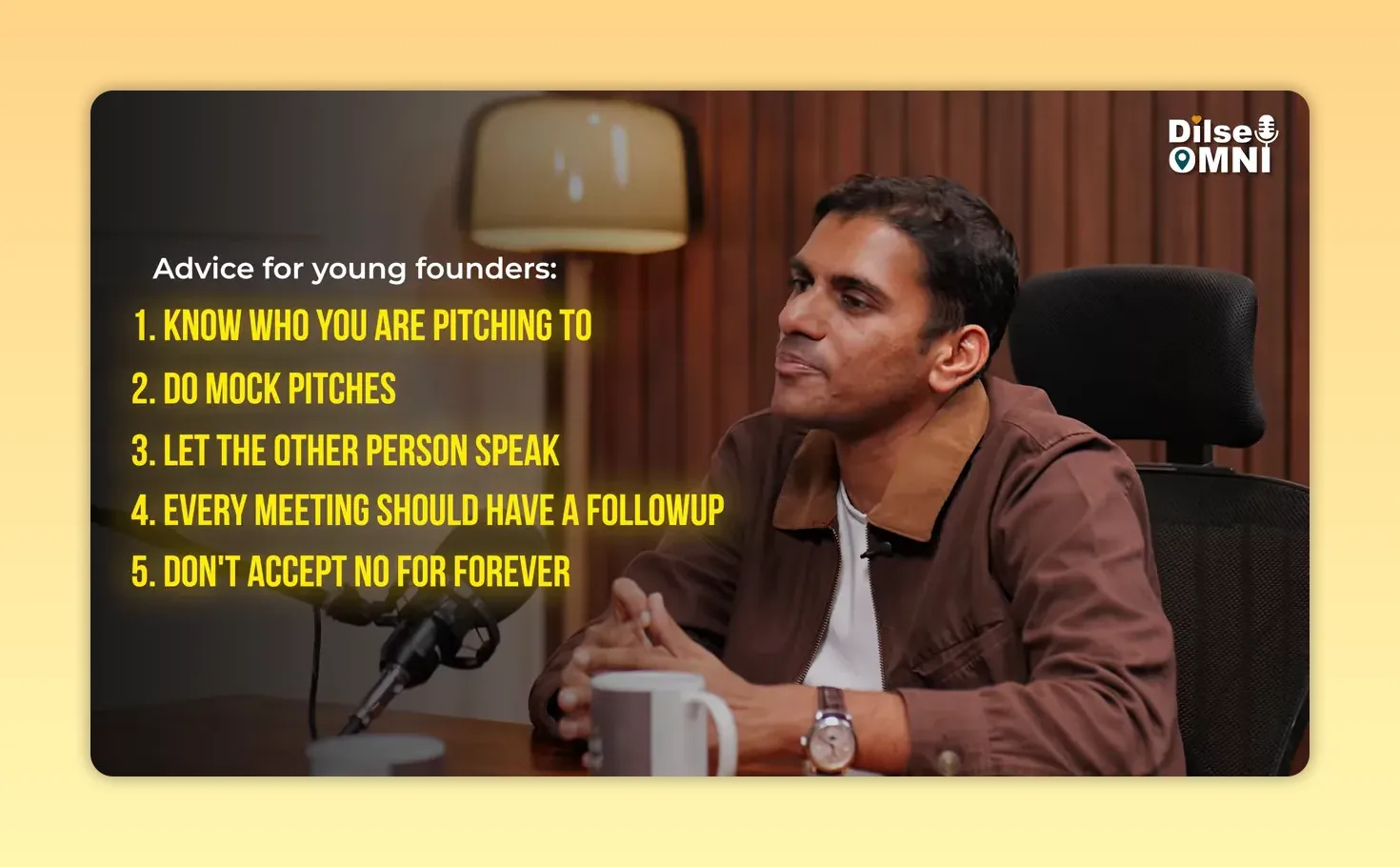
A strong pitch is personal, rehearsed, conversational, followed up, and persistent.
1. Know Who You Are Pitching To
The generic “Dear Sir/Ma’am” email is an easy way to lose attention. Research the person and the fund. Understand their portfolio, category interests, personal context, and point of view.
Arjun put it simply: if someone refers to something genuinely relevant to him, whether it is his daughter, Mumbai Indians, fitness, padel, or pickleball, they have his attention. This is not about artificial flattery. It is about doing the work to understand who sits across the table.
Personalisation signals effort. And effort is a proxy for how seriously a founder may approach everything else.
2. Do Mock Pitches Before the Real One
Founders often spend all their time polishing slides but not enough time practicing the actual conversation. A mock pitch helps identify unclear claims, weak logic, unnecessary jargon, and questions that will inevitably come up.
It also helps founders avoid two common reactions under pressure: becoming defensive or becoming overaggressive. The best response to a difficult question is neither panic nor performance. It is calm clarity.
3. Make It a Dialogue, Not a Monologue
This was one of Arjun’s strongest points. If you have a 45 minute meeting and speak for 43 minutes, the other person is likely disengaged. A pitch is not a presentation competition. It is a conversation designed to test thinking from both sides.
Pause. Ask whether the investor wants to go deeper into an area. Invite questions. Listen carefully to objections, because they show you where belief is breaking.
“Make every conversation a dialogue, not a monologue.”
4. Every Meeting Needs a Follow Up
A meeting should not end vaguely. Close with a clear next step: What information is needed? When should you reach out again? Is there a specific concern to address? What would make the opportunity more compelling?
Whether the response is good, bad, or ugly, clarity is more valuable than ambiguity. A disciplined follow up also demonstrates that you can drive a process, an important quality in any founder.
5. Do Not Treat No as No Forever
This is not permission to harass investors or ignore feedback. It is a reminder to understand the reason behind a rejection. If the reason is valid, can you come back with data, progress, or a sharper answer?
Arjun shared the example of Hosteller. He said no to founder Pranav three times. But Pranav did not respond with frustration. Each time, he came back asking for the specific concern and offering data that could address it. Eventually, Arjun took the risk. Hosteller went on to become the country’s largest backpacking hostel chain and raised ₹100 crore.
The important distinction is persistence with substance. A founder should not say, “That is not good enough for me.” Instead, they should say, “Help me understand what would make this investable, and here is the evidence that addresses your concern.”
The Real Work Is Building Better Judgment
My biggest takeaway from this conversation is that founders and investors are both in the business of judgment under uncertainty. Investors must choose which dreams to back. Founders must choose which feedback to use, which obstacles to fight through, and when to return after hearing no.
There will always be missed opportunities. There will be businesses that look impossible until they are not. There will be pitches that fail before the right one lands. The goal is not to eliminate mistakes. It is to avoid repeating the same mistake through ego, fear, imitation, or a lack of preparation.
Build the imagination to see new possibilities. Build the rigor to test them. Build the humility to learn from a rejection. And build the resilience to return with proof.
I am Saurabh Agrawal and we come with a new episode on Dilse Omni Talks every fortnight and cover different aspect of omnichannel with amazing speakers.