I have asked many operators, founders, and investors some version of the same question: when a startup is pitching, what really separates the maybes from the yeses?
When I put this to Sanjeev Bikhchandani on Dilse Omni Talks, his answer was refreshingly simple and deeply important. He did not begin with slide design, storytelling hacks, or valuation math. He began with the founder.
"Quality of founder and team, their commitment, their capabilities, their integrity. That's important, really important."
That line stayed with me because it cuts through the noise. In startup conversations, people often want a clever framework that makes investing feel mechanical. But Sanjeev brought it back to first principles. Before markets, before metrics, before the grand promise of scale, there is a person. And that person is building the company.
Table of Contents
The founder comes first
Solve a real problem
The "Right to Win" framework
Why investors study founders
The founder comes first
If I had to reduce Sanjeev's lens into one sentence, it would be this: investors are not only evaluating a business, they are evaluating the human being who will carry that business through uncertainty.
That means a founder is never being assessed on one trait alone. The real filter is a combination of qualities:
Commitment to stay with the problem long enough
Capability to build, adapt, and execute
Integrity to be trusted when things get hard
Team quality because no meaningful company is built alone
This matters because startups do not unfold in a straight line. The original idea changes. The market teaches you things you did not expect. Customers behave differently from what the spreadsheet assumed. A founder with shallow conviction or weak character often breaks before the model does.
And that is where Sanjeev's experience comes through. He is not trying to find the most polished founder in the room. He is trying to understand whether this is the right person to back over a long period of time.
"The founder often matters more than the idea."
That may sound counterintuitive, especially to first-time founders who spend months obsessing over the deck. But if an idea will evolve, then what remains constant? The founder's judgment. The founder's values. The founder's ability to learn. The founder's stamina.
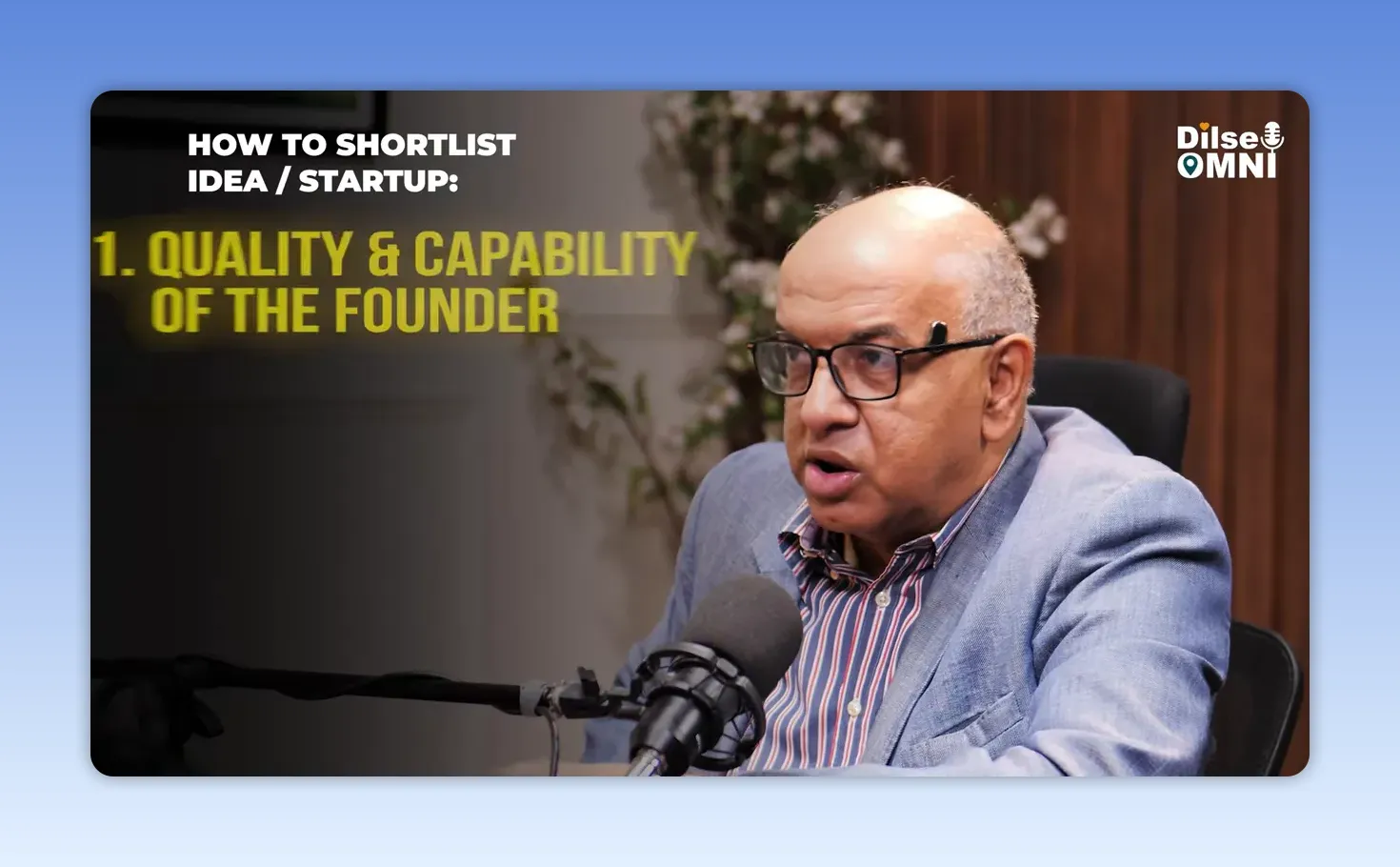
The first screen worth remembering says it plainly: founder quality and capability come before everything else.
I also took away something subtler from this conversation. Founder quality is not a branding exercise. It reveals itself in how someone thinks, how honestly they answer, what tradeoffs they have made, and whether they understand the burden of building.
There is a temptation in startup culture to romanticize certainty. But serious investors are often looking for something more grounded: clarity without arrogance, ambition without fantasy, and confidence without performance.
That is why this first filter is so powerful. It is not only about whether the founder can start. It is about whether the founder can last.
Solve a real problem
The second principle Sanjeev shared is one of those ideas that sounds obvious until you realize how often it is ignored.
"Are they solving an unsolved problem?"
That question is sharper than it first appears. A lot of startups do not fail because the market is too small. They fail because they are entering a crowded race with no real reason to win.
Sanjeev's point was direct: if twenty people are already doing the same thing, why should this one succeed more than the others? Unless there is a genuinely differentiated insight, superior execution path, or structural advantage, the odds are not great.
That is why "real problem" is a better phrase than "big idea." A real problem has pain attached to it. It has urgency. It has unmet need. It has room for value creation. And crucially, it is not already being solved well enough by many others.
This is where founders often confuse activity with originality. A category may be hot. Capital may be flowing. Everyone may be talking about the same trend. But a fashionable sector is not the same thing as an unsolved problem.
When I reflect on what Sanjeev said, I see three tests hidden inside that one principle:
Is the problem real? Is there actual pain, or just a nice-to-have concept?
Is it unsolved? Are existing options failing users in a meaningful way?
Is this founder uniquely positioned to solve it? Insight without fit is still weak.
This is also where first-mover advantage gets discussed with more nuance than usual. Sanjeev was not saying that being first automatically guarantees success. He was saying that if you are early and solving something genuinely unresolved, your chances improve because you may have the first credible claim to that space.
"If you're a first mover and you're solving an unsolved problem, you have a higher chance of success."
That is a very different statement from startup mythology. It is not hype. It is probability.
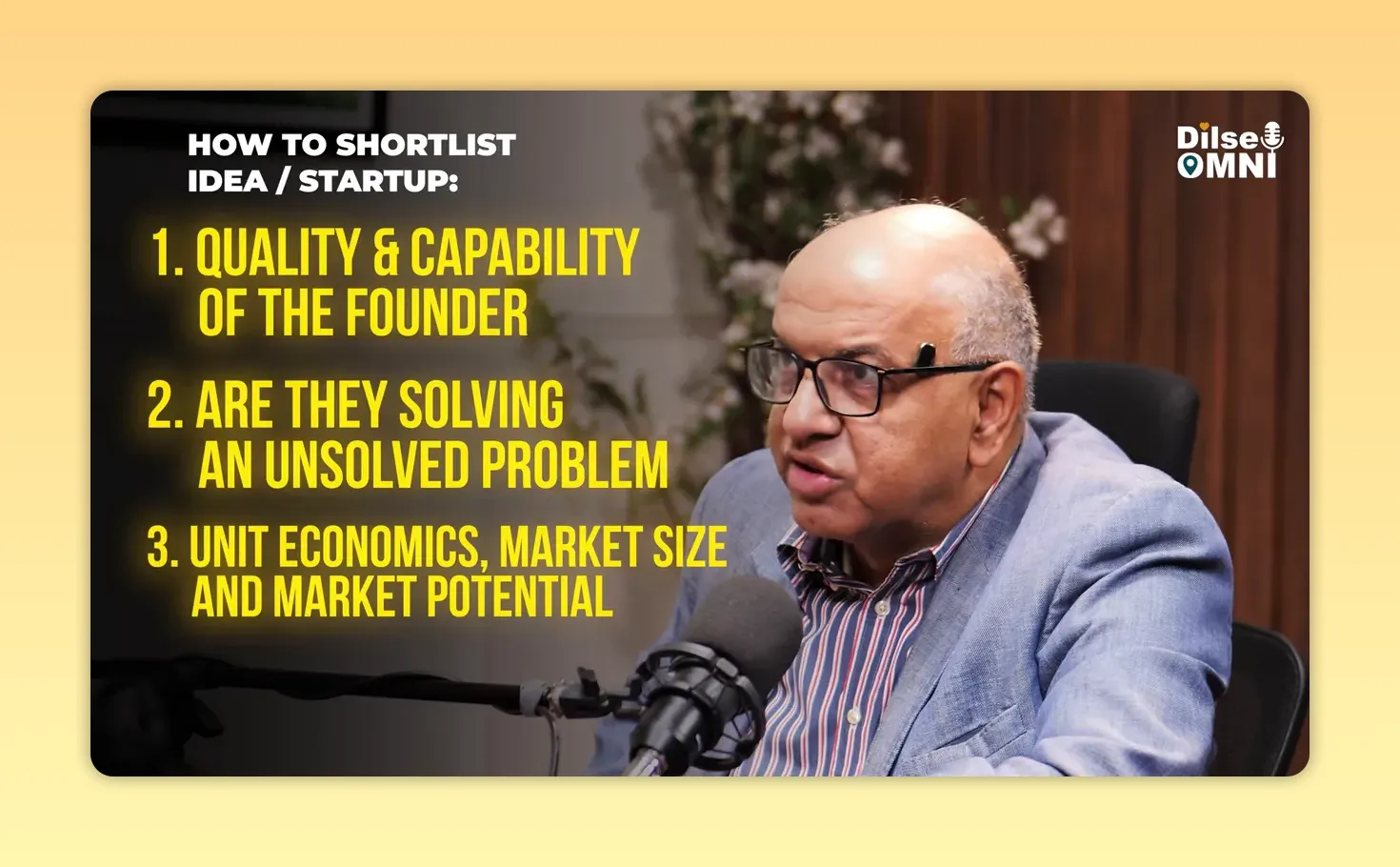
Once the founder and the problem pass the test, the rest of the business starts to matter in a more meaningful way.
Only after that does the broader business stack come into focus: unit economics, market size, market potential, industry structure, market power, intellectual property, and network effects. These are essential, but they come after the foundational question of whether the company is addressing something that genuinely needs solving.
I think that ordering matters a lot. Many founders want to lead with TAM, growth curves, and category slides. But if the core problem is weak or already saturated, the rest becomes decoration.
The "Right to Win" framework
The phrase that stood out most in our conversation was this one: the right to win.
It is one of those phrases that can instantly improve how founders think about their own business. Not just, "Can this market become large?" but, "Why should we win in this market?"
"So basically, do you have the right to win or no?"
That is a brutal question, and a necessary one.
Here is the simple masterclass version of the framework I took away from Sanjeev's thinking:
A simple Right to Win checklist
Founder advantage
Does the founder have unusual insight, credibility, obsession, or lived experience in the problem space?Problem advantage
Is the startup attacking a problem that is genuinely under-served or unsolved?Timing advantage
Is the market ready enough for adoption, but early enough that a strong player can still define the category?Business advantage
Do the unit economics, market structure, and customer behavior support a durable company?Defensibility advantage
Can the company build some moat through IP, network effects, trust, distribution, or execution speed?
If the answer to most of these is vague, then the startup may have an interesting concept but not a convincing case.
If the answer is strong, then the conversation changes. Investors are no longer just hearing a pitch. They are seeing a path.
What I appreciate in this framework is that it protects founders from lazy optimism. It forces a startup to explain its advantage in concrete terms. Not ambition. Not buzzwords. Not "the market is huge." A right to win.
And there is another lesson tucked inside this. A lot of companies spend too much time trying to sound unique and too little time becoming meaningfully unique. The right to win is earned through clarity, focus, and compounding strengths.
So when founders prepare for investors, this is one of the most useful exercises they can do:
Write down the top five reasons you think you will win.
Then ask which of those reasons a skeptical investor would actually believe.
Then ask what evidence supports each one.
That process alone can sharpen strategy.
It can also expose wishful thinking early, which is far better than discovering it after raising money and burning through it.
Why investors study founders
The final part of the conversation may be the most useful for anyone preparing to raise capital, because Sanjeev explained not only what he looks for, but how he looks for it.
He does not begin by interrogating the spreadsheet line by line. He starts by understanding the person.
"We like to get to know the person first. It's important to know the person."
That struck me because many founders assume investor meetings are mainly about correct answers. But often, they are about revealing patterns.
Sanjeev described a process that feels almost like building a mosaic. You ask the founder to tell their story. Where do they come from? What do they want to do? How have they reached this point? What is their family background? What brought them here?
Each answer, by itself, may seem ordinary. Together, they create a picture.
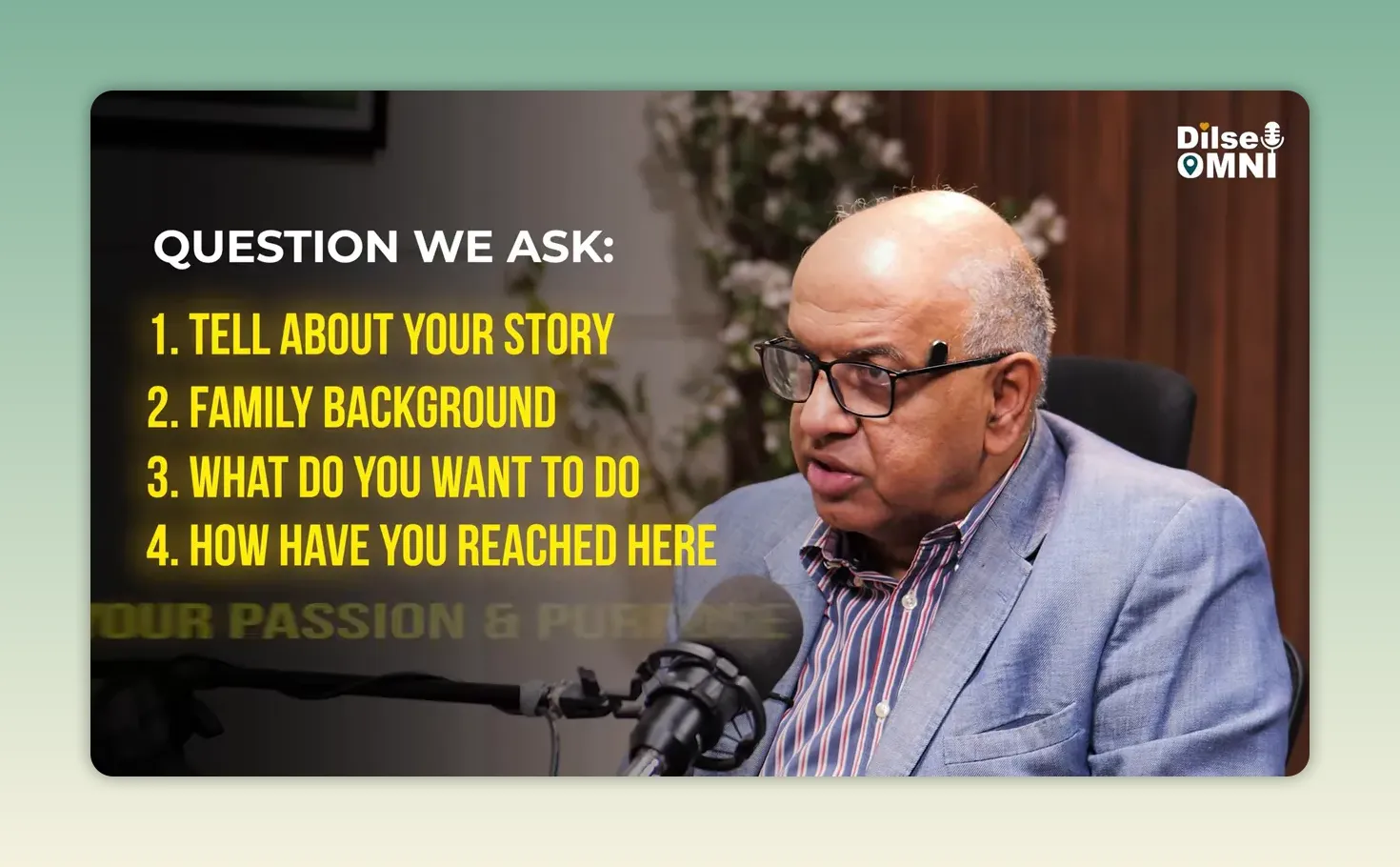
Great investor questions do not only probe the business. They reveal the person behind the business.
The questions themselves are deceptively simple:
Tell us about your story
Tell us about your family
What do you want to do?
How have you reached here?
What is your passion and purpose?
These are not soft questions. They are diagnostic questions.
From the answers, an experienced investor can infer resilience, self-awareness, ambition, honesty, motivation, and depth of conviction. They can understand whether the founder is borrowing a trend or pursuing a mission.
And then comes the second layer. Once the person begins to come into focus, the questioning branches into the business. Why this market? Why now? How does this work? What assumptions are hidden underneath? Where are the weak points?
This sequencing is important.
First understand the person. Then probe the business in detail.
That is how better questions lead to better judgment.
I also liked the distinction between classical questions and intelligent questions. Classical questions cover the basics. Intelligent questions test fit. They help answer the deeper investor question: is this the right person to back on this journey?
For founders, there is a practical lesson here. Do not treat your own story as a side note. If your story explains your commitment, your insight, or your endurance, it is central to the investment case.
Not because investors want sentiment. Because they want signal.
The more I sit with this conversation, the more I believe this is the real masterclass. Startup evaluation is not magic. It is disciplined pattern recognition anchored in a few timeless principles:
Back people with character and capability
Prefer real, unsolved problems
Ask whether the startup has the right to win
Study the founder before over-indexing on the deck
Those principles sound simple because the best principles usually do. But they are not easy. They require patience, judgment, and honesty from both sides of the table.
For me, this conversation with Sanjeev Bikhchandani reinforced something I have seen repeatedly in business and omnichannel growth: sustainable outcomes do not come from cleverness alone. They come from clarity. From knowing what problem matters, why you matter to that problem, and whether you have built the substance to deserve the opportunity.
That is as true for a startup raising capital as it is for any business trying to build for the long term.
"Knowing the person is key before we know the idea."
That may be the line to carry forward.
I am Saurabh Agrawal and we come with a new episode on Dilse Omni Talks every forthnight and cover diffsrent aspect of omnichannel with amazing speakers.
This article was created from the learnings from the video The First Thing Investors Look for Before They Invest | Sanjeev Bikhchandani.