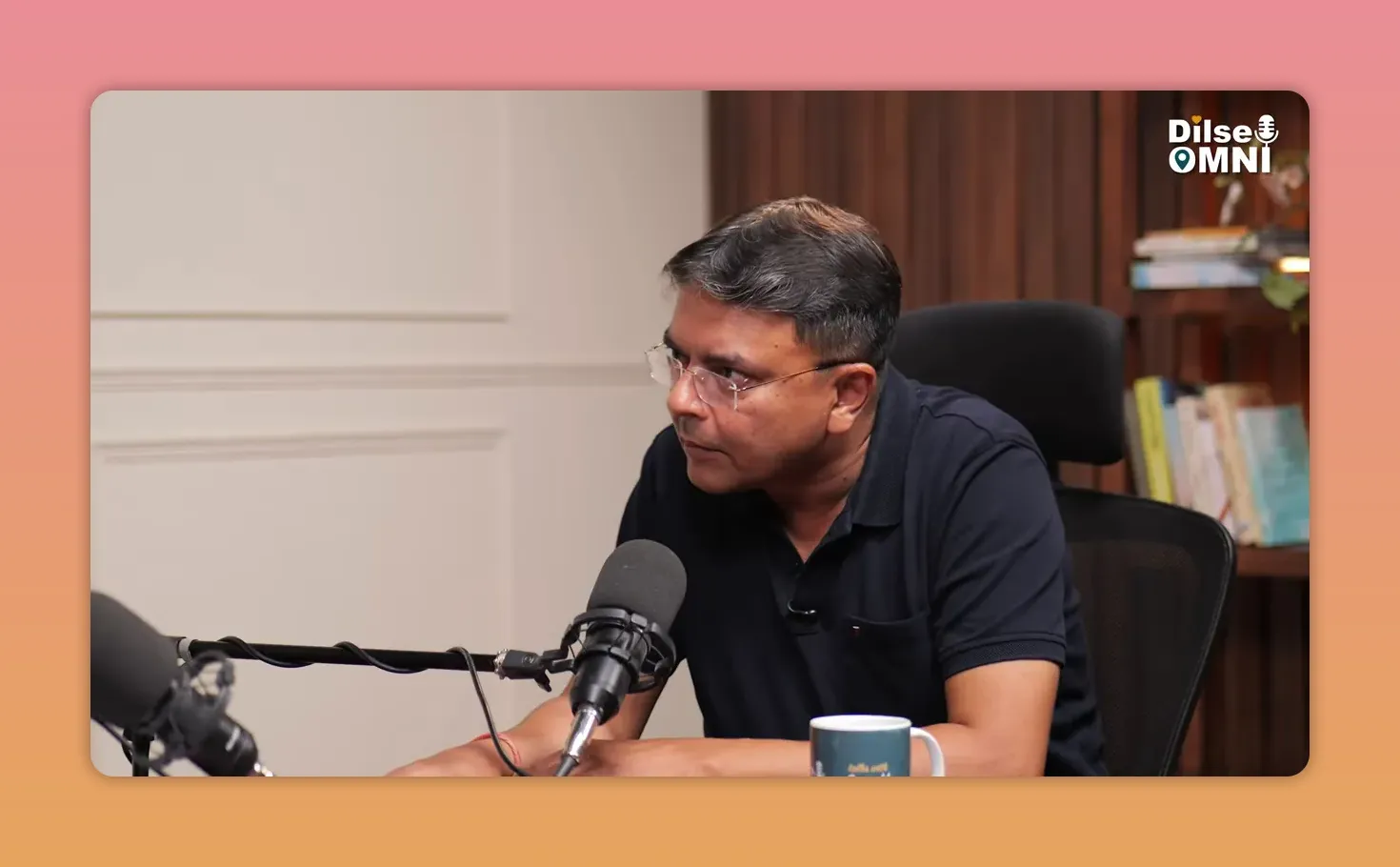
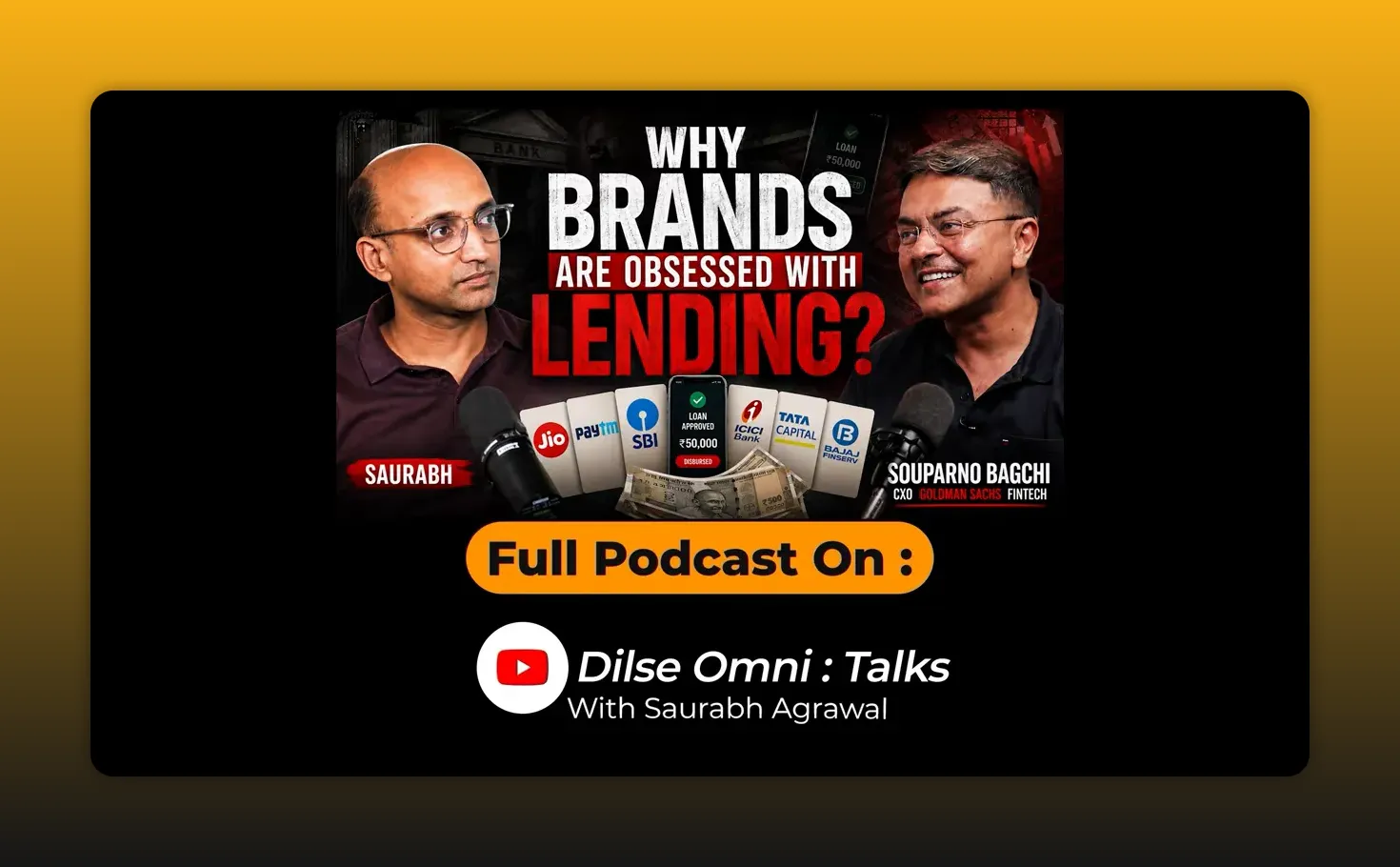
When I sat down with Souparno Bagchi on Dilse Omni Talks, one question stayed with me: if India has brought so many people into banking, what should financial inclusion deliver next?
Souparno brings a valuable combination of perspectives. His career includes nearly nine years at TCS, more than six years at Goldman Sachs, consulting, and then building and scaling micro-lending businesses in the startup world. He is an ISB alumnus who also teaches there. His father spent 32 years in banking, giving him a personal connection to the profession long before his own career began.
Today, his work sits at the intersection of AI, risk, and India’s credit divide. But the lesson I took from our conversation was not about a particular technology. It was about distinguishing access to the financial system from the ability to participate meaningfully in it.
That distinction helps explain why wealth and investment could become an important next opportunity for Indian FinTech.
Table of Contents
1. A Bank Account Is the Beginning, Not the Finish Line
2. Why Wealth Could Be the Next FinTech Opportunity
3. A Simple Framework: Access, Payments, Credit, Wealth
4. Formal Lending Is Still a First-Generation Story
5. A Billion Mobile Users Is Not a Billion App Customers
6. Feature Phones Still Belong in the Innovation Conversation
7. India 1, India 2, India 3: Replace Averages with Cohorts
The Next Boom Will Depend on Who Can Participate
1. A Bank Account Is the Beginning, Not the Finish Line
Souparno put the scale of progress into perspective with a rough estimate: almost 90% of India now has banking access, supported by efforts such as Jan Dhan. We discussed this in terms of roughly 100 crore people having bank accounts.
These were conversational estimates, not a statistical reconciliation of account ownership. Their purpose was to establish the larger point: the foundation has changed substantially over the past decade.
For a financial services business, that matters enormously. Without an account or the appropriate device, a customer may not even be reachable through the service being built. Before discussing customer acquisition or product adoption, there has to be a practical route into the system.
But Souparno described account ownership as a frontline indicator. I found that framing useful. It tells us something important about access without telling us everything about usage.
A bank account does not, by itself, establish whether someone borrows formally, uses an investment platform, or can access an app-based financial product.
The next question is therefore not simply how many accounts exist. It is what those accounts enable people to do.
2. Why Wealth Could Be the Next FinTech Opportunity
Once basic banking access expands, the conversation naturally moves towards brokerage, wealth, and investment solutions. Souparno sees this as a potentially significant opportunity, while retaining an important qualification: headline numbers do not reveal the entire serviceable market.
That qualification makes his argument stronger. He was not suggesting that every bank account holder is immediately ready for every investment product. He was asking us to recognise that the foundation for a broader range of financial services is now in place.
For me, this shifts the strategic question from “How large is India?” to “Which customers can we serve next, and what are they aspiring to do?”
Wealth is not one uniform requirement. The opportunity depends on the cohort, its aspirations, and its ability to access the service. A large national population is a starting point for analysis, not a substitute for it.
This connects with the broader question of who will own the customer relationship in the future of banking. Infrastructure creates access, but businesses still have to turn that access into something useful for a particular customer.
3. A Simple Framework: Access, Payments, Credit, Wealth
I found it helpful to organise the discussion into four layers. This is my synthesis of the conversation, not a formal model Souparno presented.
Access → Payments → Credit → Wealth
Layer | What it represents | The question for a business |
|---|---|---|
Access | An entry point into formal finance through banking and connectivity. | Can this customer reach our service? |
Payments | The ability to transact using an accessible payment instrument. | Can this customer actually complete a transaction? |
Credit | Participation in formal borrowing and the development of credit history. | What financial history exists for this customer? |
Wealth | Access to brokerage, investment, and wealth solutions. | Which aspiration can we meaningfully serve? |
This is not a compulsory sequence for every individual. Someone does not need to borrow before investing. The framework is useful because it separates different kinds of participation rather than grouping them all under “financial inclusion.”
It also prevents a common strategic mistake: assuming that progress at one layer means the next layer is already solved.
4. Formal Lending Is Still a First-Generation Story
When our discussion turned to lending, Souparno added historical context that changed how I interpreted the remaining gap.
“In India formal lending is a first generation story.”
Souparno Bagchi
His point was not that bank lending did not exist earlier. It was that the broader ecosystem of credit bureaus, recorded borrowing histories, and more systematic participation is relatively young. He placed that development in a roughly two-decade context.
I responded by pointing to India’s long history of informal borrowing. Souparno added that even earlier bank lending was often more selective and relationship-led, rather than the broad ecosystem we are discussing today.
That context matters when interpreting credit penetration. A substantial number of adults remain outside formal lending, but it is also important to recognise how recently the supporting ecosystem has developed.
The numerical estimates in our exchange touched on different notions of borrowing engagement and credit history. I would not collapse those into one definitive penetration figure. The clearer takeaway is that having a bank account and having an established formal credit history are different things.
As a host, I found this a useful reminder: a gap can represent unfinished work and meaningful progress at the same time.
5. A Billion Mobile Users Is Not a Billion App Customers
The next distinction was just as important for anyone building a digital business.
Souparno discussed India’s mobile user base as being above a billion, while estimating smartphone users at roughly 650 million to 700 million at the time of our conversation.
These are approximate figures, but the strategic lesson is clear: mobile access and smartphone access are not interchangeable.
Many banking and FinTech solutions are built around apps. Their journeys assume the customer has a smartphone. Yet the broader mobile population includes a substantial feature-phone segment.
During our exchange, I added another requirement: the customer also needs a usable payment instrument. The device alone does not complete the picture.
This is where an impressive market-size slide can become misleading. A person can be included in the national mobile count and still be outside the practical reach of a particular app-based service.
The serviceability filter
My practical interpretation of Souparno’s argument is to apply three checks before calling someone an addressable customer:
Banking access: Does the person have the account access the service requires?
Device compatibility: Can their phone support the experience being designed?
Transaction capability: Do they have an appropriate payment instrument?
Each check narrows the gap between a theoretical market and a serviceable one. This is not about making the opportunity look smaller. It is about understanding what must be built to make it real.
6. Feature Phones Still Belong in the Innovation Conversation
Souparno was enthusiastic about businesses building for feature phones. In his rough framing, these devices still represented around 30% to 40% of mobile users.
That is too significant a segment to dismiss simply because smartphone apps dominate product discussions.
The lesson I took was straightforward: a business can exclude customers through its design choices before it ever begins marketing to them.
If the service assumes a smartphone, the feature-phone customer is not merely difficult to acquire. The service may not be accessible to them at all.
This is also an omnichannel lesson. The right starting point is the customer’s actual access conditions, not the channel the business finds most convenient. Our discussion of what changed in India’s financial infrastructure provides related context for separating the underlying system from the customer experience built on top of it.
7. India 1, India 2, India 3: Replace Averages with Cohorts
“India cannot be a monolith in any ways.”
Souparno Bagchi
This was the thread connecting the entire discussion. Souparno referred to India 1, India 2, and India 3 as a way to recognise different customer cohorts and aspirations. He placed India 1 at roughly 15 crore to 16 crore people in this exchange.
He did not establish detailed definitions for all three groups here, so I would avoid turning those labels into rigid categories.
What matters is the discipline behind them: do not assume the same access, device, financial history, or aspiration across the country.
For a wealth business, that means identifying the cohort before designing the proposition. For a lending business, it means understanding the customer’s relationship with formal credit. For an omnichannel business, it means asking whether the chosen experience can actually reach the intended person.
The Next Boom Will Depend on Who Can Participate
I came away from this conversation with a more precise way to think about India’s FinTech opportunity.
Banking access has expanded. Formal credit has developed substantially within a relatively young ecosystem. Wealth and investment could be an important next frontier. But none of those opportunities can be understood through national totals alone.
The real work is connecting access, capability, and aspiration for a specific customer.
That is what made Souparno’s perspective valuable to me. He acknowledged the scale of India’s progress without treating inclusion as complete. And he pointed towards the next opportunity without assuming that one product or one channel could serve everyone.
I am Saurabh Agrawal and we come with a new episode on Dilse omni talks every fortnight and cover different aspect of omnichannel with amazing speakers.