What happens when you put ₹10 lakh worth of products into the market and ₹9 lakh comes back? For Arjun Vaidya, it became a lesson in knowing when to stop.
I sat down with Arjun on Dilse Omni Talks to understand how that experience shaped his thinking about building consumer brands. He founded and scaled Dr. Vaidya’s, an Ayurvedic wellness brand, before its exit. Since then, he has mentored more than 1,500 entrepreneurs through GrowthSchool and his Founders for Founders initiative, appeared as a judge on Idea Baaz, and become Managing Partner at V3 Ventures, investing in consumer brands and consumer technology.
What interested me was the combination of those perspectives. A founder experiences the consequences of a decision. A mentor sees similar problems across businesses. An investor has to decide which founders and markets deserve conviction.
Our conversation brought those lenses together into a masterclass on a deceptively simple question: Are you building around a channel, or around the customer?
Table of Contents
From Building One Brand to Learning Across Many
Arjun’s Investment Framework: 50% Founder, 20% Market, 30% Numbers
Quick Commerce and the Cost of Limited Imagination
The Metric Founders Underappreciate: Non-Paid Revenue Share
The Bigger Lesson: Conviction Without Rigidity
The ₹10 Lakh Lesson: Distribution Is Not Demand
Arjun launched Dr. Vaidya’s in October 2016 with an event at Taj Lands End. He signed six distributors and introduced three products through offline distribution. About ₹10 lakh worth of stock entered the market.
On paper, that looked like a beginning. There were distributors, purchase orders and products moving out.
Then came the collection cycle.
After roughly two to three months, only about ₹1 lakh worth had sold. He received approximately ₹1 lakh in payment, while ₹9 lakh worth of stock returned. What had looked like distribution progress had not translated into consumer demand.

Getting stock into distribution was not the same as getting products into customers’ hands.
This distinction matters enormously for consumer founders. Moving inventory into a channel can feel like validation. But the more meaningful question is whether that inventory moves through the channel to customers and turns into cash.
My takeaway was simple: measure the commercial outcome, not just the activity that precedes it. Distributor sign-ups and dispatches matter, but they cannot substitute for sales and collections.
Giving Up on a Channel Is Not Giving Up on the Business
Arjun’s response challenged the usual entrepreneurial advice about persistence. He described quitting offline as one of his best decisions. More strikingly, he did not present it as an elegant pivot with a fully prepared alternative. He stopped without a backup plan.
“The best decision I made was giving up on offline.”
That is uncomfortable advice in a world that celebrates never giving up. But there is a difference between commitment to a business and attachment to a particular way of building it.
The next opening came from a straightforward observation: ecommerce was growing, and there appeared to be an opportunity to build an Ayurvedic brand online. In November 2017, Dr. Vaidya’s launched its single-brand Ayurvedic products website.
The lesson is not that every struggling offline brand should move online. It is that founders need permission to stop repeating an approach that is not working. I explore that distinction further in why giving up on offline became Arjun’s best decision.
D2C Is a Philosophy, Not a Permanent Channel Choice
Arjun’s opening thought reframed the entire discussion:
“D2C is not a channel, it’s a philosophy.”
He associated that philosophy with being close to the customer, breaking new ground and being disruptive. That is a much broader idea than selling through your own website.
To me, this separates two decisions that often get mixed together. One is how you understand and serve your customer. The other is where you sell. A brand can remain customer-led while its distribution changes.
This is why omnichannel should not become a checklist of places where a brand must appear. The channels are tools. The customer relationship is the organising principle. That shift is central to D2C as a consumer-building philosophy.
A Practical Framework: Customer → Channel → Capability → Cash
Here is my synthesis of the channel lessons from Arjun’s journey. It is a discussion framework, not a formula he prescribed.
Lens | Question for the founder |
|---|---|
Customer | Does this route help us reach and serve the customer? |
Channel | Is there evidence of actual demand, beyond inventory placement? |
Capability | Do we have the expertise to operate this channel well? |
Cash | Are products selling and payments being collected? |
The sequence keeps the conversation grounded. Before asking how many channels to enter, ask what each channel contributes and what the business needs to make it work.
Why Offline Still Had a Role Later
I asked Arjun whether, as Dr. Vaidya’s scaled and he considered an exit, offline had returned to his thinking. His answer was clear: yes.
He had once believed online might have a ceiling somewhere around ₹100 crore to ₹200 crore. He also acknowledged that he had been wrong about that ceiling.
Meanwhile, the prospective acquirer already had an offline distribution footprint of about 150,000 stores and understood that business far better than he did.
These details change the interpretation of his earlier decision. He was not rejecting offline forever. He was recognising that the channel required capabilities, and another organisation already possessed them at scale.
A channel can be wrong for your business at one stage and useful at another. Timing and execution capability matter as much as ambition. Rising online customer acquisition costs may prompt the question, but they do not, by themselves, answer when a D2C brand should go offline.
From Building One Brand to Learning Across Many
Arjun’s work with more than 1,500 entrepreneurs adds another dimension to his experience. Through GrowthSchool and Founders for Founders, he has moved from solving problems inside one company to engaging with founders across businesses. His students have also reached Shark Tank India.
As someone who teaches at ISB, I brought my own belief into this part of the conversation: teaching is a two-way learning process. Explaining an idea forces you to sharpen it. Questions reveal where your assumptions need work.
His experience as a judge on Idea Baaz offered a different reminder. Entrepreneurship on television may look polished, but making it is demanding. Arjun described the work as tiring, with long production days.
For me, the connection was that neither mentoring nor judging is simply about delivering opinions. Both require attention to another founder’s context, often repeatedly and under pressure.
Arjun’s Investment Framework: 50% Founder, 20% Market, 30% Numbers
When I asked how he evaluates investments, Arjun offered a clear three-part framework.
Weight | Investment lens | Central consideration |
|---|---|---|
50% | Founder | Who is building the business? |
20% | Market | Can the market support the growth rate he seeks? |
30% | Numbers | What do the business’s numbers show? |

Arjun gives the founder half the weight in his investment decision.
The weighting is the important part. Numbers matter, but they do not stand alone. The founder receives half the decision weight, while the market must be capable of supporting the expected growth.
My interpretation is that a founder preparing for investment should make all three parts legible: the person building, the opportunity being pursued and the evidence already available. A compelling story cannot replace numbers, just as numbers cannot remove the need to understand the founder.
Quick Commerce and the Cost of Limited Imagination
One of Arjun’s most candid admissions concerned Zepto. He missed its first investment round because he did not believe the proposition could become possible. He called that a lack of imagination.
I appreciated the honesty. It is easy to explain a missed opportunity after the outcome becomes visible. It is harder to identify the limitation in your own thinking.
For me, this is a useful lens for quick commerce and other emerging consumer models. Commercial discipline remains essential. But uncertainty and impossibility are not the same thing.
The challenge is to hold two questions together: What evidence do we have today, and what might change tomorrow? Arjun’s mistake was not a reason to abandon judgement. It was a reminder to examine the assumptions behind it.
The Metric Founders Underappreciate: Non-Paid Revenue Share
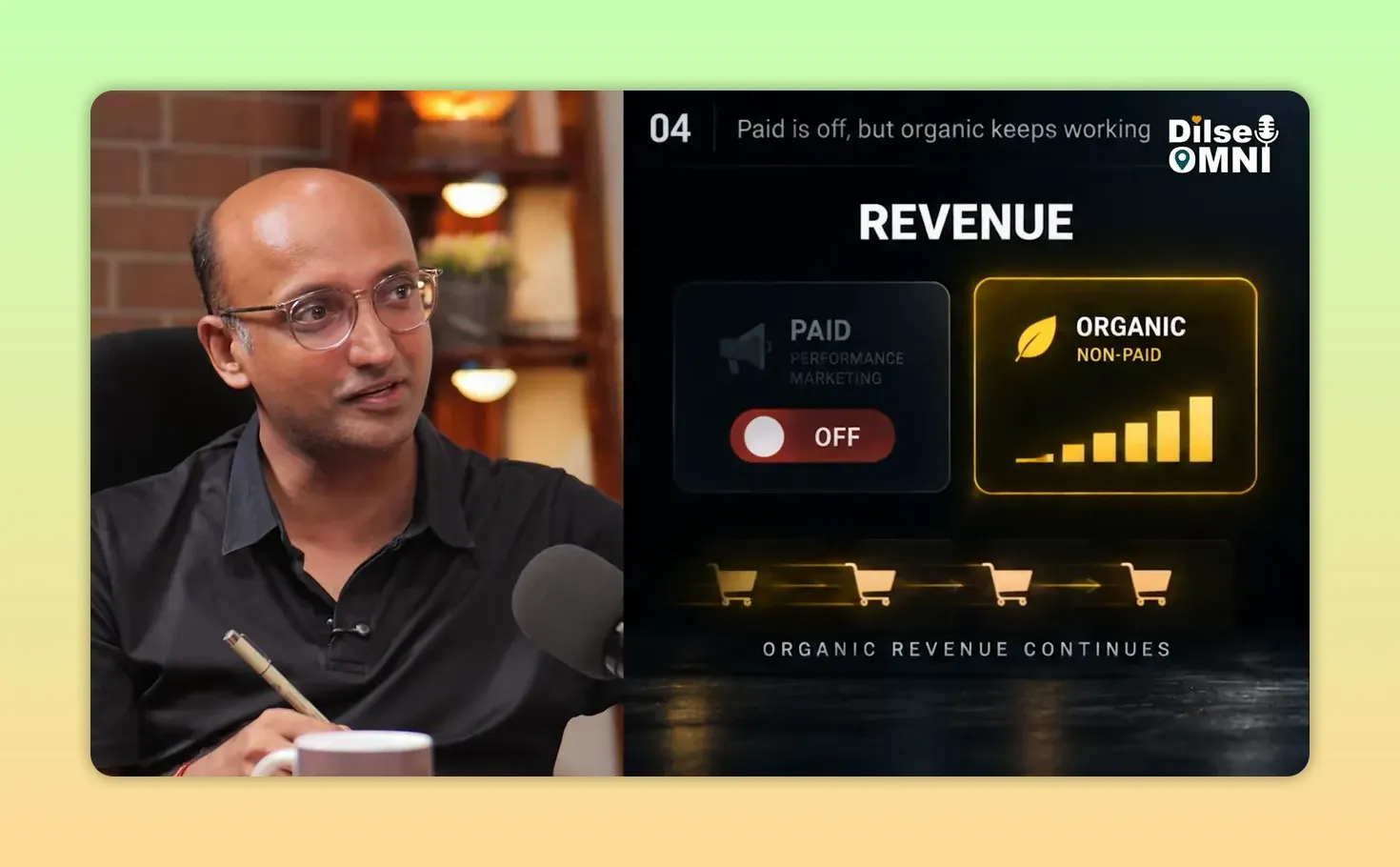
When I asked for an underrated metric, Arjun’s answer was immediate: organic, non-paid share of revenue.
I put it another way: if you switched off performance marketing, what would keep coming in?
That question cuts through a lot of growth reporting. Total revenue tells you the size of the business. Non-paid revenue share helps you examine how much demand exists without continuously paying to generate it.
A simple way to express the measure is:
Non-paid revenue share = Revenue attributed to non-paid sources ÷ Total revenue × 100
This is not an argument against performance marketing. It is a prompt to distinguish paid acquisition from the underlying strength of demand. For a founder considering another channel, that distinction is particularly valuable: expansion should not obscure what is happening in the existing business.
The Bigger Lesson: Conviction Without Rigidity
Arjun’s interests extend across sports, health and wellness, specialised beauty, men’s grooming and pet humanisation. But the strongest lesson I took away was not a category prediction.
It was a way of making decisions. Stop confusing distribution with demand. Stay close to the customer. Revisit channel choices as capabilities change. Give the founder, market and numbers their due. And leave room for a future that does not fit your current assumptions.
That is conviction without rigidity: staying committed to building a valuable business without insisting that the first route must be the final one.
I am Saurabh Agrawal and we come with a new episode on Dilse omni talks every fortnight and cover different aspect of omnichannel with amazing speakers.