When we talk about India’s fintech revolution, the conversation often becomes too simplistic. UPI arrived, QR codes became universal, and suddenly every chaiwala, fruit seller, neighbourhood store, and independent professional could accept a digital payment. The popular conclusion was obvious: UPI killed wallets.
But in my conversation with Souparno Bagchi on Dilse Omni Talks, I came away with a much more useful way to see this shift. UPI did not destroy wallets. It changed the role they played. More importantly, it transformed India’s financial rails from something broad and heavy into something granular, accessible, and deeply inclusive.
Souparno brings a rare perspective to this subject. He has spent nearly nine years at TCS, over six years at Goldman Sachs, worked in consulting, and then crossed into the startup world to build and scale micro-lending businesses. An ISB alumnus who also teaches there, Souparno has experienced Indian banking from both sides. His father spent 32 years in banking, and Souparno’s work today sits at the intersection of AI, risk, lending, and the question that really matters: who gets access to capital in India, and who still does not?
That is why this is not merely a conversation about payments. It is a masterclass in how public digital infrastructure can create the foundation for a new financial economy.
Table of Contents
The Mistake of Looking at UPI Only as a Payment Product
From Big Trucks to Two-Wheelers
Why Wallets Did Not Disappear
India Stack Was Built Layer by Layer
From Identity to Account Aggregator
What Financial Services Can Build Next
The Mistake of Looking at UPI Only as a Payment Product
Most of us in India’s metro cities experience UPI as an effortless way to pay. Scan a QR code, enter a PIN, and the transaction is done. From our perspective, it is primarily an outflow of money.
But Souparno made an important distinction. For a large part of the country, particularly what we call India 3, UPI is not only about making payments. It is about receiving money, participating in formal transactions, and becoming economically visible.
“It’s not about making a payment. Maybe you and I make payments primarily. But for India 3, UPI opened up the entire gamut for growth and opportunity.”
A bank account by itself does not guarantee inclusion. An account can exist and still remain dormant. It may have been opened for a government programme, a one-time requirement, or simply because access became possible. The account is technically there, but the individual may not actively participate in the financial system.
UPI changes that equation. When a nariyal pani seller can receive money instantly through a QR code, their bank account becomes an active commercial tool. A small merchant is no longer limited by the cash in a customer’s pocket. Every digital transaction becomes a part of an active financial identity.

For a small seller, receiving a digital payment can turn a dormant bank account into an active economic tool.
This is the deeper story of financial inclusion. It is not just about opening doors. It is about helping people walk through them repeatedly, confidently, and productively.
From Big Trucks to Two-Wheelers
Souparno’s most memorable framework was his analogy for the evolution of payment infrastructure.
Older financial infrastructure worked like a big truck. It could move value, but it was built for larger, more formal, and often more cumbersome journeys. The process was capable, but not always accessible at the smallest level of commerce.
UPI created something closer to a two-wheeler. It brought the ability to move money to a far more micro level. That matters in a country where commerce is not only conducted by large retailers, banks, and organised businesses. India runs on millions of small transactions, independent workers, local merchants, and informal businesses.
“It’s not always the trucks. The bikes do wonder.”
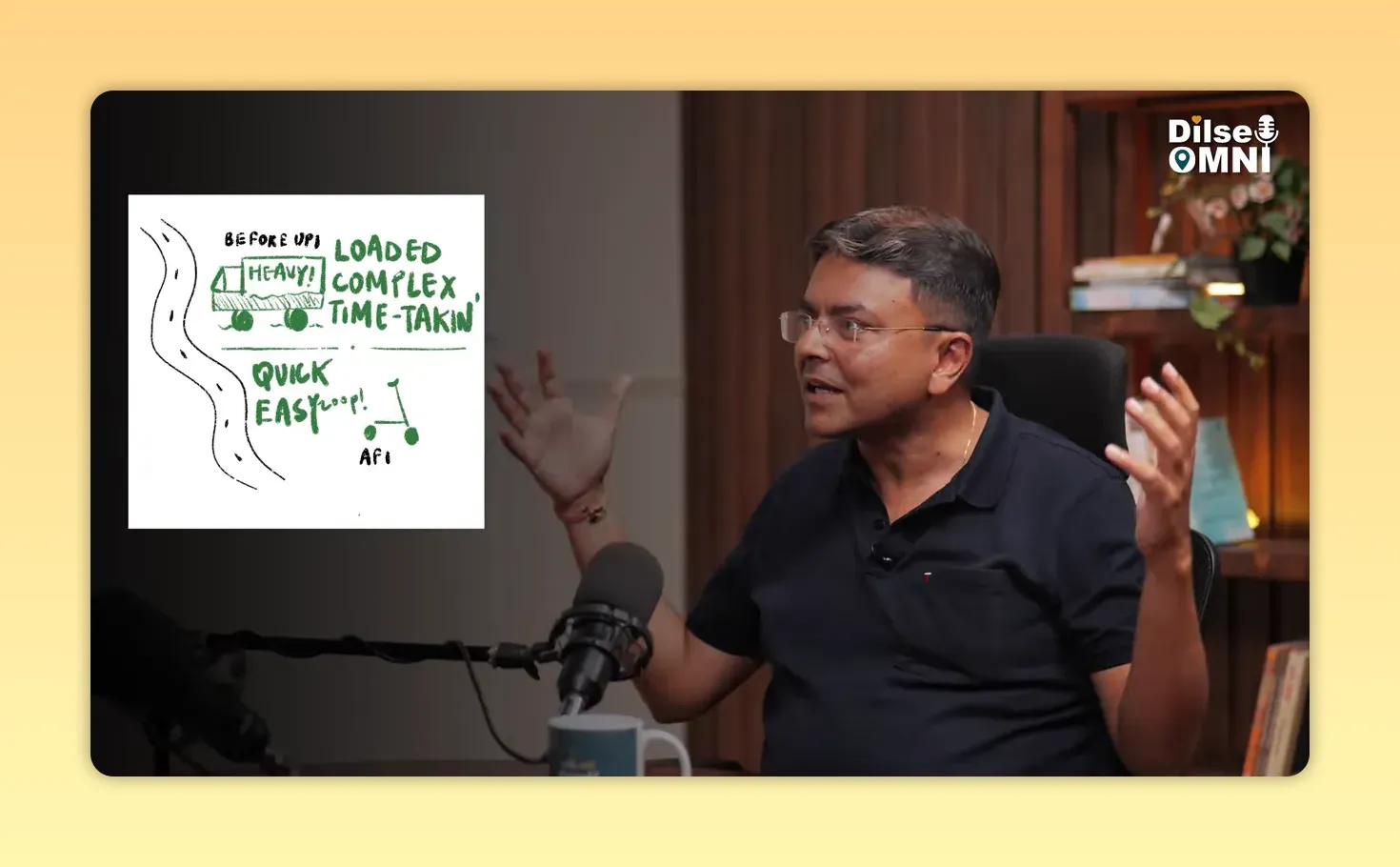
UPI made payment infrastructure lighter, more granular, and usable at the smallest points of commerce.
The lesson extends well beyond financial services. For any omnichannel business, scale is not only about building a powerful central platform. It is about making that platform useful at the edge, where a customer, partner, seller, or frontline employee actually interacts with it.
That is the same reason an omnichannel strategy needs more than a central database or a digital storefront. The real test is whether the infrastructure works smoothly in the smallest moment: a local pickup, a loyalty interaction, a payment, a customer-service conversation, or a repeat purchase. I have explored this broader shift in why every brand in India is moving toward omnichannel growth.
Why Wallets Did Not Disappear
The idea that UPI disrupted wallets completely is attractive because it creates a neat story. But it misses what actually happened.
UPI became the micro-infrastructure layer for moving money. Wallets continued to operate as an experience layer. They could still bring convenience, rewards, loyalty mechanics, offers, and a familiar interface to a customer journey.
In other words, the underlying payment rail and the customer-facing experience do not have to be the same thing.
The Infrastructure and Experience Framework
Layer 1: Foundational access
Mobile connectivity, telecom networks, and increasingly affordable smartphones.
Layer 2: Identity
Aadhaar created a scalable identity layer that could be used across financial services.
Layer 3: Transaction rail
UPI enabled low-friction, real-time, account-to-account money movement at a micro level.
Layer 4: Experience and engagement
Wallets, rewards, loyalty, merchant interfaces, and customer journeys made these rails easier and more compelling to use.
Layer 5: Consent-based financial intelligence
Account Aggregator opens the possibility of data sharing, with consent, for better financial decision-making.
This framework helps explain why wallets could pivot rather than vanish. Once UPI made the core payment action easy, the wallet’s job was no longer simply to store money. Its value could shift toward experience, engagement, and contextual financial services.
For brand leaders, it is a useful reminder: when a new infrastructure layer emerges, do not assume every existing product disappears. Ask instead, what part of the old value proposition has become a commodity, and what new layer of value can be built on top?
India Stack Was Built Layer by Layer
India did not wake up one day with UPI. The shift was the result of layers being built over time.
Souparno took us back to Aadhaar, introduced in 2009, and then to the years that followed, when mobile connectivity, smartphones, digital identity, and payment systems began to work together. Each layer increased what could be built on top of the previous one.

India’s advantage comes from interoperable layers that allow multiple financial services to be built above a common foundation.
The important word here is interoperability. A strong public digital infrastructure does not exist to create a single winner. Its purpose is to allow many organisations to build useful products and services on common rails.
That is why India’s opportunity may be bigger than any individual fintech company. A common infrastructure can support banks, NBFCs, micro-lenders, merchants, consumer apps, and entirely new financial models that have not yet been imagined.
For those thinking about the future of financial services, this is also why the line between fintech, banking, retail, and customer experience is increasingly blurred. The customer does not think in industry categories. They think about whether money can move, whether credit is available, and whether the process is simple enough to trust.
From Identity to Account Aggregator
The early focus of India’s digital public infrastructure was identity. Aadhaar created a means of identifying individuals at scale, which could then be leveraged for financial purposes.
The next layer is about making financial information more usable, with consent. This is where Account Aggregator becomes significant.
Account Aggregator is not just another fintech buzzword. It points toward a financial ecosystem where individuals can consent to share relevant financial data with institutions. In principle, that can help financial providers understand a customer more accurately and build better products.
For lending, especially micro-lending, the implications are meaningful. Traditional credit systems often struggle when a person does not fit the old template of formal employment, established credit history, or conventional paperwork. Better access to consented data can potentially improve how risk is understood and how access to credit is assessed.
That is closely connected to the larger discussion around financial inclusion. Payment activity can make participation visible. Identity can make access possible. Consent-based data can help institutions make better decisions. Together, these pieces could reshape who can be served and how.
The same logic applies to customer experiences across industries. Businesses need to move from isolated transactions toward connected signals and informed decisions. In financial services, that could mean a fairer assessment of a borrower. In retail, it can mean a more relevant service journey. In both cases, trust and consent have to remain central.
What Financial Services Can Build Next
UPI was a watershed moment because it proved that public infrastructure, if built at the right level of granularity, can change behaviour at scale.
But the next phase is not about declaring payments solved. It is about asking what becomes possible when identity, transactions, consent, and customer experience come together.
For financial institutions, the opportunity is to build products that recognise the real diversity of India. A borrower, a merchant, a gig worker, a small business owner, and a salaried professional may all interact with the formal financial system differently. The best financial products will not merely digitise old processes. They will be designed around the realities of those users.
For brands, the lesson is equally relevant. Infrastructure creates the possibility. Experience creates adoption. Loyalty is not built because a payment works once. It is built when every interaction feels useful, timely, and trustworthy.
And for all of us building in India, the broader takeaway is clear: the most transformative systems are often the ones that work quietly in the background. They make it easier for millions of people to transact, receive, participate, and grow.
UPI did not kill wallets. It made the payment layer more universal and more granular. In doing so, it pushed wallets and other financial products to find their real role: creating better experiences on top of a stronger public foundation.
I am Saurabh Agrawal and we come with a new episode on Dilse omni talks every fortnight and cover different aspect of omnichannel with amazing speakers.