When I asked Swapnika Nag what she had learned about building AI products, I expected a conversation about models, speed, and product metrics. We covered all of that. But the bigger lesson was about something much more familiar: understanding where people actually do their work.
Swapnika is the Founder and CEO of Periskope and PerisClaw. Periskope automates WhatsApp operations for more than 5,000 businesses across 100 countries. PerisClaw is an AI executive assistant that runs on your own WhatsApp number. An IIT alumna and former McKinsey consultant, she is building both companies with her husband as co-founder.
Our conversation on Dilse Omni Talks became a practical masterclass in building AI products: anticipate changing behaviour, move quickly as technology improves, and measure whether customers trust the product enough to delegate real work.
And underneath those lessons sat a powerful observation. For many businesses, the operating system is not an elaborate enterprise platform. It is WhatsApp plus Google Sheets.
Table of Contents
1. Build for the Behaviour That Is Coming
2. Speed Means Evaluating, Not Just Shipping
3. Look Beyond ARR: Magic, Habit, and Autonomy
4. Community Growth Started With a Practical Gap
5. WhatsApp Is More Than a Communication Channel
6. WhatsApp Plus Google Sheets: The Informal CRM
My Biggest Learning: Start Where the Work Already Happens
1. Build for the Behaviour That Is Coming
Swapnika’s first lesson was that an AI founder has to think several steps ahead. Relevance can change quickly when new capabilities appear almost overnight.
She brought up Jensen Huang’s idea of betting on markets that are worth nothing today but could become enormous tomorrow. NVIDIA’s long investment in CUDA, its GPU computing platform, illustrated the point: the groundwork preceded the explosion in AI demand.

For a founder, the useful question is not simply, “Which category is growing?” It is, “How is life changing, and what will people expect to be able to do next?”
That distinction matters for personal AI agents. Searching for information is one behaviour. Asking software to follow up, coordinate with other people, and complete a workflow is another.
My takeaway was straightforward: build around an emerging customer need, not just an impressive technical capability. The model may change. The work someone needs completed is the more durable starting point.
2. Speed Means Evaluating, Not Just Shipping
The second lesson was speed. But Swapnika was not talking only about releasing features faster.
Her team had gone through six or seven product versions within a couple of months. They had used Gemini models and partly DeepSeek models, adapting their approach as capabilities and costs changed.
There are two reasons to keep evaluating new models:
Better intelligence: a stronger model can improve the experience or make a more complex workflow possible.
Lower costs: cheaper intelligence can make those workflows more economical to deliver.
She shared a revealing detail about their working rhythm. Sometimes, when she woke up at five or six in the morning, Bharat was already evaluating a model released at two. He was testing whether it improved their workflows and whether they should switch.
The important part was not the early hour. It was the discipline of evaluation before adoption.
I would summarise that operating loop as new model → workflow evaluation → quality and cost comparison → adoption where useful. This is my synthesis of her approach, not a separate framework she named.
Speed without evaluation is model chasing. Speed supported by evaluation is a way to keep improving what customers can accomplish.
3. Look Beyond ARR: Magic, Habit, and Autonomy
I then asked the familiar SaaS question: beyond annual recurring revenue, which numbers tell you whether the product is succeeding?
Swapnika’s response shifted the conversation.
“ARR is always a lagging metric.” Swapnika Nag
Revenue matters, but it does not explain the behaviours that precede conversion. For PerisClaw, her team focuses on three things: Magic, Habit, and Autonomy.

Here is the framework as a simple progression:
MAGIC → Experience value. Does the customer reach a meaningful moment of usefulness within the first seven days?
HABIT → Return regularly. Does the product become part of the customer’s working routine?
AUTONOMY → Delegate real work. Does the customer trust it to run a task rather than merely answer a question?
I found this useful because each pillar asks a different question. A product can be impressive without becoming habitual. It can be used frequently without earning the trust required for delegation.
Magic: Make the First Useful Outcome Happen Quickly
For PerisClaw, Swapnika described three kinds of early magic.
Finding something buried: retrieving an Amazon link that someone shared in a chat last month.
Taking an action: scheduling a message, setting a reminder, or handling a follow-up.
Coordinating with others: finding a suitable time for a group activity, following up with participants, and blocking calendars.
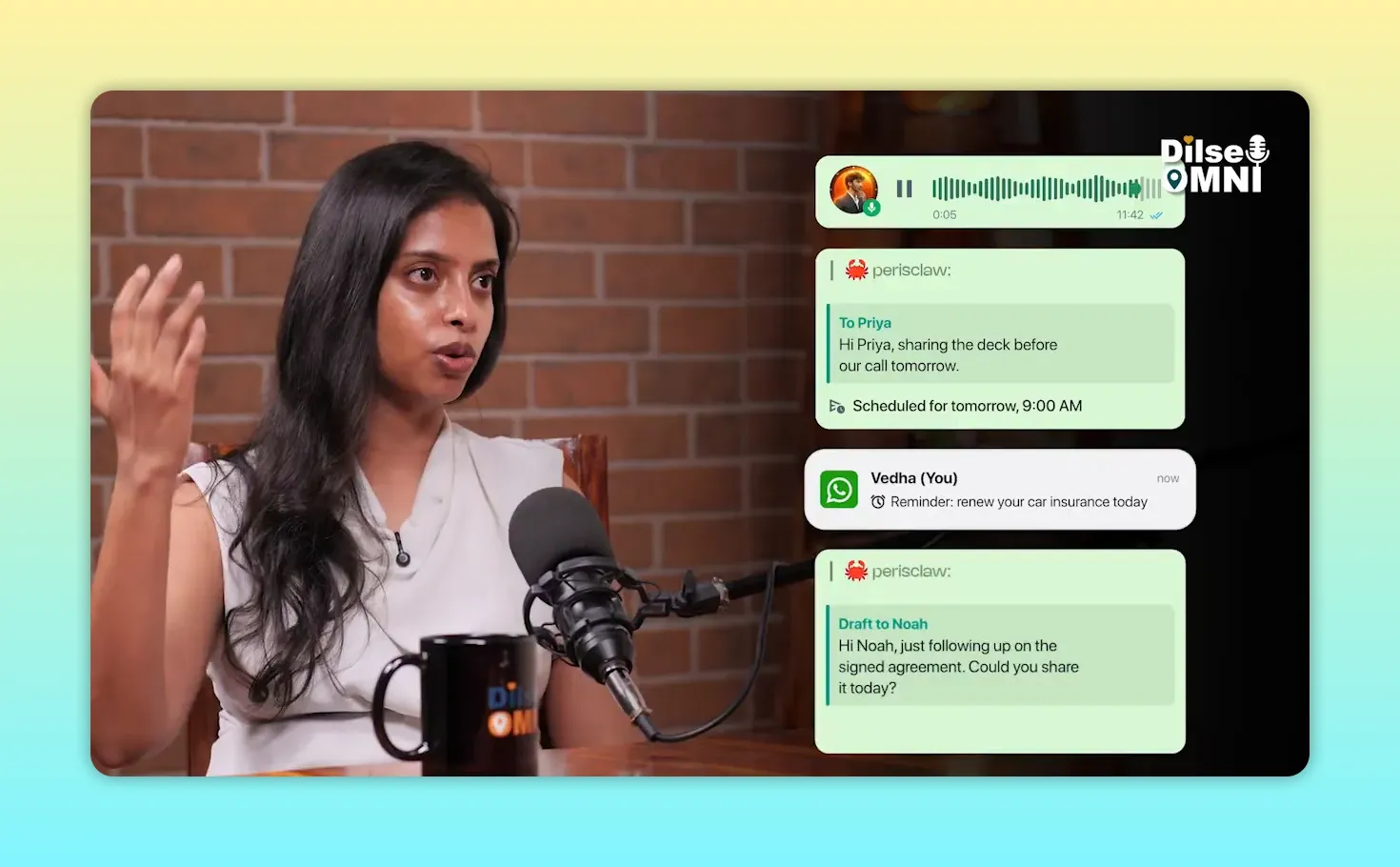
These are not abstract demonstrations of intelligence. They remove small but persistent pieces of work.
At the time of our conversation, Swapnika said about 50% of users reached a magic moment within their first seven days. The team wanted to increase that substantially.
The lesson for builders is to define activation around a completed customer outcome, not simply a completed setup process.
Habit: Measure Whether People Come Back
Next comes regular use. Her team tracks daily active users relative to weekly active users, alongside weekly activity relative to monthly activity.
Swapnika reported a DAU-to-WAU ratio of approximately 60% to 65% for Perisclaw. That is a strong signal of frequent engagement within its weekly active base.
What interested me was the connection to the product’s environment. WhatsApp is already deeply embedded in people’s routines. An assistant operating there does not ask customers to develop an entirely separate destination for work.
That connects naturally with the broader question of how conversational AI can support customer engagement: usefulness increases when the interaction fits the way people already communicate.
Autonomy: The Difference Between Asking and Delegating
The third pillar produced the most striking comparison.
Swapnika said conversion was approximately 17% among users who did not run autonomous jobs, compared with 58% among those who did. That is more than three times the conversion rate.
Autonomous work could include following up with a vendor for an invoice, taking over a chat for a defined task, or working with a Google Sheet as part of a broader workflow.
These were different user cohorts, so the comparison does not establish that delegation alone caused the difference. But it gives the team a clear behavioural signal to investigate and improve.
My learning was that, for an AI agent, frequent conversation is not the whole story. The deeper milestone is a customer handing over responsibility for a useful task.
4. Community Growth Started With a Practical Gap
When we discussed referrals, Swapnika mentioned one person who had referred more than 120 people. I had also recommended the product to roughly 20 or 30 people by then.
But the more interesting story involved community AI trainers, particularly in Kolkata’s business community.
These trainers were teaching people how to use tools such as Claude and GPT. A recurring question emerged: those workflows were useful, but what about businesses whose daily operations happened on WhatsApp?
That question led them to PerisClaw. They tried it and recommended it because it addressed something their communities needed. Some later became affiliates, but the recommendations began before that commercial relationship.
For me, this was a grounded lesson in word of mouth. The product spread through people helping others solve a specific problem. The distribution followed the usefulness.
5. WhatsApp Is More Than a Communication Channel
Then came the line that brought the conversation together.
“WhatsApp is the operating system of the world.” Swapnika Nag
It is a provocative way of describing a practical reality. Business conversations, coordination, follow-ups, and decisions frequently happen inside WhatsApp.
I shared my own example: when I left my previous job, I had to exit around 300 WhatsApp groups. That is a lot of operational context sitting inside a messaging app.
Swapnika cited approximately 200 million businesses using WhatsApp. Her larger point was not just its reach. It was how deeply work had become organised around it.
We also discussed Nokia, BlackBerry, and the danger of assuming that scale guarantees permanence. The lesson is not to treat any platform as untouchable. It is to recognise current customer behaviour without becoming blind to future change.
6. WhatsApp Plus Google Sheets: The Informal CRM
When Swapnika asked what the world’s biggest CRM might be, the answer was not a conventional software brand.
Her observation was that WhatsApp plus Google Sheets functions as an informal CRM for millions of businesses, including businesses across India, Latin America, the Middle East, and Southeast Asia.
Our discussion challenged the assumption that workflows designed around Western, email-centric businesses automatically fit WhatsApp-led operations. This is a question of fit, not a claim that established CRMs have no value.
The operating loop she described is simple:
Conversation: business information arrives through WhatsApp.
Structure: relevant information moves into Google Sheets.
Action: information from the sheet feeds back into WhatsApp communication and follow-ups.
Update: the next conversation creates information that needs to return to the sheet.
WhatsApp ↔ Google Sheets is the core loop. The opportunity for AI is to help execute the work between those two systems.
For omnichannel leaders, this is an important reminder: the customer’s operating reality matters more than our preferred software architecture. It is also central to building omnichannel growth in India, where connected experiences need to reflect how businesses and customers actually interact.
My Biggest Learning: Start Where the Work Already Happens
I came away with three questions for anyone building an AI product: How quickly does a customer experience meaningful value? What brings them back? And what makes them comfortable delegating work?
Swapnika’s Magic, Habit, and Autonomy framework makes those questions measurable. Her WhatsApp and Google Sheets insight tells us where to look for the workflows worth solving.
The strongest opportunity may not be persuading people to adopt a completely new way of working. It may be making their existing way of working substantially better.
I am Saurabh Agrawal and we come with a new episode on Dilse omni talks every fortnight and cover different aspect of omnichannel with amazing speakers.