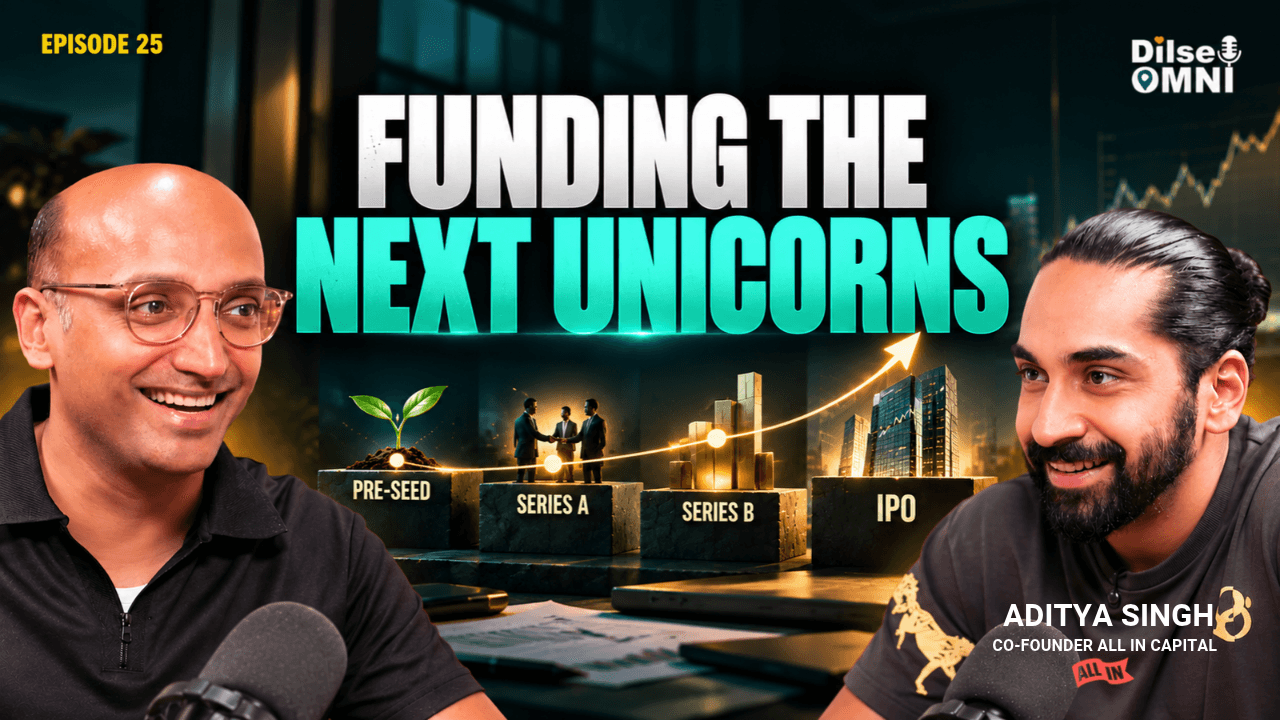
Can AI open up education, healthcare and guidance to millions of Indians who could never afford them? And can the same technology make an AI startup irrelevant overnight? My conversation with Aditya Singh on Dilse Omni Talks brought these two questions together.
Aditya is the Co-Founder and Founding Partner of All In Capital, an early-stage venture capital fund investing in Indian startups. He previously built BookMyForex, worked with AWS and Stride Ventures, and backed more than 50 early-stage companies as an angel investor. He brings both an entrepreneur’s understanding of execution and an investor’s awareness of how uncertain outcomes can be.
What stayed with me was the distinction between believing AI will change the world and knowing which AI businesses will survive. Those are very different things. Our discussion became a masterclass in accessibility, market selection and the uncomfortable question every AI founder must answer: why will someone keep paying for your product?
Table of Contents
1. The Opportunity Starts with Understanding Who You Serve
2. AI for Bharat Is an Accessibility Thesis
3. What This Looks Like in Actual Companies
4. AI for India and AI for the World Are Different Bets
5. A Transformative Technology Does Not Make Every Investment Attractive
6. Vertical SaaS vs Horizontal SaaS, Without the Jargon
7. The One-Update Test for Your AI Startup
Build Around the Need, Not the Hype
1. The Opportunity Starts with Understanding Who You Serve
I began with a story about meeting Alakh Pandey of Physics Wallah, a brand I admire for its connection with what we often call India 2 and India 3.
As someone who talks frequently about first-party data, I asked how well he knew his customers. He immediately corrected my language. They were students, children, not simply customers.
“They are not customers for us. They are our children.”
That correction was small, but the lesson was not. Before we discuss technology, personalisation or scale, we need to understand the relationship a business is trying to build.

I shared how Physics Wallah and similar providers had brought annual preparation costs down to roughly ₹2,000 to ₹5,000, compared with offerings costing ₹50,000 to ₹1 lakh. But Alakh’s deeper concern was even more revealing: some students could struggle to afford a ₹300 monthly phone recharge.
Think about that. We might be debating whether a course is attractively priced while the student is worrying about staying connected to it.
My takeaway: affordability is not just your subscription price. It includes the cost of accessing and continuing to use your service. For founders building for Bharat, that is where customer understanding becomes practical rather than theoretical.
2. AI for Bharat Is an Accessibility Thesis
Aditya connected that story to his investment thesis. AI, he believes, can make services accessible to Tier 2 and Tier 3 India that were previously out of reach.
Consider personal guidance. Someone who could not afford a trainer or tutor might eventually access an AI-based service for ₹100 or ₹200 a month. These were possibilities we discussed, not guaranteed price points. The important idea was the change in who could participate.

Education makes this particularly tangible. We discussed AI-assisted testing that can analyse a student’s responses and identify a specific weak area within a subject, rather than merely return an overall score.
The difference is between receiving another practice paper and receiving guidance about what to study next. AI could make that kind of feedback much cheaper to deliver.
Healthcare also came up as a vast area of unmet need. Aditya’s point was that access remains difficult even in larger cities, and the depth of the challenge outside them is easy to underestimate.
The Accessibility Chain
I would summarise this part of our conversation through a simple framework. This is my synthesis of Aditya’s reasoning, rather than a named framework he presented.
Starting point | AI intervention | Opportunity |
|---|---|---|
A useful service is too expensive | Reduce the cost of delivering guidance | Bring it within a smaller household budget |
Expert attention is scarce | Make some assistance available digitally | Reach people beyond existing service locations |
Feedback is generic or costly | Analyse individual responses | Offer more targeted learning support |
The sequence matters: unmet need → lower delivery cost → affordable access → a broader market. Starting with the need produces a very different business conversation from starting with an AI feature.
3. What This Looks Like in Actual Companies
Aditya illustrated the opportunity through companies All In Capital has backed.
Supernova: An English-learning business aimed at mass-market India. Aditya compared its role to a Duolingo-style experience built for this audience.
NPrep: Founded by three doctors from AIIMS, it supports nursing exam preparation, including NORCET. Aditya described shortages of teaching capacity and highlighted the performance of its learners in the exam.
Super Living: An AI companion focused on lifestyle and well-being questions, including skin, hair and everyday wellness.
These are different businesses, and they should not all be treated as identical AI products. What connects them in Aditya’s explanation is the effort to make support available to people who have not been adequately served.

NPrep, for example, illustrates technology-enabled access to exam preparation. That is not the same as replacing formal nursing education or clinical training. Keeping that distinction clear helps us understand the actual problem being solved.
For me, the common thread was simple: the customer’s aspiration already exists. The business opportunity is to remove a barrier between that aspiration and meaningful help.
4. AI for India and AI for the World Are Different Bets
Aditya divided the market into two broad categories: AI for India and AI for the world.
He was much more cautious about India-based startups competing for global AI product markets. His concerns were commercial, not simply technical: the amount and speed of capital available in the US, proximity to customers, and the difficulty of selling into an unfamiliar market.
His analogy was useful. Expecting a founder to arrive in the US and immediately understand how to sell there is a little like expecting an American entrepreneur to arrive in India and effortlessly build a local D2C brand.
This was Aditya’s investment judgment, not a settled rule that Indian founders cannot build global companies. In fact, he offered an exception from his own portfolio: Broccoli AI.
A creator-focused writing product offered another example. A general model can generate a script, but the result may sound generic. A specialised product can add context and tailor the experience to the creator’s actual needs.
The promise of vertical AI is therefore not merely a narrower label. It is a more relevant solution.
But specialisation leads directly to the difficult question: what happens when the general model improves?
7. The One-Update Test for Your AI Startup
Aditya used legal AI to explain the risk. Suppose a law firm pays for a specialised product. If a general-purpose model becomes good enough, could that firm build an acceptable internal alternative instead?
“One update will kill your AI startup.”
He was explaining the concern behind that phrase, not predicting that every vertical AI company will disappear. Harvey could also become an enduring business. His point was that nobody knows the answer with certainty today.
Here is the practical framework I took away for founders:
The access test: What previously unavailable or unaffordable help are you providing?
The market test: Do you understand the people who will buy and use it?
The workflow test: What specific task becomes easier or more valuable?
The substitution test: If the underlying model improves tomorrow, why would the customer still pay you?
This is my synthesis of the discussion, not a guarantee of startup success. But it moves the conversation beyond the demo and towards the business.
For omnichannel leaders, I see the same underlying discipline: understand people, remove friction and use technology to deliver something useful. Our free guide takes that broader operating perspective into omnichannel growth.