Sometimes, the starting point for a business is sitting inside a conversation you have already forgotten.
That was one of my biggest takeaways from speaking with Swapnika Nag on Dilse Omni Talks. Swapnika is the Founder and CEO of Periskope and PerisClaw, an IIT alumna and former McKinsey consultant. She builds both companies with her husband and co-founder, Bharat. Periskope automates WhatsApp operations for more than 5,000 businesses across 100 countries. PerisClaw brings an AI executive assistant onto your own WhatsApp number.
Those are interesting products. But what made our conversation a masterclass was the thinking behind them: how to identify an overlooked problem, validate it with payment, and build around behaviour that already exists.
The opportunity was not to send more messages on WhatsApp. It was to make sure the messages that mattered actually led to action.
Table of Contents
Lesson 1: A Good Pivot Keeps What You Have Learned
Lesson 2: Search for Persistent Pain, Not Just New Ideas
Lesson 3: A Three-Day MVP Needs a Commercial Test
Lesson 4: WhatsApp Is an Operations Channel Too
Lesson 5: Turn the WhatsApp Black Box into Three Manageable Problems
Lesson 6: Personal AI Needs to Fit Existing Habits
Lesson 7: Everyday Use Can Become Distribution
My Biggest Takeaway
Lesson 1: A Good Pivot Keeps What You Have Learned
Before Periskope, Swapnika and Bharat were building Hashmail, a communications product for the Web3 ecosystem. Their work centred on Telegram and Discord, two important channels in that space.

After roughly a year, they concluded that the market was smaller than the one they wanted to build for. But they did not throw away their communications experience. Instead, they asked where else that capability could solve a larger problem.
WhatsApp was an obvious channel to explore. The less obvious decision was what not to build.
Plenty of companies were already working on WhatsApp marketing and consumer support. Swapnika did not want to enter the same space with another version of an existing solution.
For me, that distinction matters. Choosing a large platform is only the beginning. You still need to find a problem that the existing ecosystem is not solving well.
Lesson 2: Search for Persistent Pain, Not Just New Ideas
The discovery happened through a wonderfully simple action: Swapnika searched for “WhatsApp” inside her own WhatsApp.
She found an old message in a McKinsey alumni group from Treebo co-founder Sidharth Gupta. His business had thousands of WhatsApp groups involving enterprise relationships. Important issues and escalations were getting lost because the groups were so noisy.
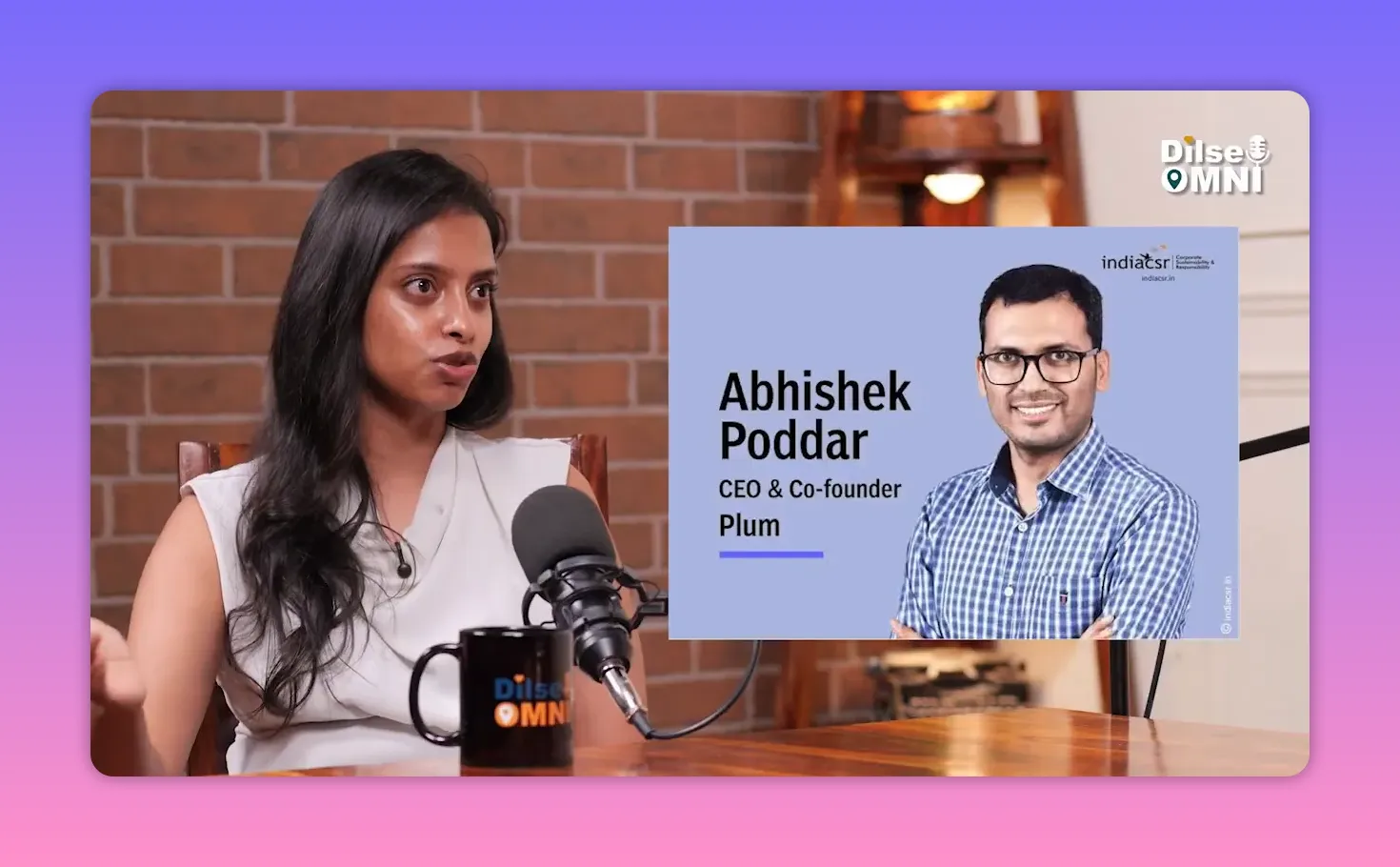
Abhishek Poddar of Plum Insurance had responded with a similar problem. Others had joined in too.
These messages were about a year old. That could have made them seem irrelevant. Instead, Swapnika reached out and asked whether the problem still existed.
It did. And it remained one of the bigger unresolved operational headaches.
That is the detail I found most powerful. This was not someone casually suggesting a feature. Multiple businesses had described the same pain, and a year later, it had still not gone away.
An old complaint that remains unresolved can be a stronger signal than a fresh expression of interest.
Lesson 3: A Three-Day MVP Needs a Commercial Test
Swapnika remembers identifying the opportunity around August 2, 2023. By August 5, her birthday, they had a basic minimum viable product ready.
Three days. Not a complete platform, but enough to start testing whether the problem deserved a business.
“If this is a deep enough pain point, someone will be willing to pay us.”
Swapnika Nag
They asked potential partners for a few thousand dollars to work with them on solving the problem. A luxury real estate firm agreed. Much of its property dealership activity happened in WhatsApp groups, so the operational pain was significant.
The important signal was not praise for the demo. It was a customer willing to commit money to a very early product.
The fuller version took another four to six months to develop, with Periskope launching in early 2024. Speed helped them test the opportunity. It did not eliminate the work required to build a dependable product.
The Pain-to-Payment Framework
I would distil her approach into this simple sequence. This is my synthesis of the journey, rather than a named framework she presented:
Repeated complaint → Persistent problem → Small working solution → Paid commitment → Deeper product
Listen for repetition: Do several businesses independently describe the same issue?
Check persistence: Is it still painful after they have had time to find alternatives?
Build the smallest useful response: Test the core problem before expanding the feature set.
Ask for commitment: Find out whether solving it is worth a real budget.
Build with the customer: Use that partnership to understand what a complete solution requires.
One paying partner does not establish complete product-market fit. But it is a much more meaningful early validation than polite enthusiasm.
Lesson 4: WhatsApp Is an Operations Channel Too
Periskope now serves more than 5,000 businesses across approximately 100 countries. About 40% of its business comes from India, with customers across Latin America, the Middle East, Southeast Asia, Europe, and elsewhere.
Swapnika recalled investigating a signup with a +229 phone number and discovering a customer from Benin. For her, it illustrated how deeply WhatsApp is embedded in everyday business activity across markets.
Her examples included Aditya Birla, Groww, and Policybazaar. Interestingly, just before our conversation, I had met Shubham Choudhary from Policybazaar at an ET MarTech event, where he mentioned his team using Periskope.
The larger lesson is easy to miss if we think of WhatsApp only as a campaign channel. Businesses also use it for sales, customer success, enterprise relationships, and day-to-day coordination.
In omnichannel, understanding where work actually happens is as important as understanding where communication is delivered.
Lesson 5: Turn the WhatsApp Black Box into Three Manageable Problems
The Periskope name reflects its purpose: helping businesses see into activity they otherwise cannot easily observe. Swapnika described three use cases that make this concrete.
1. Group Operations: What Has Been Missed?
Enterprise WhatsApp groups can contain 20, 30, or 40 participants. Important requests sit alongside routine conversation. Ownership becomes unclear, responses get delayed, and escalations appear later.
Swapnika explained that the WhatsApp Business API approach they encountered was well suited to marketing but did not address the group workflows their customers needed.
Periskope allows businesses to work through one or two central numbers while giving restricted access to hundreds of team members. Its tools help track unanswered queries and response times, with an AI layer for answering, taking over tasks, and qualifying leads.
2. Sales Visibility: Where Is Revenue Leaking?
The second problem arises when salespeople work through separate WhatsApp numbers, often corporate-issued ones. Managers cannot easily see which leads arrived, which received replies, or which were dropped.
Swapnika described connecting large numbers of sales accounts to create that visibility and give teams tools to respond faster.
“That is pure revenue leakage.”
Swapnika Nag, on leads getting dropped
This changes the value conversation. The benefit is not simply a tidier inbox. It is identifying missed commercial opportunities.
3. Data Governance: What Information Does the Business Hold?
The third, evolving use case is compliance. Swapnika connected this to India’s DPDP requirements and the difficulty of managing customer information scattered across employee WhatsApp accounts.
Her point was operational: businesses need visibility into the information customers have shared and the ability to address deletion requests. That becomes difficult when conversations sit outside central oversight.
This should not be read as a claim that one tool guarantees legal compliance. The lesson is that data governance starts with knowing where the data is.
My shorthand for these three needs is Visibility → Action → Governance: see the work, respond to it, and manage the information responsibly.
Lesson 6: Personal AI Needs to Fit Existing Habits
PerisClaw emerged from another repeated customer request. Founders liked Periskope for teams, but their personal WhatsApp accounts were still chaotic. They wanted help without moving into another app.
The demand existed before the technical approach clicked.
Swapnika described being awake late at night caring for her baby and exploring OpenClaw. At around 3 a.m., she woke Bharat with a question: could an AI agent run on someone’s own WhatsApp number?
They worked through the architecture at a nearby chai house. About three weeks later, PerisClaw launched in private alpha.
The name combines the Periskope connection with its OpenClaw inspiration. Swapnika said the product began as an OpenClaw fork, which they subsequently tore down and rebuilt.
What interests me is the adoption principle: bring assistance into the place where people already communicate. It connects with the broader shift explored in our conversation about agentic marketing, where AI becomes more useful when it participates in real workflows.
Lesson 7: Everyday Use Can Become Distribution
PerisClaw can be used in a self-chat or invoked inside another conversation. The team expected self-chat to dominate. But group usage created an unexpected discovery mechanism.
Friends began invoking it for playful tasks, including roasting someone in a group. Responses appeared from the user’s number with a PerisClaw header. Other participants became curious and asked how it worked.
Use → Visible result → Curiosity → New interest
That is the growth loop I took away. Swapnika described it in terms of network effects and virality. More specifically, the product’s use made it discoverable to other people in the conversation.
There was a practical constraint too: growing interest created capacity pressure, and costs needed optimisation. Distribution and delivery economics had to develop together.
My Biggest Takeaway
I brought up Kunal Shah’s Delta 4 idea during our conversation because I keep asking a simple question about personal AI: has it meaningfully improved someone’s productivity?
Swapnika’s story brought that question back to basics. Start with a painful job. Test whether someone will pay to improve it. Build where the behaviour already exists.
For omnichannel leaders, the implication is clear. Before adding another communication layer, examine the conversations already carrying your revenue, service, and operational commitments. The next opportunity may be hiding there.
I am Saurabh Agrawal and we come with a new episode on Dilse omni talks every fortnight and cover different aspect of omnichannel with amazing speakers.