When we talk about food brands, the conversation usually starts with product quality, packaging, distribution, and margins. But in my conversation with Nitin Puri, Founder of KisaanSay, the discussion went a layer deeper. What if the real opportunity is not simply to optimise the supply chain, but to redesign who benefits from it?
Nitin is an IRMA alumnus and the founder of KisaanSay, a farmer-first food brand working closely with farming communities to bring authentic, traceable products directly to consumers. His thinking is refreshingly clear: farmers should not be treated like nameless suppliers or daily-wage participants in a supply chain. They should be business partners.
That idea forms the foundation of KisaanSay’s Farmer-to-Consumer, or F2C, model. It is a business model, a brand-building philosophy, and an omnichannel playbook all at once.
Table of Contents
The Problem With the Traditional Food Supply Chain
The KisaanSay F2C Framework: Co-Brand, Co-Profit, Co-Trust
Organic Storytelling Is Not a Marketing Hack
Omnichannel Growth: Expand Discovery Before Distribution
Customer Experience Is Expectation Versus Delivery
Why Imperfection Is a Feature of Natural Food
The Larger Lesson for Consumer Brands
The Problem With the Traditional Food Supply Chain
Nitin shared a simple but uncomfortable reality. In a conventional food supply chain, when a consumer spends ₹100, the farmer may receive less than ₹30. Even when the final product is positioned as healthy, premium, or natural, the person who grows it often gets only a small share of the value created.
The traditional model can make farmers feel like suppliers at the bottom of the chain. KisaanSay’s model asks a different question: how do we make the farmer an essential stakeholder in the brand itself?
“Farmer ko as a trader nahi, as a partner treat karna hai.”
This is not just a nice sentiment. It has tangible implications for product design, branding, economics, consumer trust, and long-term loyalty.
Nitin’s view is that a business like this cannot be built with a short-term exit mindset. The intention is to build something that carries India’s food heritage forward for generations. That requires trust, and trust does not arrive in one campaign. It is built slowly, through consistency, transparency, and shared ownership.
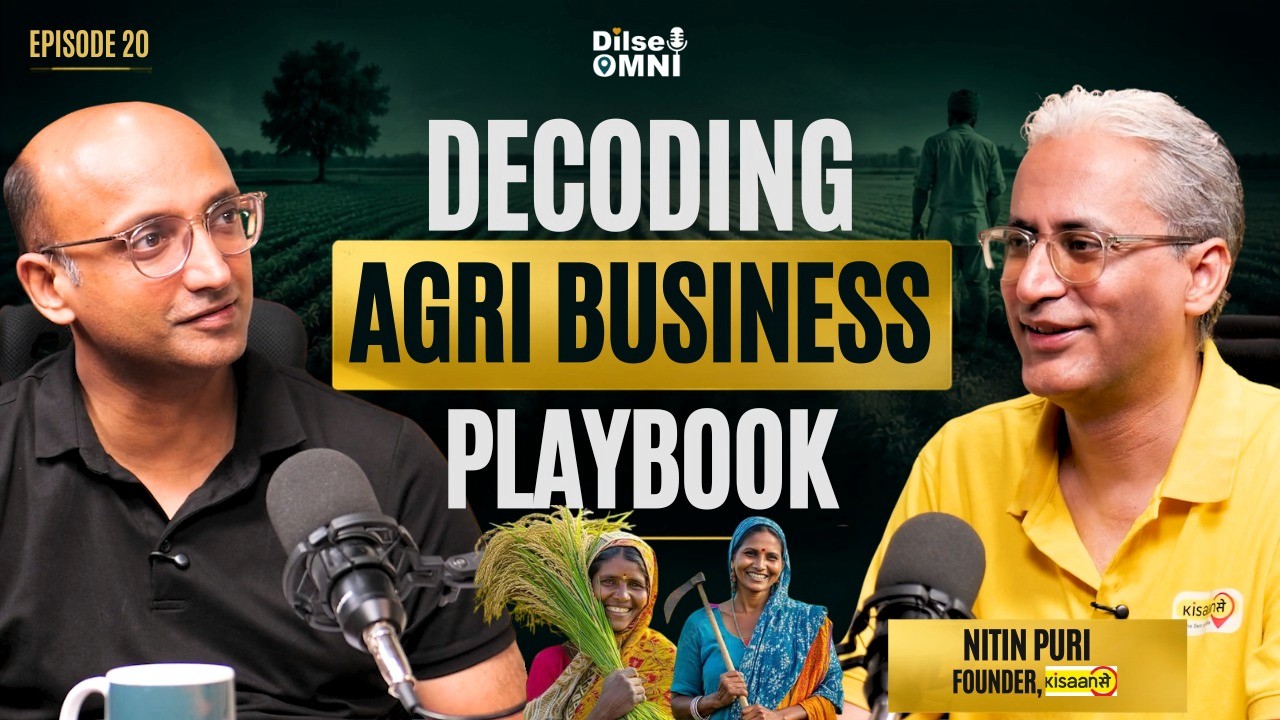
This connects strongly with the discussion in our earlier conversation on decoding the agri-business playbook: farmers are not merely producers. They are entrepreneurs who deserve a larger share of the value they create.
The KisaanSay F2C Framework: Co-Brand, Co-Profit, Co-Trust
I found it useful to organise Nitin’s approach into a simple three-part framework. This is the real engine behind the F2C model.
1. Co-Brand: Put the Farmer’s Identity on the Pack
Every KisaanSay pack carries not only the KisaanSay logo but also the identity of the relevant farmer group. This gives the product a visible origin. Consumers know where it comes from, which community produced it, and that there is a traceable story behind the food.
For the customer, this creates authenticity and transparency. For farmers, it creates pride. Their name, village, and collective are no longer invisible behind a generic commodity.
When a producer knows that the product carries their identity, quality becomes personal. There is ownership. There is accountability. There is dignity.
2. Co-Profit: Share the Value Created
The second part is perhaps the most powerful. Once the operational costs of sourcing, processing, supply chain, distribution, and marketing are accounted for, KisaanSay shares the remaining profit with farmer groups on a 50-50 basis.
That changes the economics significantly. Nitin shared that in the traditional model, farmers may receive around ₹30 for every ₹100 spent by a customer. Through KisaanSay’s model, the farmer’s share can reach ₹50 to ₹60.
That is not a marginal improvement. It is close to doubling the farmer’s income share from the final consumer rupee.
3. Co-Trust: Build a Brand for the Long Term
Trust is not an operational metric alone. It is the result of every promise a brand makes and keeps. Nitin explained that trust may take months or years to earn, but it can disappear in seconds.
When farmers are partners, they are invested in the product. When customers can see the origin, they are more willing to believe in the brand. And when the brand communicates honestly, it has a stronger chance of building lasting relationships on both sides.
“Trust earn karne mein mahine aur saal lagte hain, lekin jaane mein ek second.”
Organic Storytelling Is Not a Marketing Hack
One of the most interesting parts of our conversation was KisaanSay’s approach to brand building. Between Nitin’s personal LinkedIn presence and the KisaanSay profile, they have built close to 60,000 followers without spending money on follower acquisition.
That is significant, especially for a young food brand. But the reason it works is not because LinkedIn is a magic channel. It works because the content is aligned with the character of the brand.
KisaanSay is natural, raw, and real. Its communication is also natural, raw, and real. The team shares farmer stories, product stories, founder stories, and stories from the food and agriculture ecosystem without over-polishing them into advertisements.
That approach creates awareness before it creates a transaction. It helps people understand why a GI-tagged rice variety matters, why a regional food product is different, or why natural ingredients might not resemble standardised supermarket products.
As Nitin put it, the job is to educate customers. A person may ultimately buy black salt rice from KisaanSay or another brand, but once they understand the product category, they begin to value it properly. If the product is genuinely the best, they will return.
Some paid promotion may be needed for distribution and reach. But the foundation should remain organic, because that is where trust compounds.
Omnichannel Growth: Expand Discovery Before Distribution
A very practical learning from Nitin’s journey is that omnichannel expansion should not begin by placing products everywhere. It should begin by creating enough awareness that distribution can actually convert.
KisaanSay sells primarily through its own website and has also been launching its app. It is available through Amazon and Blinkit, and through more than 60 physical stores across Delhi NCR, including Reliance Retail and supermarkets in Delhi, Gurugram, and Noida.
The demand is not limited to metros. A differentiated food proposition can travel far beyond the expected market.
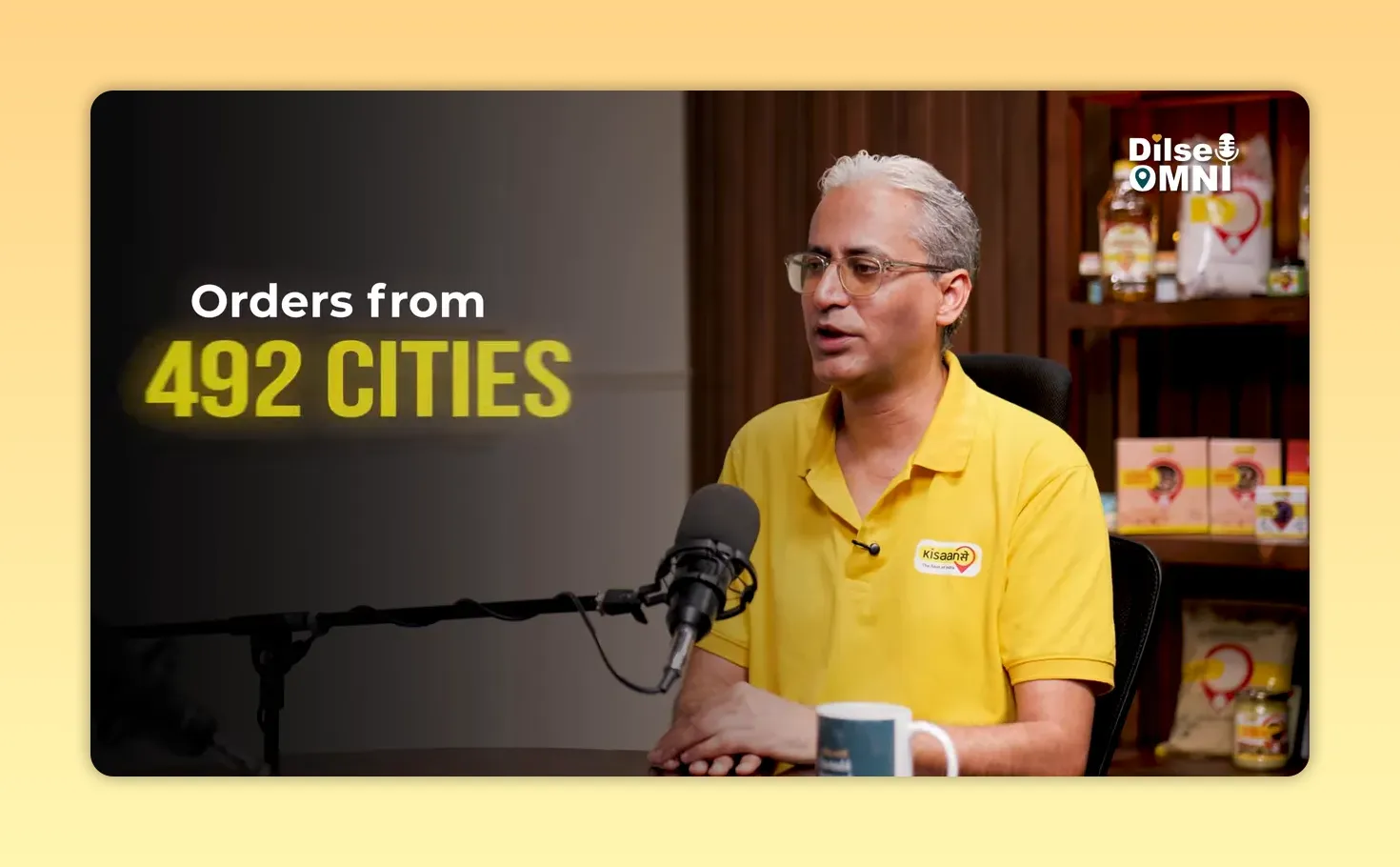
What surprised me most was the reach. KisaanSay receives orders from 492 cities across India. For a two-year-old brand without enormous advertising budgets, that is a powerful signal. Orders have come from places such as Pulwama, Chandrapur, Kohima, and many other cities beyond the usual Delhi, Mumbai, Bengaluru, or Hyderabad lens.
India is far bigger, more diverse, and more premium-ready than many brands assume. There are customers in Tier 2 and Tier 3 cities who value authentic products and are willing to pay for differentiation.
The sequencing matters. Nitin’s logic is compelling:
Build awareness through founder-led and product-led content.
Create discovery through the owned website and selective marketplaces.
Enable trial by placing a focused set of SKUs on platforms such as Amazon and Blinkit.
Expand into retail after some brand familiarity exists.
Build repeat behaviour through the app and owned customer relationships.
If a new brand enters physical stores before anyone knows it, the inventory may simply sit on the shelf. But if the customer has already heard the story and later notices the product in-store, the probability of trial changes dramatically.
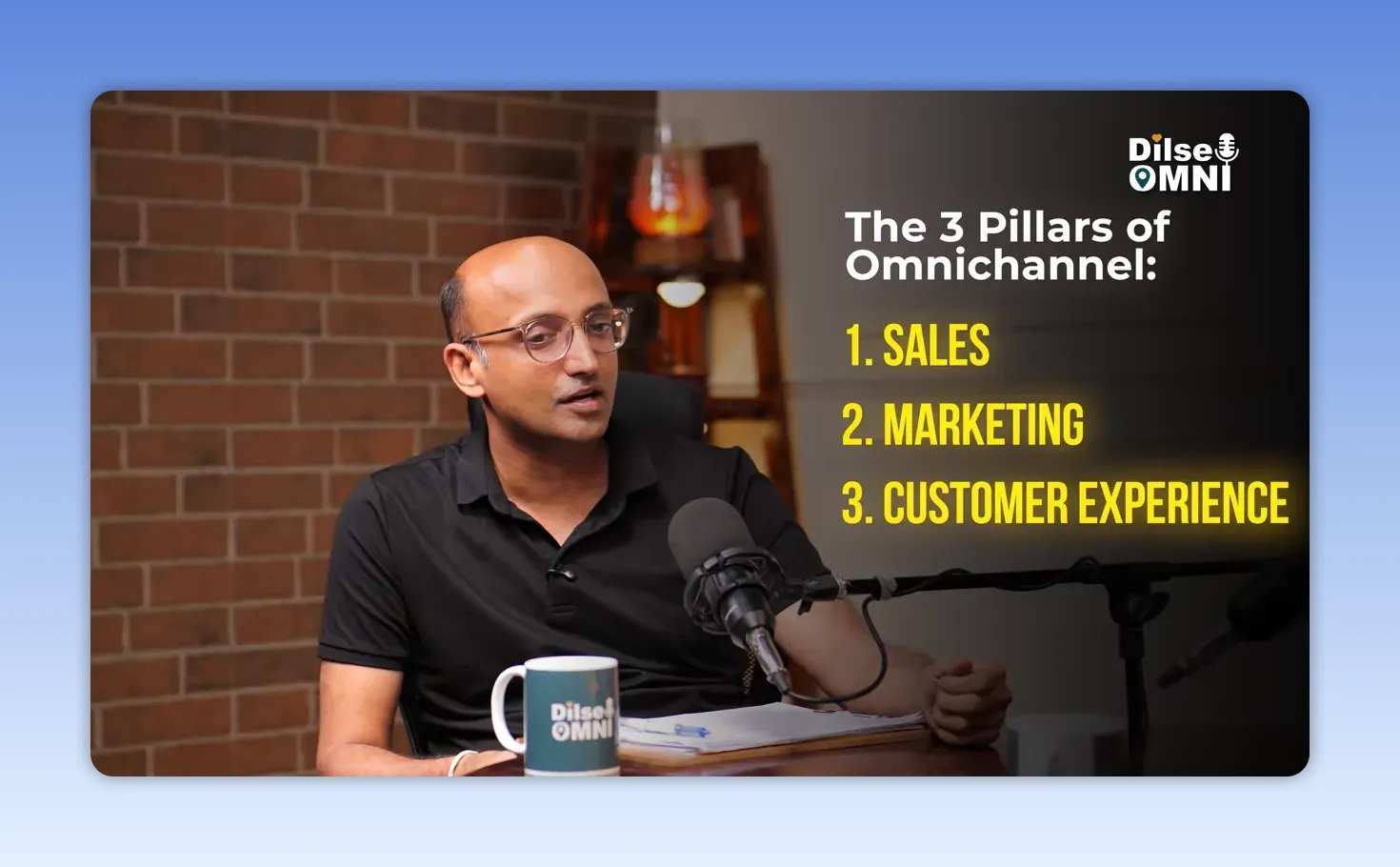
Omnichannel works when sales, marketing, and customer experience reinforce one another instead of operating in silos.
For me, omnichannel always comes back to three connected pillars: sales, marketing, and customer experience. KisaanSay is building all three.
Sales: Website, app, marketplaces, quick commerce, and offline retail expand availability.
Marketing: Authentic content creates awareness, education, and consideration.
Customer experience: The delivered product must fulfil the promise created by the story.
This is a useful lens for every consumer brand, not only food. For a deeper discussion on aligning these dimensions, read our conversation on decoding omnichannel marketing.
Customer Experience Is Expectation Versus Delivery
One of the most important moments of the conversation came when we discussed customer experience. I shared a simple way to think about it:
Customer experience is shaped by what someone expects compared with what they receive for what they pay.
When delivery matches expectation, the relationship is stable. When delivery exceeds expectation, a brand earns goodwill. But when marketing creates a grand image that reality cannot support, disappointment follows.
Food makes this especially complex because taste is subjective. One person may enjoy a ₹100 rice product while another prefers a ₹500 product. The challenge is not merely to claim that something is premium. The challenge is to explain what makes it different and set the right expectation before the pack arrives.
For a natural food brand, education is part of the customer experience. It is not a side activity.
Why Imperfection Is a Feature of Natural Food
Nitin gave two brilliant examples of the gap between consumer perception and natural reality.
The first is traditional short-grain rice. Even if the product listing and packaging clearly describe it as short-grain, some customers may still receive it and assume that it is broken or rejected rice. Why? Because they have been trained over generations to associate long, uniform grains with quality.
The second example is Kashmiri mamra almonds. Imported almonds may be larger, uniform, and visually impressive. But Kashmiri mamra almonds can be smaller, irregular, and sometimes even slightly bitter. Their appearance does not follow the industrial standard of perfection.
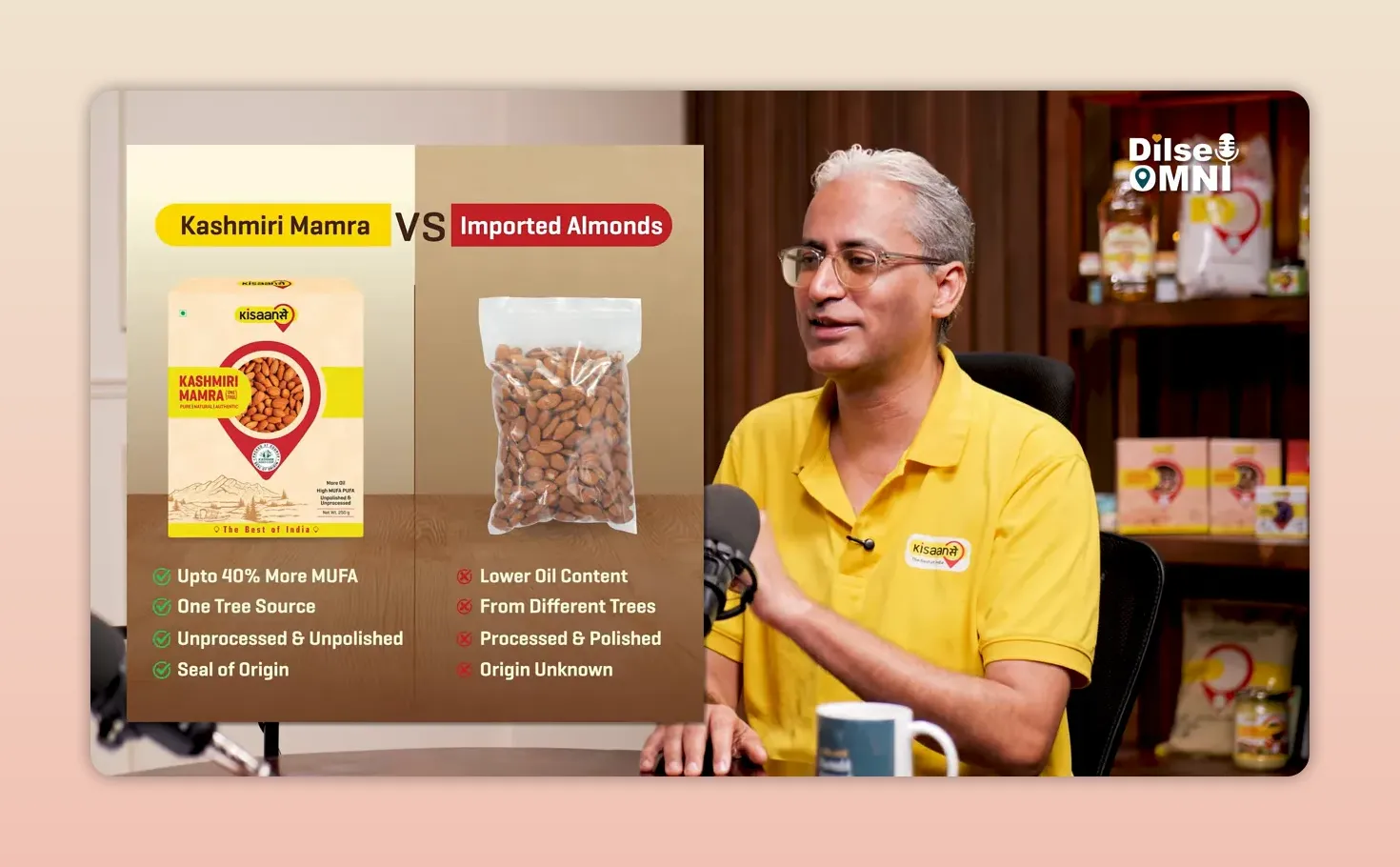
Natural food often looks less uniform, but appearance alone cannot tell the full story of flavour, origin, or quality.
That is exactly the point.
“Imperfection is a feature.”
In food, outer beauty can sometimes be a signal of excessive standardisation. A fruit, nut, or grain that looks exactly the same every time may have been bred, processed, or selected for visual consistency. Natural food behaves differently. The grains can vary. The almonds can vary. One tree can produce nuts of different sizes depending on sunlight, shade, and location.
That variability is not necessarily a flaw. It can be evidence of authenticity.
Nitin described how a group of international MBA students tasted Kashmiri almonds during a visit. They were surprised by the flavour because the small, unimpressive-looking almonds tasted far richer than the almonds they were used to in California. Once people taste and understand the story, perception can change.
That is the real task for brands in premium natural food: do not hide the difference. Explain it clearly, make it tangible, and let the product speak.
The Larger Lesson for Consumer Brands
KisaanSay’s F2C model shows that a strong brand can be built without separating purpose from profit. In fact, purpose can strengthen the economics when it improves trust, differentiates the product, creates producer ownership, and gives customers a reason to care.
The masterclass from Nitin is simple but powerful:
Build the farmer into the brand, not merely into procurement.
Share value, not just orders.
Use transparency to create confidence.
Tell real stories before buying reach.
Expand channels in the right sequence.
Educate customers when the product challenges familiar perceptions.
Remember that in natural food, uniformity is not always quality.
When these pieces come together, a food business becomes more than a D2C brand selling products online. It becomes an ecosystem that connects growers, heritage, commerce, and consumers in a more meaningful way.
I am Saurabh Agrawal and we come with a new episode on Dilse Omni Talks every fortnight and cover different aspect of omnichannel with amazing speakers.