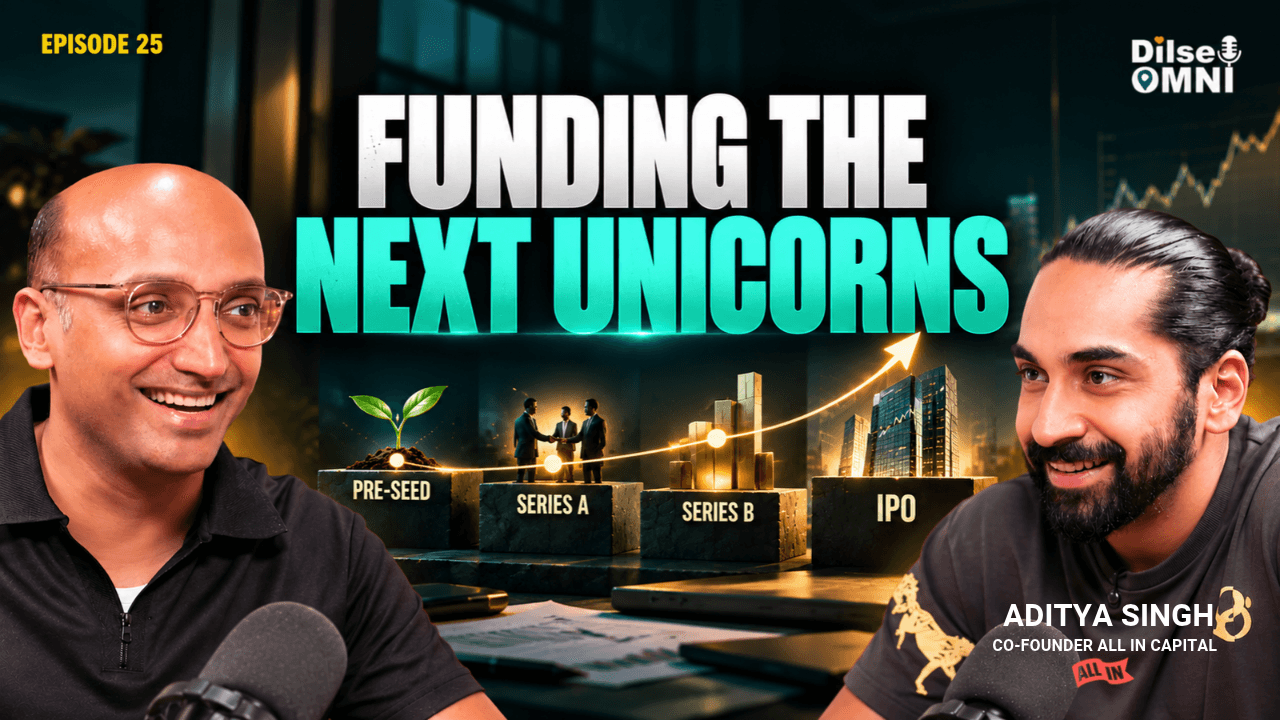
Is the next big Indian consumer brand being built for the same premium customer everyone else is chasing? Or is the more interesting opportunity somewhere founders are not spending enough time?
That question stayed with me after my conversation with Aditya Singh on Dilse Omni Talks. Aditya is the Co-Founder and Founding Partner of All In Capital, an early-stage VC fund investing in Indian startups. A former entrepreneur who built BookMyForex, he has also worked with AWS and Stride Ventures and backed more than 50 early-stage companies as an angel investor.
But this was not a conversation about investing from a distance. His stories were about eating at a restaurant, recognising a product his parents wanted again, and backing a mother-son team selling a regional snack.
What emerged was a practical masterclass: understand the customer first, establish the product’s value, and then choose distribution that makes economic sense. Not the other way around.
Table of Contents
1. Quick Commerce Is a Channel, Not the Business
2. Master Chow: The Product Came Before the Platform
3. Premiumization Is Real, but So Is the Fight for Attention
4. India 1, India 2 and India 3: A Framework for Choosing Your Customer
5. You Cannot Solve Distribution from South Bombay
6. Mom’s Made: Regional Understanding Meets Digital Skill
7. Convenience Has a Different Value in Every Household
The Playbook Starts with Understanding
1. Quick Commerce Is a Channel, Not the Business
I began by asking whether quick commerce was like Amazon and Flipkart. Aditya’s answer brought the discussion straight to distribution economics.
His argument was that quick commerce filled a distribution gap. But founders should not assume that the attractive terms of an emerging channel will remain unchanged.

He described payment cycles stretching from roughly seven days to a month, alongside increasing listing and advertising costs. These were his observations, not a universal rate card. The underlying lesson matters more than any individual charge: a channel that helps you grow can also become more expensive as your dependence on it increases.
For a brand he discussed, Aditya said a network of 100 distributors was cheaper than quick commerce. That challenges the assumption that a newer channel must automatically be a more efficient one.
My takeaway was not to reject quick commerce. It was to evaluate it properly. Payment timing, visibility costs and the expense of moving goods all belong in the calculation. Revenue alone does not tell the story.
2. Master Chow: The Product Came Before the Platform
The Master Chow story made that distinction tangible.
Before it became a packaged Asian sauces brand, Aditya knew the founders through Wok Me, a place where he would eat Asian bowls after visiting Summer House in Delhi. He knew the food, had his preferred bowl and understood which sauces he liked.
Then COVID shut the restaurants. The founders began considering whether they could bottle their sauces and sell them for home consumption.

India 1, in his framing, is the premium audience with access to abundant choices and convenience. India 2 and India 3 represent substantial value-conscious opportunities where affordability and distribution need a different approach.
I found it useful to organise his thinking into this decision map:
Decision | India 1 emphasis | India 2 and India 3 emphasis |
|---|---|---|
Customer value | Upgrades, differentiation and convenience | Affordability and a compelling product |
Competitive challenge | Standing out among many premium choices | Serving customers at viable price points |
Acquisition | Competing for crowded digital attention | Keeping customer acquisition costs low |
Distribution | Assessing marketplaces and quick commerce | Solving access close to the customer |
Founder advantage | A memorable reason to choose the brand | Deep understanding of local needs and behaviour |
This is not an argument that premium brands cannot succeed. Aditya admired Snitch, while identifying it as an India 1 brand at an accessible price point. He also highlighted Lahori Jeera. The distinction is important: an accessible premium offering is not automatically a mass-market proposition.
It also connects with the broader questions of product-market fit and offline economics in our conversation on building omnichannel consumer brands with Ankur Khaitan.
5. You Cannot Solve Distribution from South Bombay
Why are more founders not building for these value-conscious customers?
Aditya’s first answer was proximity. Founders may not come from the market they want to serve. They need to spend time there, understand the problems and work through distribution.
“You cannot build it while sitting in South Bombay.”
Aditya Singh
His second answer was customer acquisition cost, or CAC. Consider his shampoo example: a customer buying at ₹200 to ₹300 gives the business very different acquisition economics from someone purchasing an ₹800 product.
You cannot simply copy the same digital advertising approach and expect the numbers to work.
Offline distribution or broader mass-market marketing may offer a route. Online can work too, as some of his portfolio companies demonstrate. But it has to work at the customer’s price point, not at the founder’s preferred marketing budget.
6. Mom’s Made: Regional Understanding Meets Digital Skill
Mom’s Made was the story that brought these ideas together.
The founder had moved to Bengaluru looking for work without having attended college. At Kutumb, he spent several years running advertisements and testing business ideas. Later, his mother and younger brother joined him in the city.
His mother began making thekua, a regional snack strongly associated with Bihar and Chhath Puja. The product carried familiarity and nostalgia. The son brought digital acquisition experience and explored a jaggery-based version positioned around healthier indulgence.
Orders grew until their housing society objected to the scale of activity. The founder contacted Aditya, wanting to turn it into a brand.
According to Aditya, around a year after his investment, the business was generating approximately ₹2 crore in monthly revenue, was EBITDA profitable and had raised capital at a ₹75 crore valuation.
The striking part was that it was selling online. This was not a contradiction of his warning about CAC. It showed why founder insight and acquisition capability matter.
My synthesis of the story is a four-part framework:
Customer familiarity: Understand the people and the occasion behind the purchase.
Product strength: Offer something they genuinely enjoy and recognise.
Acquisition capability: Reach them at a cost the product can support.
Operational capacity: Expand production when demand justifies it.
As Aditya put it, “Without the product, there is nothing.”
7. Convenience Has a Different Value in Every Household
Our conversation ended with the limits of quick commerce beyond the premium audience.
For a household managing a tight budget, delivery charges and basket requirements are not minor details. Repeated convenience spending competes with savings, education and other priorities.
There is also a behavioural difference. Shopping outside the home may be a family outing or part of an existing routine. It is not always a chore waiting to be eliminated.
That is why the question of quick commerce’s role in India’s retail market needs more than a single answer. A compelling service for one customer can be an unnecessary expense for another.
The right channel is the one that fits the customer’s life and the brand’s economics.
The Playbook Starts with Understanding
I came away from Aditya’s masterclass with a simple reminder: India’s next consumer-brand opportunity does not have to look like the last one.
Master Chow showed how product love can precede platform-led scale. Mom’s Made showed how regional understanding and digital skill can build a profitable business. Both challenged the idea that distribution strategy should begin with whichever channel is getting the most attention.
Start with the customer. Build a product worth buying again. Then find the economics and distribution that let the business last.
I am Saurabh Agrawal and we come with a new episode on Dilse omni talks every fortnight and cover different aspect of omnichannel with amazing speakers.