I sat down with Ankit Kumar, Founder and CEO of Skye Air Mobility, and came away feeling that most of us still underestimate how complex drone logistics really is.
Ankit is one of the pioneers building India’s drone logistics ecosystem. Skye Air has already completed millions of drone deliveries, and what impressed me most was this: he is not thinking of drones as gadgets. He is thinking of them as infrastructure.
That shift changes everything.
When people hear drone delivery, they imagine a flying box that picks up a package and drops it at the destination. Clean, futuristic, efficient. But as Ankit explained, that is only the visible layer. The real business is everything underneath: airspace access, weather prediction, safety systems, ground stations, routing logic, autonomy, and reliable handoff at the last mile.
One line from Ankit stayed with me:
“It’s not just the drones. It’s the air infrastructure, the ground infrastructure, and the autonomy that you’re putting in.”
Table of Contents
The first mistake people make: thinking empty air is free air
Ankit’s core framework: drone logistics is a 3-layer system
What is air infrastructure in drone logistics?
The moat is not the drone. The moat is the infrastructure
Pipeline business or platform business? Skye Air is building toward platform
The economics of a drone fleet in India
How drone delivery actually works in India
Why last mile logistics in India is still so expensive
India Post may become a big story in this transformation
My biggest takeaway from Ankit Kumar
The first mistake people make: thinking empty air is free air
The most useful way to understand drone delivery in India is to begin with what makes it hard.
At first glance, the sky looks empty. So the naive question is obvious: why can’t drones simply fly above traffic and solve last mile logistics?
Ankit broke that illusion quickly. Airspace is not empty. Even under the regulatory ceiling of 120 meters above ground level, there are multiple risks.
Manned aircraft operate at different altitudes
Helicopter movements can happen at lower levels
Unexpected obstacles such as kites can appear
Unauthorized drones can enter the same zone
Terrain and low altitude weather can change very quickly
So the challenge is not simply flying. The challenge is flying safely, repeatedly, and commercially.
And that is where the infrastructure mindset becomes powerful.
Ankit’s core framework: drone logistics is a 3-layer system
If I were to turn Ankit’s explanation into a simple operating framework, it would look like this:
Layer 1: Air infrastructure
This is the digital and operational system that determines whether a drone can fly safely in a specific corridor at a specific moment.
Layer 2: Ground infrastructure
This includes hubs, pods, stations, and delivery handoff points that organize how shipments move through a city.
Layer 3: Autonomy and control
This is the intelligence layer that ties everything together: connectivity, navigation, safety logic, reliability, and system level decision-making.
That is why drone delivery is not just a hardware story. It is a systems story.
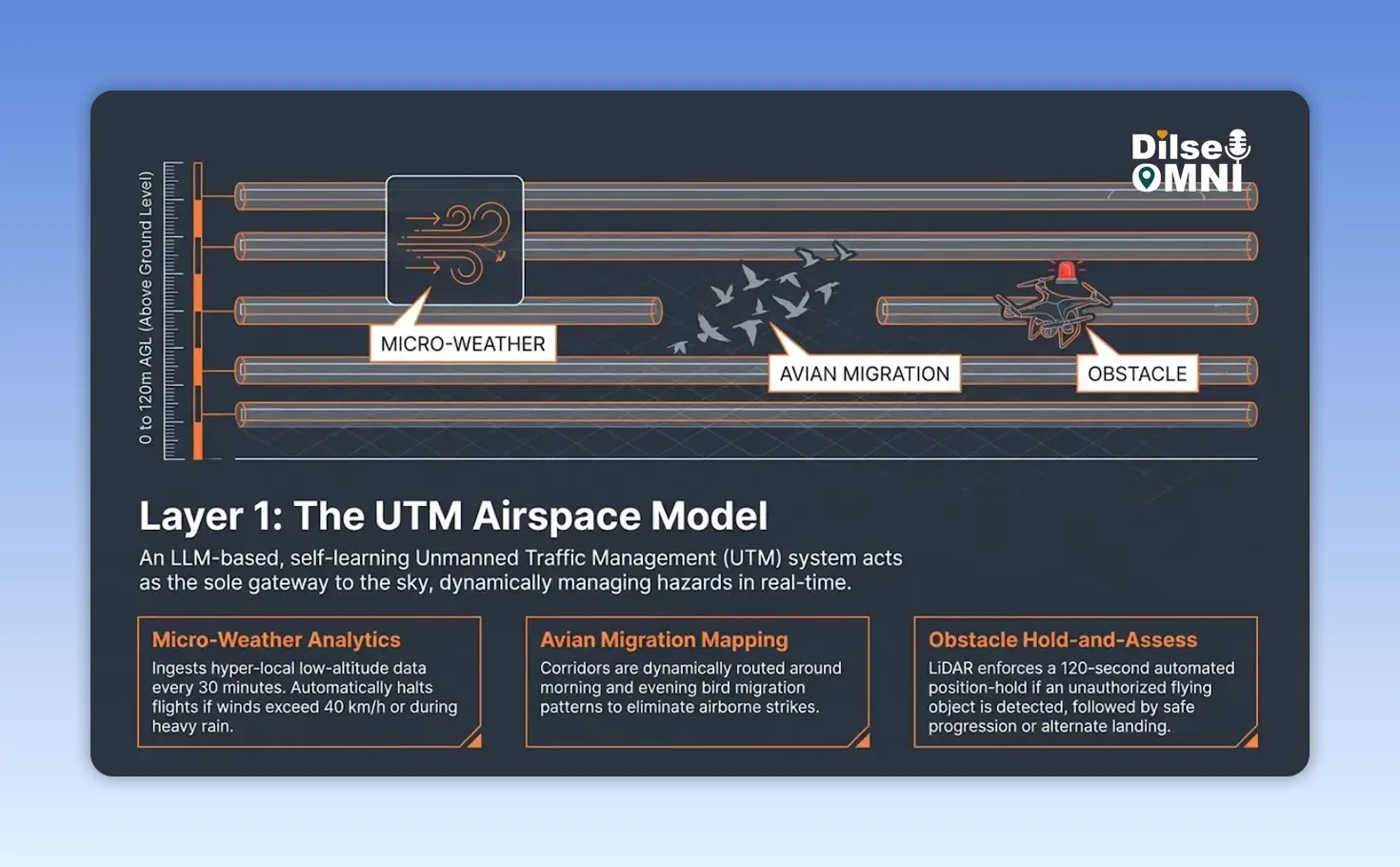
This is the invisible operating layer most people miss when they think about drone delivery.
What is air infrastructure in drone logistics?
This part of the conversation was especially fascinating because it gets into the mechanics of airspace management.
Skye Air built what Ankit calls Sky UTM, or an unmanned traffic management system. In simple terms, it acts as a gateway to the airspace. It helps determine how drones move safely by combining multiple data points such as terrain, obstacles, and low altitude weather conditions.
That matters because the conditions a human feels on the ground are often very different from what a drone experiences at 120 meters.
Ankit put it sharply:
“If there is one thing in the entire drone industry people underestimate, that’s weather.”
His argument was not theoretical. It was operational.
For drone logistics, you need precise low altitude weather intelligence, not just broad aviation or city level forecasts. A drone may face a gust that pushes it away from its designated path even when everything feels normal at street level.
Skye Air uses predictive weather analytics at regular intervals for that reason. The goal is not merely to know what the weather is. The goal is to know whether the drone can safely complete its mission within the corridor and altitude where it actually flies.
Conditions that can stop a flight include:
Wind speed beyond 40 km per hour
Heavy rainfall intensity
Unsafe low altitude conditions along the route
This makes drone logistics feel less like aviation theater and more like disciplined risk management.
The moat is not the drone. The moat is the infrastructure
One of the most revealing parts of the discussion was when we started talking about competitive advantage.
Many founders obsess over the visible product. In this case, the drone. But Ankit’s thesis is different. He believes the real moat lies in building the infrastructure layer that others will find difficult to recreate.
That includes both air infrastructure and ground infrastructure.
And he was very candid about why this matters. In any difficult category, if a company can establish the infrastructure standard early, it can create a very strong long-term position.
Another line worth highlighting:
“For us, that’s the infrastructure layer we’re creating, both ground and air.”
I found this important because it shifts the conversation from novelty to defensibility. A drone can be copied. A deeply integrated operating network is much harder to copy.
Pipeline business or platform business? Skye Air is building toward platform
I brought up a framework I like from the world of business models: the difference between a pipeline business and a platform business.
A pipeline business controls the flow end to end. A platform business creates the ecosystem where multiple participants operate on top of shared infrastructure.
My initial assumption was that Skye Air was more pipeline than platform. Ankit corrected that immediately.
His view is that the company was always meant to become a platform.
The nuance is this: in an early market, sometimes you need to operate parts of the system yourself in order to create the market at all. Once the infrastructure is proven, the model can open up more meaningfully.
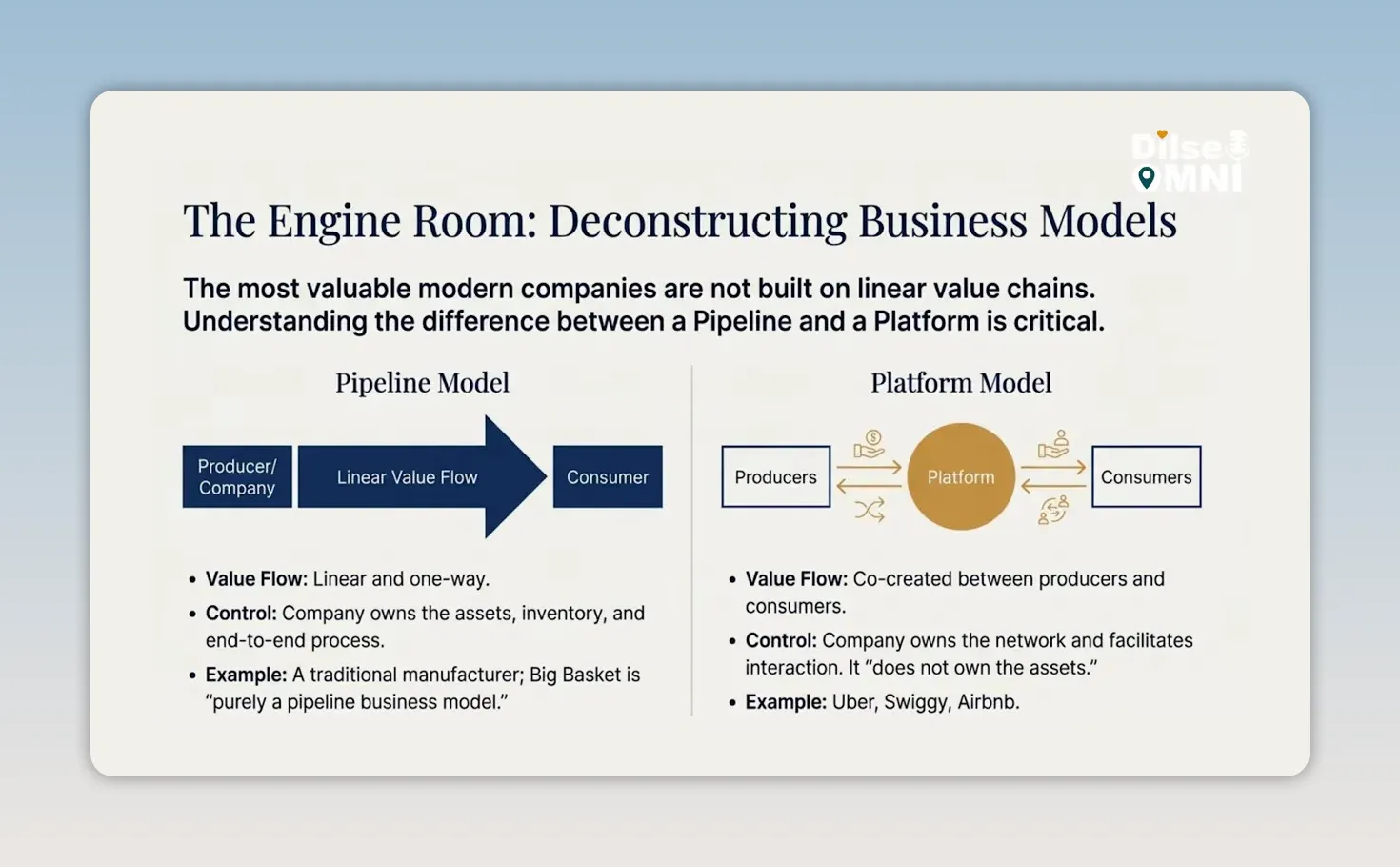
This distinction helps explain why building the market first can be a prerequisite to opening the platform later.
That has implications far beyond India. Ankit mentioned that if they expand into markets like the US or UAE, they would prefer a platform led approach there, licensing infrastructure to local players who can run operations.
That is a smart capital allocation insight.
You build the base layer where it matters, then let the ecosystem scale on top of it.
The economics of a drone fleet in India
When I asked Ankit how many drones Skye Air currently has, his answer was precise: 33 drones.
These are small category drones with a maximum takeoff weight of up to 25 kilos, carrying payloads of about 10 kilos.
The average cost per drone is around ₹6 lakh.
But again, the interesting part was not the headline number. It was how he thinks about what to build in-house.
Ankit’s belief is that drones themselves will increasingly become off the shelf commodities. If that happens, then the sustainable value will not sit in generic hardware. It will sit in specialized subsystems and operational intelligence tailored to the use case.
Skye Air’s approach reflects that logic:
About 60 percent of the drone comes from OEM partners
About 40 percent of the value addition is done in-house
That in-house layer focuses on:
Connectivity
Navigation
Autonomy
Safety
Reliability
I liked the analogy Ankit used. The refrigerator maker may build the cold box, but the enduring value often accrues to the company that turns that capability into a compelling application.
In other words, commodity hardware plus proprietary orchestration can become a powerful model.
How drone delivery actually works in India
This is the part everyone wants to know, and Ankit explained it very clearly.
Drone delivery is not usually a pure hub-to-door aerial drop. Instead, it is a hybrid logistics model designed around efficiency and practicality.
The Skye Air delivery flow
Shipments first arrive at a Skye Air station or hub.
Each hub is mapped to a specific geography and set of pin codes.
The drone takes off from that hub.
It flies to the nearest pod allocated for that pin code or local area.
The package is handed off there.
A delivery associate, called a Skywalker, completes the final doorstep delivery.
This model is practical because it preserves the speed benefit of aerial movement over longer or more difficult stretches while keeping the final handoff human and flexible.
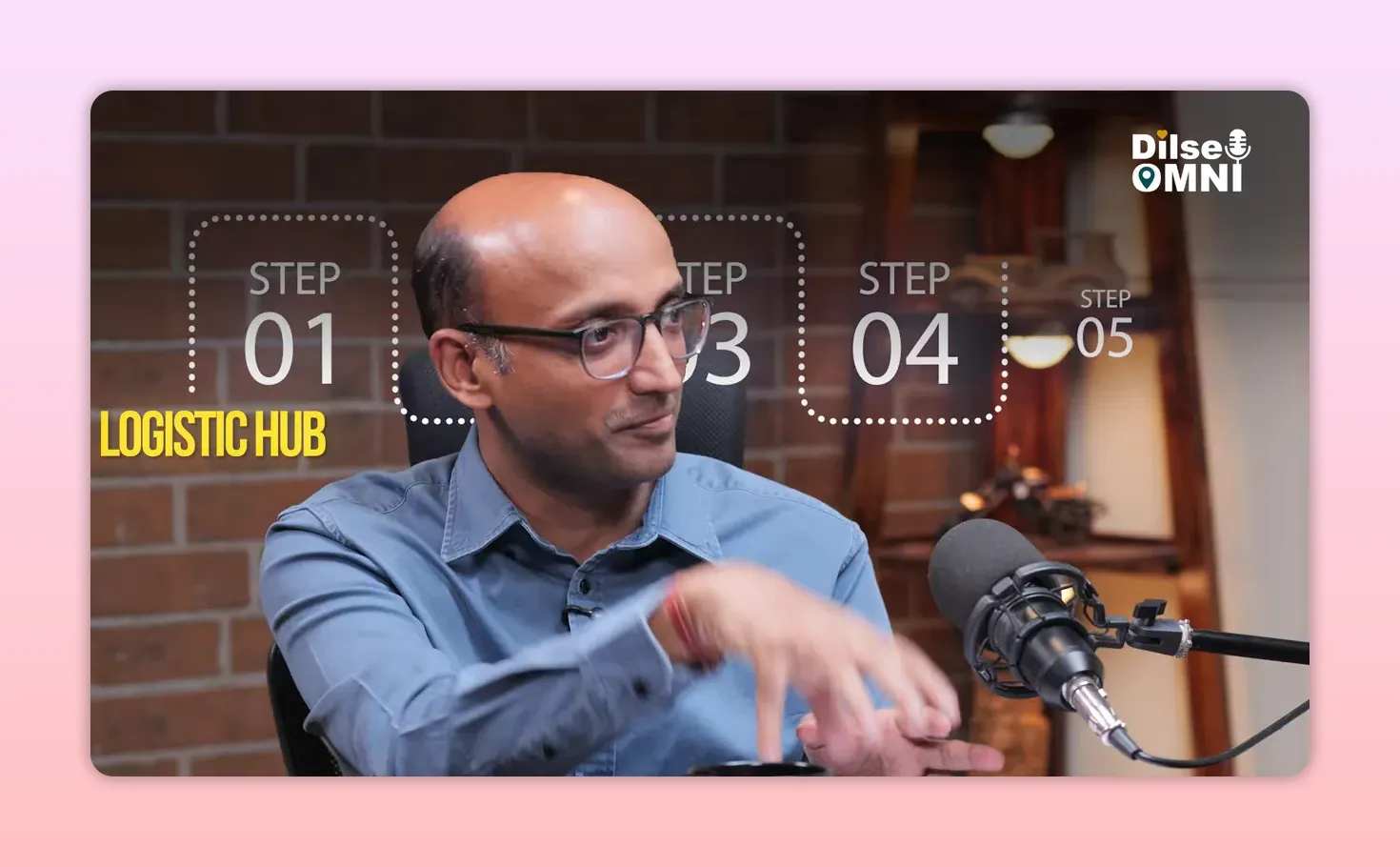
The journey is best understood as a staged network, not a single dramatic flight from warehouse to doorstep.
That handoff design also reveals a deeper truth. Last mile logistics is rarely solved by one vehicle alone. It is solved by a network architecture.
Why last mile logistics in India is still so expensive
The broader market problem Ankit is trying to solve is significant.
India spends roughly 15 to 16 percent of product cost on logistics, while the global average is in single digits. That gap tells you there is enormous room for structural improvement.
According to Ankit, the issue is not that India’s average order values are uniquely broken. The bigger issue is inefficiency in how last mile logistics works today.
His diagnosis has a few parts:
The system is highly dynamic and fragmented
Distances are long
Volumes are often low for many brands
Brands are increasingly pressured into faster delivery expectations
That speed pressure can destroy unit economics when the network is not designed for it
This part resonated with me because it is not just a logistics conversation. It is an omnichannel and brand strategy conversation too.
D2C brands that never intended to promise ultra-fast delivery are increasingly forced into it because customer expectations have shifted. But if the delivery network underneath is inefficient, faster delivery does not create advantage. It creates cost pain.
That is where drone logistics becomes interesting. Not as a flashy alternative to everything, but as a targeted way to remove inefficiency from specific parts of the network.
India Post may become a big story in this transformation
One answer from Ankit caught me by surprise.
When I asked about top logistics providers in India, the usual private players came up. But then we discussed India Post, and his perspective was far more optimistic than many people would expect.
His view is that India Post already has enormous geographic coverage through its pin code network. The real question is transformation. And from what he has seen, that transformation is becoming serious.
He believes the potential for India Post to enter the top tier is very real if it continues improving cost structures and operations.
That is worth paying attention to because whenever an institution with deep reach modernizes, it can alter the economics of the entire sector.
My biggest takeaway from Ankit Kumar
If I had to reduce the full conversation into one strategic insight, it would be this:
Drone delivery in India is not a hardware innovation. It is an infrastructure innovation.
That distinction matters because it helps separate hype from substance.
The winners in this space may not be the ones with the most eye-catching drones. They may be the ones that build the most reliable system across airspace intelligence, weather prediction, route safety, hub design, pod deployment, and last mile orchestration.
Ankit Kumar is building exactly from that lens, and that is why I found this conversation so educational.
There is also a broader lesson for founders here. In difficult categories, the obvious product is often not the real business. The real business sits in the operating layer no one sees at first glance.
I am Saurabh Agrawal and we come with a new episode on Dilse omni talks every fortnight and cover different aspect of omnichannel with amazing speakers.
This article was created from the video How does drone delivery actually work in India?