Marketing careers are changing faster than most job descriptions can keep up with. In my conversation with Dr. Ashish Bajaj on Dilse Omni Talks, we explored what this means for brand managers, analysts, martech specialists, retention marketers, and anyone aspiring to become a CMO.
Dr. Ashish Bajaj is a seasoned marketing leader, former Group CMO, and author of The Martech Playbook. Across leadership roles at Narayana Healthcare, Ola, Nokia, and Microsoft, he has worked at the intersection of consumer understanding, communication, media, technology, and business outcomes.
The central lesson from our conversation is simple but demanding: the age of being “just” one kind of marketer is fading. The marketer who can connect content, consumer behavior, data, technology, and commercial outcomes will be far more valuable than the person who only executes one isolated piece of the puzzle.
Table of Contents
The Traditional Marketing Role Is Being Rewritten
Three Traditional Silos Are Converging
The Full-Stack Marketer Framework
Why Content Creation Is a Career Superpower
The Biggest Mistake: Thinking Only in Tasks
Roles Change Fast, So Define Outcomes Clearly
Retention Marketing Is a Customer Journey Problem
A Practical Career Roadmap for the Next Four to Five Years
The Traditional Marketing Role Is Being Rewritten
For many years, the brand manager was primarily associated with creative development, consumer understanding, campaign planning, and often P&L responsibility. Those capabilities remain important. But they are no longer sufficient on their own.
Today, a brand manager is increasingly expected to understand the tools that enable customer engagement, campaign measurement, personalization, and retention. The conversation has moved from, “Can you make a strong campaign?” to “Have you worked with the relevant tools? Can you use them to create an outcome?”
“From knowing how to make a film or understanding the consumer, it is becoming: have you used these tools or not?”
That shift changes the definition of marketing capability. Great creative still matters. Deep consumer insight still matters. But both must now operate alongside a practical understanding of martech, first-party data, funnel performance, and business metrics.
This is not about expecting every marketer to become an engineer or a data scientist. It is about building enough fluency to connect the work. A marketer must be able to ask better questions, interpret what the data is saying, understand what a tool can enable, and make faster decisions across the customer journey.
Three Traditional Silos Are Converging
Dr. Bajaj explained this evolution through three groups that historically operated more separately: brand and creative teams, analytics and consumer insights teams, and marketing technology teams. Each group now needs capabilities that previously sat somewhere else.
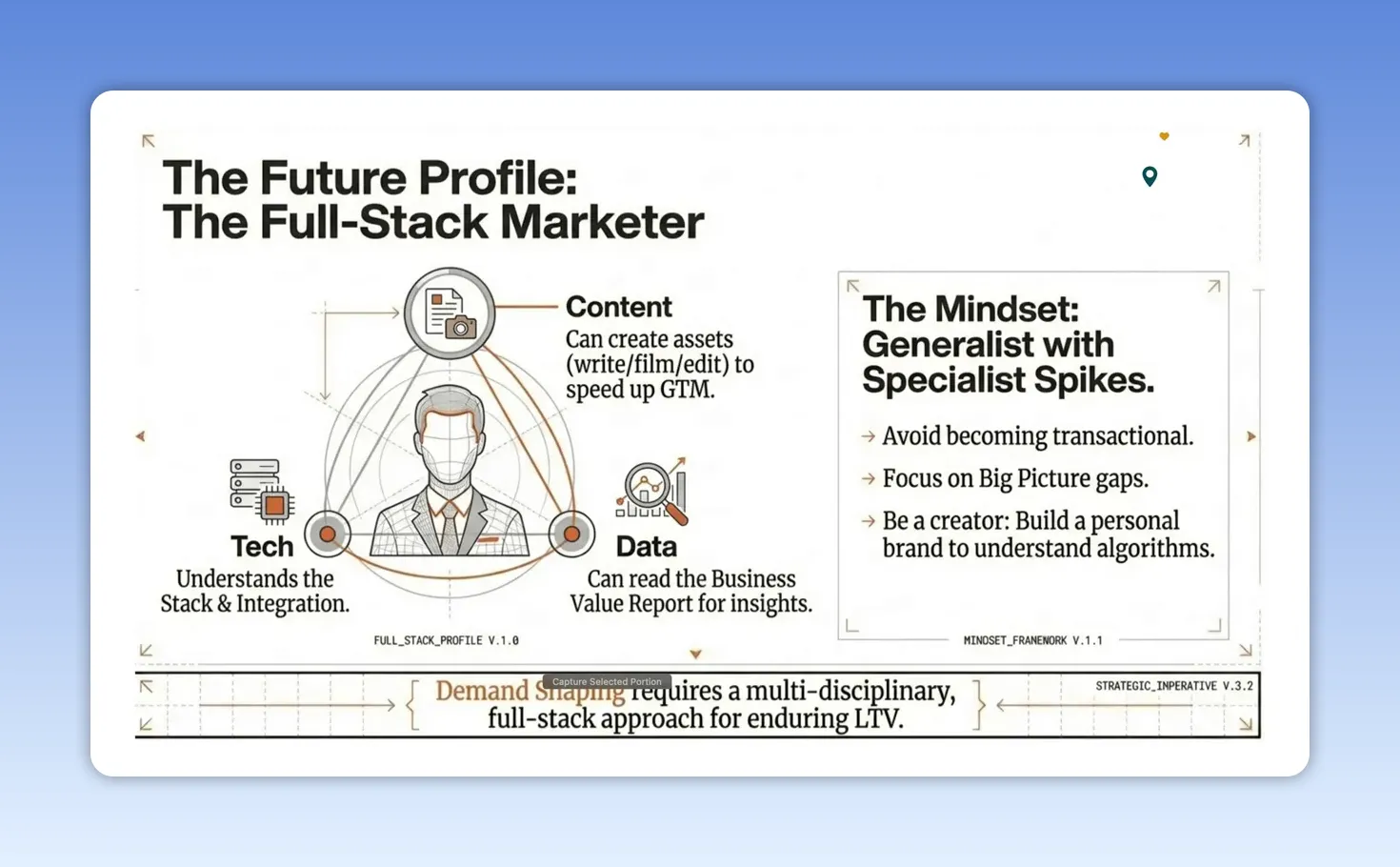
The future marketer connects content, data, consumer understanding, and technology instead of operating in one isolated lane.
1. Brand managers must become tool-aware
Brand managers still need to understand consumers, build distinct communication, and shape a brand’s commercial direction. However, they also need comfort with the platforms and systems that bring campaigns to life across channels.
If customer behavior changes, if a campaign underperforms, or if repeat purchase drops, the modern brand manager cannot remain disconnected from the data and technology behind those signals. They need enough familiarity to participate intelligently in solving the problem.
2. Analytics professionals must understand consumers
Analytics is no longer just about reporting numbers from first-party data. The stronger analytics professional can translate numbers into consumer insight. They do not stop at identifying a decline in conversion or a segment with low engagement. They ask why that behavior may be occurring.
This is where consumer insight and analytics are beginning to play together. Consumer insight teams need to become more comfortable with first-party data. Analytics teams need to become more curious about motivation, context, and the human behavior behind the dashboard.
“Analytics is now becoming relevant by saying that it doesn’t stop at first-party data. Can you also understand consumer insights?”
A conversion rate is an output. An insight explains the possible reason behind it. The most effective teams bring both perspectives together before deciding what to do next.
3. Tech teams must understand creative effectiveness
Marketing technology professionals are often responsible for the systems that deliver communications through the funnel. That means they cannot treat creative as a black box.
If a team is optimizing click-through rates, view-through rates, completion rates, or subsequent actions, it must understand which creative is working and why. A technically correct campaign setup is not enough if the message fails to earn attention or motivate action.
The technology layer distributes the communication. The creative layer makes the communication meaningful. The data layer shows whether the communication is doing its job. These are no longer three independent conversations.
The Full-Stack Marketer Framework
The result is the rise of the full-stack marketer. I do not see this as a demand to become an expert in every discipline. Rather, it is a call to become a capable generalist with one or more areas of depth.
Dr. Bajaj described a reality many organizations are experiencing: teams that were once large and specialized are now leaner. A marketer may need to engage with content, technology, and data within the same week, sometimes within the same campaign.
The Full-Stack Marketing Loop
Understand the consumer: Identify the need, friction, motivation, and context behind a customer’s behavior.
Create relevant content: Develop communication that is timely, useful, and appropriate for the audience and channel.
Activate through technology: Use the right tools, journeys, audiences, and touchpoints to deliver the message.
Measure the response: Examine engagement, conversion, drop-offs, repeat behavior, and revenue impact.
Optimize the experience: Improve the next message, next audience, next journey step, or next offer based on learning.
This loop is particularly important in omnichannel marketing. A customer does not experience an organization through its internal departments. They experience a sequence of messages, channels, products, service interactions, and offers. The marketer who can see this whole flow is in a stronger position to improve it.
Why Content Creation Is a Career Superpower
One of the most practical insights from our conversation was the importance of creating content yourself. This does not mean every marketing professional needs to become a full-time influencer. It means learning to communicate directly and ship useful work quickly.
If you can write a thoughtful post, make a strong reel, communicate an idea clearly, and publish it fast, you gain speed. And speed to market matters because it gives a brand an edge over competition.
Content is not only a campaign asset. It runs through the entire funnel. It shapes discovery, consideration, conversion, onboarding, engagement, retention, cross-sell, and advocacy. When a marketer can create content, they understand the work at a more practical level instead of merely directing others to do it.
“If you are able to create content, you are able to understand because through and through, the funnel is content only.”
There is also a valuable personal benefit. Creating content builds a visible body of work. Instead of relying only on a CV, a marketer can demonstrate their thinking, communication skills, channel understanding, and consistency in public.
My advice from this discussion is not to spread yourself thin across every platform. Master one channel first. Learn its format, audience behavior, creative rhythm, and feedback loop. Build the habit of sharing consistently. That channel can eventually become part of your professional identity and even your hiring proposition.
When you create useful content regularly, you do more than build visibility. You attract people who resonate with your way of thinking, including future colleagues, collaborators, and employers.
The Biggest Mistake: Thinking Only in Tasks
The career mistake Dr. Bajaj highlighted is very common. A marketer can become overly transactional and define their role only by a list of assigned tasks. Make a campaign. Build a creative brief. Launch a journey. Produce a report. Complete the quarterly plan.
Those tasks matter, but they are not the role’s ultimate purpose. The broader purpose is to understand the consumer and move the business forward.
“The minute you start seeing the big picture, you will start seeing the gaps. And the minute you start seeing the gaps, you will start solving those gaps.”
That is where career growth happens. The professional who only completes assigned tasks is useful. The professional who spots an unaddressed customer problem, identifies the business impact, and helps solve it becomes much harder to replace.
A brand manager aspiring to become a CMO cannot stop at saying, “I was hired to make creative.” They must ask: What consumer problem are we solving? What is stopping customers from progressing? Which part of the journey is leaking value? What commercial outcome must improve?
It is easy to say, “Nobody told me I could do that.” But marketing roles are evolving so quickly that waiting for a perfect instruction manual can become a limitation. The mindset must evolve from permission seeking to opportunity spotting.
Roles Change Fast, So Define Outcomes Clearly
There is also an organizational responsibility here. If roles are changing every few months, leaders must write better job descriptions and define clearer KPIs. A vague role creates confusion. A task-only KPI creates narrow behavior.
Good role design should connect three things:
Business requirement: Why does this role exist and which business problem does it address?
Customer outcome: What part of the customer journey, experience, or behavior should improve?
Measurable result: Which metrics will demonstrate whether the work is creating value?
This is especially important when implementing a martech stack. Martech should not be treated as a technology purchase that is complete once the platform is live. It is a business investment that must show impact.
The measurement approach should include conversions, the number of people landing at key stages, drop-offs across the funnel, revenue generated, and repeat behavior. These metrics make it possible to evaluate not only whether the system has been implemented, but whether it is yielding the intended business result.
Retention Marketing Is a Customer Journey Problem
Retention is a powerful example of why marketing cannot work in silos. Suppose a retention marketer is asked to increase repeat purchase from 8% to 9%. That looks like a simple KPI on paper, but it cannot be solved by sending more messages alone.
The marketer needs to understand the full customer journey. What did the customer do earlier? Where did they engage or disengage? Is there a relevant cross-sell opportunity? Is there an upsell opportunity? Is the previous flow helping or hurting the next action?
The first question is commercial: can we generate more revenue from the same number of people? The next question is operational: at each level of the customer journey, have the conversions improved?
This is why retention, martech, customer experience, analytics, and content are fundamentally connected. A retention number is not merely a marketing metric. It reflects the quality of the relationship created across the customer journey.
A Practical Career Roadmap for the Next Four to Five Years
For anyone building a marketing career, the direction is clear. Do not abandon your specialization. Build on it. But make sure your specialization connects to the larger marketing and business system.
Learn one marketing technology tool: Get hands-on exposure instead of only understanding concepts.
Become comfortable with first-party data: Learn to read funnel movement, conversions, drop-offs, and repeat behavior.
Develop consumer curiosity: Ask what customers are trying to achieve and what is blocking them.
Create content yourself: Build the ability to write, record, edit, or publish in at least one format.
Master one channel: Gain depth in a platform where you can build a visible and credible body of work.
Think in outcomes: Connect every campaign, tool, and journey to customer and business impact.
Look beyond the job description: Identify gaps and contribute to solving them before someone assigns them to you.
The next generation of marketing leaders will not be defined only by their creative instincts, analytical ability, or technology knowledge. They will be defined by their ability to bring these capabilities together and turn them into business outcomes.
I am Saurabh Agrawal and we come with a new episode on Dilse Omni Talks every fortnight and cover different aspect of omnichannel with amazing speakers.