One question comes up repeatedly in conversations with D2C founders: when is the right time to launch a mobile app? Is it the moment the website goes live? Is it after reaching a revenue milestone? Or is there a more meaningful signal?
I discussed this with Abhijeet Singh, Co-founder of Appbrew, a mobile commerce platform helping brands build scalable, high-converting shopping apps. Abhijeet works closely with brands that want to grow through better app experiences, stronger customer engagement, and deeper retention. His answer was refreshingly direct: an app is not the starting point of the business. It is a multiplier for a business that has already found its footing.
The temptation for a founder is understandable. Apps feel like a sign of maturity. They create a direct channel with customers, enable richer experiences, and can strengthen retention. But launching one before the fundamentals are stable can simply move a broken journey from a browser to a smaller screen.
Table of Contents
The Real Question Is Not Revenue, It Is Readiness
The App Readiness Framework: Product, Journey, Economics, Relationship
Is $1 Million in Annual D2C Revenue the Benchmark?
Why Appbrew Sometimes Says No
A Founder Checklist Before Launching a D2C Mobile App
Do Not Build an App Because It Is Expected
The Real Question Is Not Revenue, It Is Readiness
Most discussions around mobile apps begin with a revenue number. “Should I launch after hitting $1 million?” But Abhijeet’s core point is that revenue alone does not decide readiness.
“The right time to look for an app is when, as a brand, you have some kind of product market fit.” Abhijeet Singh
Product market fit is often used as startup jargon, but it is practical when you break it down. It means your product and pricing are connecting with a real group of people, your acquisition engine is working, and your customer journey is delivering a credible experience.

Product market fit sits at the intersection of what you offer and what the market genuinely wants.
In our conversation, this became the foundation for every other decision. Before investing in an app, a D2C brand should be able to say:
Our product solves a meaningful customer pain point.
Our price is acceptable for the value we are delivering.
Customers are responding positively to the buying experience.
We have a working digital journey from discovery to purchase and beyond.
Our customer acquisition economics make sense for our category.
That is the sequence. Build the value proposition first. Build the business around it. Then build a deeper customer relationship through an app.
The App Readiness Framework: Product, Journey, Economics, Relationship
Abhijeet’s thinking can be turned into a simple four-part framework for founders. I call it the PJER Framework, because it helps separate the excitement of launching an app from the discipline of being ready for one.
1. Product: Is There a Clear Value Proposition?
Every brand is a unique story. A particular product is solving a particular pain point for a particular customer at a particular price. When a set of people begins to appreciate that value proposition, the brand starts building a community.
That community does not emerge because the brand has an app. It emerges because the product and the proposition work.
“Fundamentally, it is product and price. If that is not solved, no kind of tech will help you get an incremental outcome.” Abhijeet Singh
This is worth pausing on. Technology can improve a great customer journey. It can make shopping more convenient, help the brand communicate more frequently, and support retention. But it cannot compensate for a product people do not want or a pricing model that does not work.
2. Journey: Is the Website Experience Stable?
Once customers begin discovering the brand, the next question is whether the digital journey is dependable. The website is usually the first important owned commerce touchpoint. It is where customers browse, understand the product, add to cart, check out, and assess whether the brand is trustworthy.
Abhijeet shared an example of a brand that launched an app only three months after launching its website. The problem was that the website itself was not stable. Checkout was broken, and the business appeared to be following a launch checklist rather than building from customer readiness.
That is the wrong order of operations.
An app should not become an escape route from a weak website. If checkout friction, product discovery issues, fulfillment concerns, or post-purchase confusion exist on the website, the brand needs to solve those first. Otherwise, it creates more surfaces to manage without improving the actual experience.
A stable website indicates that the business understands its digital customer journey. It proves that the brand can take demand and convert it reliably before adding another owned channel.
3. Economics: Are Acquisition and Unit Economics Working?
The next layer is economics. One useful indicator is ROAS, or return on ad spend. It helps a brand understand whether paid marketing is producing sufficient revenue relative to the advertising investment.

ROAS is useful only when interpreted alongside the unit economics of the category.
However, there is no universal “good ROAS” number. That was another important insight from Abhijeet. A fashion brand may need a 3x or 5x return for the model to work, while a supplement brand with higher product margins may work successfully at 1.2x.
The correct question is not, “What ROAS should every D2C brand achieve?” The correct question is:
Does our ROAS work within our own unit economics?
Margins, repeat behavior, price point, category dynamics, and the cost of serving customers all shape that answer. If acquisition is profitable and sustainable, it is a meaningful sign that product market fit is beginning to take shape.
4. Relationship: Is It Time to Go Deeper With Customers?
When product, journey, and economics are in place, the app becomes much more than another sales channel. It becomes a way to build a deeper relationship with the customers who already trust the brand.
A brand communicates with its community through its online store, email, and SMS. The app can become another direct, high-intent channel in that ecosystem. But its role is not merely to exist. Its role is to create a better experience for a customer who has already found value in the brand.
This is where mobile commerce starts to make strategic sense. The app should support an already functioning relationship, rather than trying to manufacture one.
Is $1 Million in Annual D2C Revenue the Benchmark?
Revenue is still a helpful reference point, provided we do not mistake it for the whole decision. Abhijeet uses $1 million in annual D2C revenue as a broad minimum benchmark when evaluating whether an app conversation should begin.
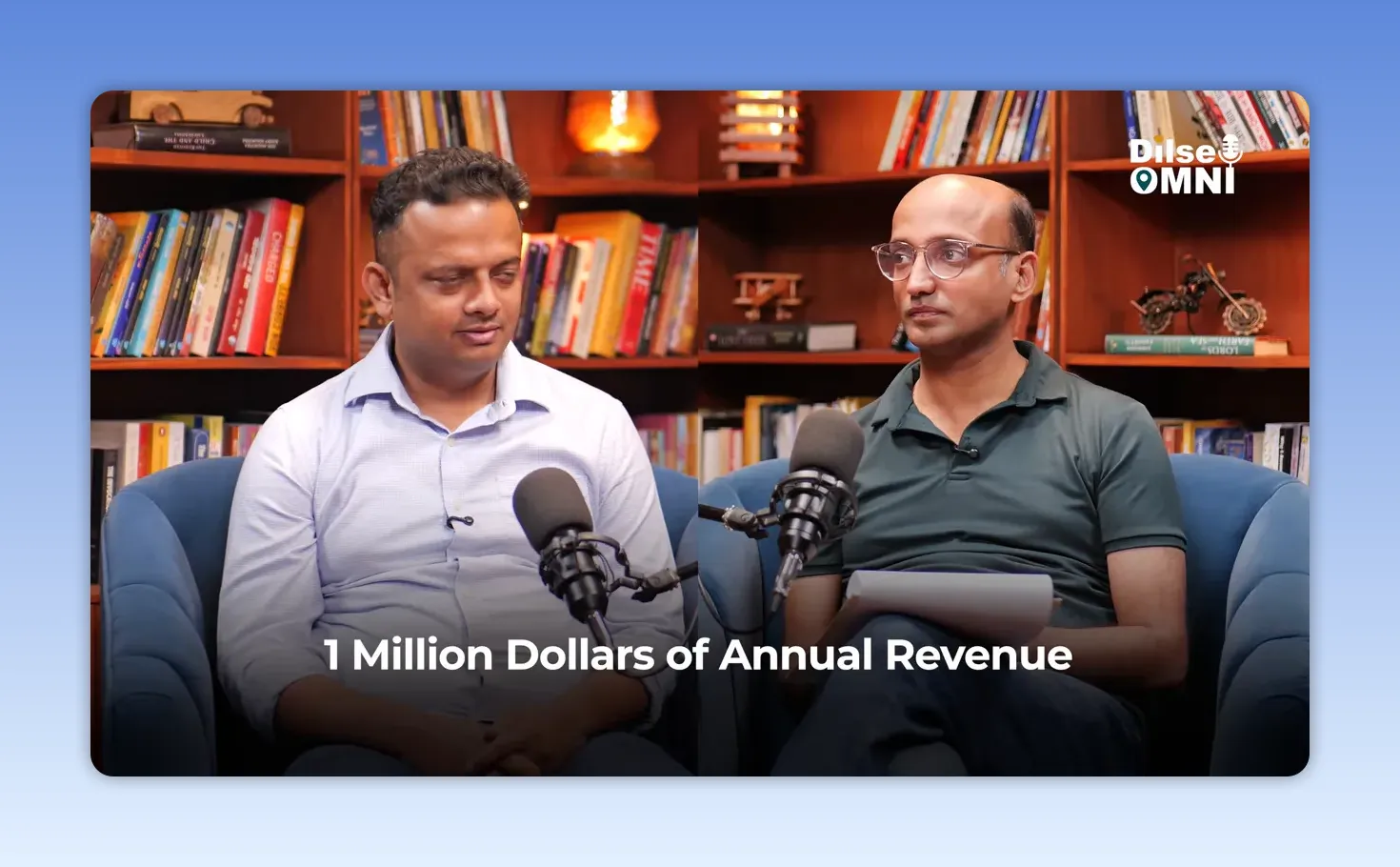
A $1 million annual D2C revenue level can be a useful reference point, not an automatic app launch trigger.
At that scale, a brand may be handling roughly 30 to 50 orders per day, depending on order value. The important qualifier is that the business should be profitable and the acquisition engine should be working.
Abhijeet also pointed out that apps tend to create more clearly incremental value once a brand crosses approximately $5 million plus in D2C revenue. At that stage, the customer base, transaction volume, and communication needs can make the app a stronger lever for growth.
But founders should not treat these figures as rigid gates. They are benchmarks, not commandments.
There are brands doing 50 to 100 orders that have already figured out their digital journey and are ready to create a better owned mobile experience. There are also brands with larger ambitions but unstable checkout flows, unclear unit economics, or unresolved customer issues. The former can be more prepared than the latter.
Why Appbrew Sometimes Says No
I found this part particularly important. In an ecosystem where every service provider is tempted to say yes, Abhijeet shared that Appbrew has said no to brands that were too early.
That is not because early-stage brands lack potential. It is because building an app is a long-term game. When the product, pricing, and digital journey are not in place, an app implementation may become a distraction rather than an accelerator.
At the same time, Appbrew has said yes to brands at a relatively early stage when those brands had already figured out the essentials. Some of those businesses went on to become much larger brands, growing dramatically over time. As their businesses grew, their net revenue and customer engagement grew as well.
The lesson is not to wait indefinitely. The lesson is to make the decision based on business clarity, not founder anxiety or a generic checklist.
A Founder Checklist Before Launching a D2C Mobile App
Before committing to a mobile app, I would encourage every D2C founder and ecommerce leader to work through these questions honestly:
Does our product have real market pull? Are customers responding to the product, value proposition, and pricing?
Are our customer experiences positive? Look at both pre-purchase and post-purchase feedback, not only sales numbers.
Is our website stable? Product discovery, cart, checkout, and communication should work consistently.
Do our acquisition economics work? Evaluate ROAS in the context of category-specific unit economics and margins.
Do we have a growing community to serve? An app is most useful when it gives an existing customer base a more direct, valuable experience.
Will the app create incremental value? Be clear about the outcome you expect, whether that is better engagement, a stronger customer relationship, or a more effective owned channel.
Do Not Build an App Because It Is Expected
The biggest mistake is assuming every D2C brand must launch an app immediately. An app is not a badge of legitimacy. It is a strategic investment that earns its place when the underlying business is ready.
Build the product people value. Get the price right. Create a stable digital journey. Understand your unit economics. Listen carefully to your customers before and after they purchase. Once those pieces are working, an app can help the brand build a deeper and more durable relationship with its community.
That is the real sequence: product market fit first, stable commerce second, deeper mobile engagement third.
I am Saurabh Agrawal and we come with a new episode on Dilse omni talks every fortnight and cover different aspect of omnichannel with amazing speakers.