Most brands begin their loyalty journey with a familiar question: should we give points, cashback, tiers, or discounts?
That is usually where the trouble starts.
In my conversation with Mahadevann Iyyer, Director at Maavrus and a deeply experienced retail and customer loyalty expert, I realised that a loyalty programme is not a rewards engine. It is a business strategy expressed through customer experience. Mahadevann has worked on loyalty programmes across brands including Tesco, Landmark, American Express, and Blackberry, and his approach is refreshingly clear: start with the business, not the points.
“Loyalty is not a short term commitment. It is a long term commitment and it has financial implications.”
That one idea should change how founders, retail leaders, CRM teams, and D2C operators approach customer retention. A loyalty programme cannot be a side project run only by marketing. It has to be built around the business model, customer behaviour, brand personality, technology reality, and measurable commercial outcomes.
Table of Contents
The five step loyalty programme framework
Step 1: Define the business objective before designing rewards
Step 2: Discover who your loyal customers really are
Step 3: Design for the customer, not for the spreadsheet
Step 4: Execute across technology, channels, and moments of truth
Step 5: Stabilise, measure, and build customer habits
Use loyalty to create a habit loop
The five step loyalty programme framework
Mahadevann’s framework is useful because it begins before the loyalty programme even exists. Think of it as a sequence, not a checklist to skip around.
Define: Clarify the business context and objective.
Discover: Understand customers through data, store visits, and conversations.
Design: Build the right value exchange for the category and customer persona.
Execute: Make the technology, omnichannel experience, training, and communication work together.
Stabilise: Measure business impact, customer behaviour, programme performance, and continuously optimise.
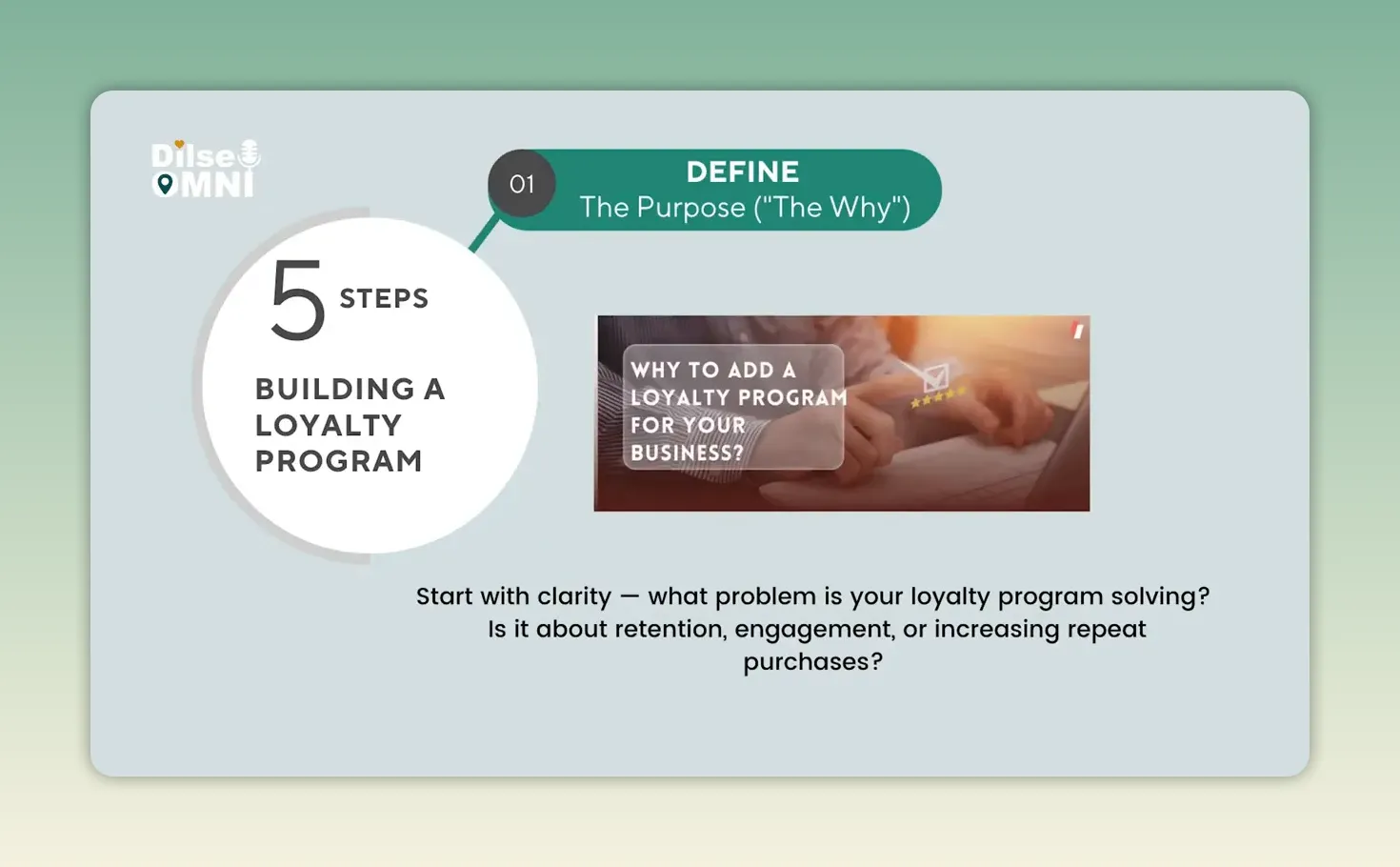
A loyalty programme begins with the business problem it is meant to solve.
Step 1: Define the business objective before designing rewards
The first conversation should not be, “What loyalty programme should we launch?” It should be, “What are we trying to achieve as a business?”
Mahadevann calls this understanding the why of the loyalty programme. But it goes deeper than loyalty. It asks why the business exists, where it stands in its market, and what growth problem it must solve now.
Are you trying to acquire more customers because you have hit saturation? Are competitors taking away your existing base? Is repeat purchase low? Is the business a disruptive newcomer, or an established player protecting its customer base? These are very different situations, and they need very different loyalty strategies.
The industry context matters just as much. A grocery chain has high purchase frequency, limited product differentiation, and tight margins. A coffee chain may see customers every day. A furniture or jewellery retailer may see the same customer only once a year or even once in 18 months. Fashion sits somewhere between these extremes.
If a customer naturally shops once a year, increasing frequency may not be a sensible primary goal. The programme may need to increase basket value, strengthen advocacy, or generate referrals instead. In grocery, frequency could be the right focus. The programme must respect the natural rhythm of the category.
“The loyalty programme comes next. The business context and objective come first.”
This requires senior leadership alignment. Loyalty creates a long-term customer promise and a financial liability through points, rewards, benefits, and fulfilment. Any team designing it must be able to ask the difficult questions of the CEO and CXO team, directly or indirectly.
Step 2: Discover who your loyal customers really are
Once the objective is clear, the next task is discovery. Mahadevann approaches discovery through three lenses: quantitative data, qualitative understanding, and execution reality.
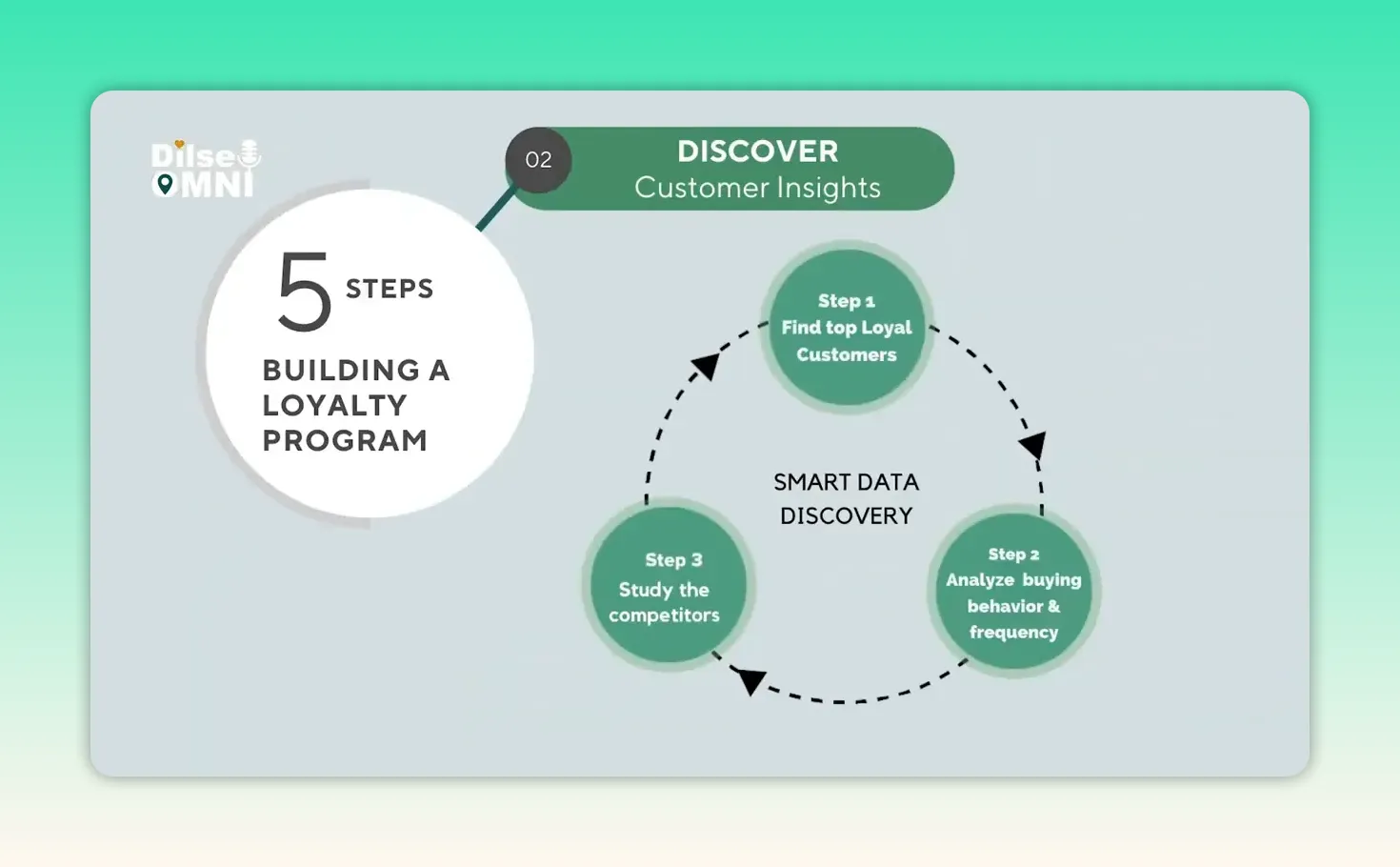
Discovery combines customer data, shopping patterns, competitive learning, and real store-level behaviour.
Start with the numbers
Look at customer segments, transactional patterns, high-value customers, purchase frequency, spend levels, and category behaviour. Who contributes the most value? How often do they buy? Which customers are growing, which are churning, and which customers have stayed loyal for years?
One of the simplest but most revealing questions Mahadevann asks businesses is this: Who are your top 20 customers?
Surprisingly, many leadership teams cannot answer it with clarity. Yet the top 20 or top 100 customers may spend multiples of what a normal customer spends. Knowing them is not just about identifying revenue. It reveals why they choose the brand in the first place.
At American Express, I had seen how seriously this can be taken. The leadership team reviewed top customer analyses, tracked shifts in their behaviour, and made personal outreach part of the process. When a customer is spending at that level, a one-to-one relationship is not a luxury. It is simply good business.
Then go to the store and listen
Data alone cannot explain loyalty. Mahadevann visits stores, speaks with customers, and deliberately avoids starting the conversation with the loyalty programme. Instead, he asks why they come to that particular store, what the brand offers that competitors do not, and why they keep returning.
Those conversations uncover the emotional reasons behind customer behaviour. They also help reveal whether the data is clean. In physical retail, customer phone number capture can sometimes be inconsistent or manipulated. Comparing the system with reality on the ground is essential.
Today, businesses do not need to wait for a formal loyalty programme to begin learning. Customers often share phone numbers for e-invoices, e-credit notes, SMS updates, or WhatsApp communication. Customer identity and transaction data can already provide useful insight.
Step 3: Design for the customer, not for the spreadsheet
This is where Mahadevann’s most important principle comes alive: loyalty design is where art meets science.
Financial modelling is necessary. You must understand the cost of rewards, the margin trade-offs, and whether the programme should increase frequency, value, retention, or referrals. But the mathematics alone cannot build loyalty.
A furniture customer and a jewellery customer may both purchase products worth a lakh or more. Yet their motivations, emotions, social context, and expectations can be completely different.
The furniture versus jewellery lesson
Furniture is relatively transactional. A customer may buy a sofa or bed, feel satisfied, and not return for another year. In this situation, referral and advocacy can be powerful ways to unlock more value from a happy customer.
Jewellery is different. The purchase is emotional, identity-led, and often socially visible. A customer recommending a jewellery brand may not want her recommendation to look like a cashback transaction in front of friends.
Mahadevann shared the example of a jewellery retailer that promoted a direct 10% reward for referrals. Referrals actually declined. The incentive made the recommendation feel transactional and potentially damaged the customer’s social positioning.
“A loyalty programme has to amplify the brand and make the person feel important.”
The better approach may be to recognise referrals more subtly. Silent points, progression to a higher tier, privileged experiences, or access connected to the brand can preserve the customer’s sense of status. The reward still exists, but it does not undermine the reason the customer is advocating.
This is the real design question: does the programme feel native to the brand? A serious premium brand may not benefit from excessive gamification. A community-led, transactional D2C brand may thrive on it. Referral, earn, burn, redemption, and tiers are mechanisms. The brand experience is what gives them meaning.
Step 4: Execute across technology, channels, and moments of truth
A beautiful programme on paper is useless if it is difficult to implement, confusing for customers, or invisible to store teams.
Execution has three connected parts: the technology architecture, the customer experience and rollout, and the measurement infrastructure.
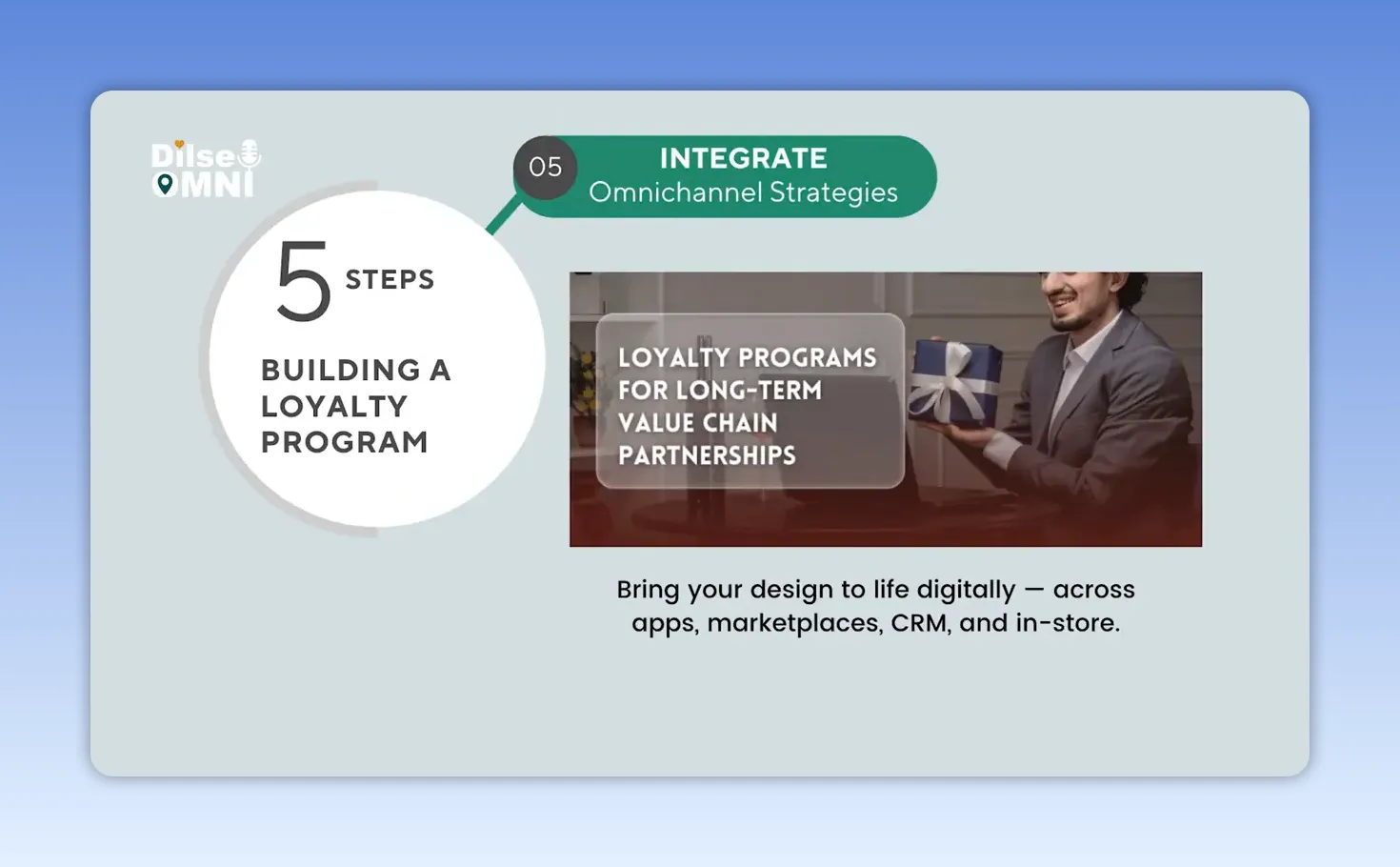
Loyalty works best when it is integrated across digital, stores, CRM, marketplaces, and the wider customer journey.
Get the technology architecture right
Most brands are moving toward omnichannel retail, either from digital into physical or physical into digital. But many businesses still operate as multichannel organisations, with different systems, different customer data, and disconnected experiences across stores and online platforms.
For example, a brand might operate online through Shopify or Magento while using another point-of-sale system in stores. That creates complexity in identity, points, redemption, and customer visibility. A customer should not feel that they are dealing with separate businesses simply because they have switched channels.
For smaller D2C brands, the barrier is much lower than it was earlier. Configurable loyalty tools can offer earn, burn, redemption, and engagement features without extensive custom development. In one D2C example we discussed, a loyalty tool was implemented quickly and customers began returning repeatedly to use their earned value.
For a larger, established retailer with multiple legacy systems, the work is more complex. The key lesson is not to design something so elaborate that it takes years to launch. Mahadevann involves technology teams during design itself, so the programme is shaped by real guardrails rather than wishful thinking.
Design every moment of truth
Execution is also about simplicity. How many clicks does a customer need to understand or redeem a benefit? Is the app or website intuitive? Can a store associate explain the benefit in a normal conversation rather than reciting a complicated script?
Store teams matter enormously because much of retail business still happens physically. They need to understand the programme, know the hero benefits, and communicate them naturally. A long list of benefits buried in an email does not create engagement.
Personalisation helps here. Instead of telling every customer everything, identify the one or two benefits most relevant to that individual and communicate them clearly. The rest can remain supporting information.
Choose build, buy, or configure wisely
A new programme can require four to six weeks for discovery and design. Implementation may take two to six weeks depending on the technology, integrations, and clarity of scope. The decision is rarely just build versus buy. Often, the most practical option is to configure an existing platform around a disciplined programme design.
Do not copy Starbucks Rewards because Starbucks is Starbucks. The best loyalty programme is not the most sophisticated one. It is the one that matches the business, customer, and operational capability.
Step 5: Stabilise, measure, and build customer habits
Launching a loyalty programme is not the finish line. It is the beginning of the actual work.
Mahadevann separates measurement into three layers.
Business metrics: Is the business growing? Is marketing ROI improving? Are same-store sales, geographic growth, or overall performance improving?
Customer metrics: Is churn reducing? Are monthly or annual spends increasing? Is predicted customer lifetime value improving?
Operational metrics: Are customers joining the programme? Are they engaging with communications? Are they clicking, redeeming, and connecting across channels?
It is important not to confuse programme ROI with business success. Repeat sales are influenced by the loyalty programme, but also by the market, product, pricing, competition, and overall business execution. The programme should be evaluated honestly within that larger context.Once these metrics are visible, the programme moves into retention marketing. Build customer journeys for meaningful events: app download, first purchase, product return, inactivity for 30 days, category exploration, or a lapse beyond the normal purchase cycle.
Then create a customer engagement calendar. If a cohort is becoming inactive, communicate a relevant benefit. If a customer has bought in one category but not another, create a thoughtful cross-category prompt. The aim is not to send more messages. It is to send the right message at the right time.
Use loyalty to create a habit loop
Great loyalty programmes understand customer behaviour and reinforce useful habits.
Starbucks Rewards, for example, uses streak-based mechanics because coffee is naturally a frequent purchase. Buying across consecutive days can unlock greater value, encouraging a repeat pattern that fits the category.
Big Bazaar’s Profit Club followed another habit-building logic. Customers paid upfront and received a monthly amount to spend over a defined period. The model encouraged recurring visits and often led customers to spend more than the monthly benefit. The programme became part of the household shopping routine.
The point is not to replicate either model. The point is to understand the behaviour you want to encourage and determine whether it is natural for your category.
A loyalty programme that starts with points may deliver discounts. A loyalty programme that starts with business strategy can deliver retention, advocacy, customer understanding, better marketing ROI, and sustainable growth.
“The heart and soul lies in the design.”
I am Saurabh Agrawal and we come with a new episode on Dilse omni talks every fortnight and cover different aspect of omnichannel with amazing speakers.