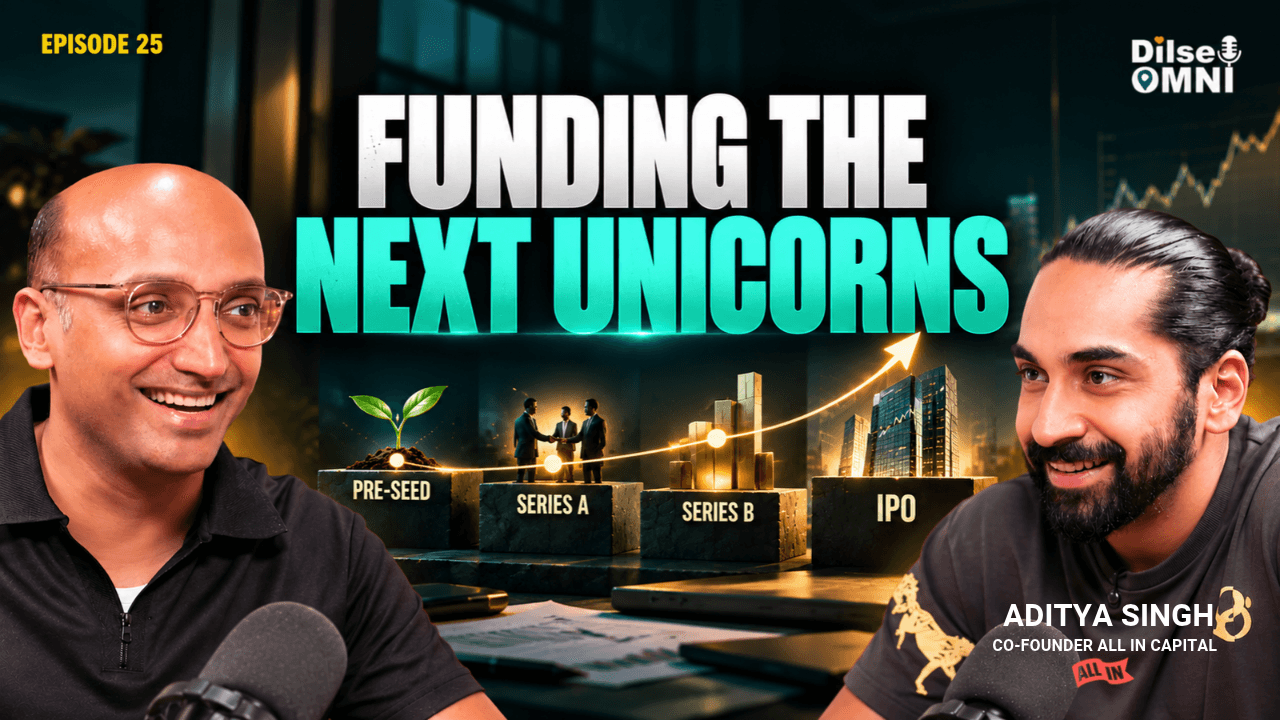
I began my conversation with Beerud Sheth on Dilse Omni Talks with a question about SaaS valuations. I left with a much bigger question: when intelligence becomes widely available, what makes a software business difficult to replace?
Beerud is the Co-Founder and CEO of Gupshup, a global conversational AI platform for marketing, commerce, and customer support. An IIT Bombay and MIT alumnus, he previously co-founded Elance, which later became Upwork. At Gupshup, he has navigated the journey from messaging to conversational AI.
That experience made this exchange a practical masterclass. We moved from the changing economics of software to faster experimentation, from prompts to graphs, and finally to the question every AI founder needs to answer: what will remain valuable when the next model gets better?
Table of Contents
1. AI Is Challenging the Economics Behind SaaS
2. The New Moat Is Proprietary Context
3. Start Inside: Reduce Organizational Debt Too
4. Cheaper Experiments Change How Teams Learn
5. From Humans to Prompts to Loops to Graphs
6. Build for the Next Model, Not Just Today’s Gap
Unique Does Not Have to Mean Small
1. AI Is Challenging the Economics Behind SaaS
I opened by asking about pressure on software companies, referring to names such as Adobe, HubSpot, and Klaviyo. Beerud deliberately avoided commenting on individual businesses. Instead, he explained the underlying shift.

Traditional SaaS economics made sense because building software was expensive. One company would invest in development, add features for many different customers, and spread that cost across thousands of subscriptions.
Customers accepted a broad product, even if they used only a fraction of its capabilities, because buying was usually easier than building.
AI is changing that calculation.
As development becomes cheaper and faster, a business can consider building a smaller tool around its own requirements. It does not necessarily need to recreate an entire platform.
“They just have to build the 10% of the software that they actually use.”
Beerud Sheth
That 10% is an illustration, not a universal measurement. But the principle is powerful: the competitive threat may not be another full-featured SaaS company. It may be a customer deciding that a focused internal solution is enough.
Beerud shared that Gupshup has already automated some work previously handled through external software. The intention was not to launch competing products. It was to create something better suited to Gupshup’s needs and more closely integrated with its operations.
My takeaway was simple: feature breadth becomes a weaker advantage when customers can build precisely what they need.
2. The New Moat Is Proprietary Context
If software becomes easier to create, what remains defensible?
Beerud’s answer was not a cleverer prompt or a more polished interface. It was context that a general AI model cannot access on its own.

A model can have tremendous intelligence without knowing how a particular enterprise operates. It may understand an industry broadly while lacking the company’s internal policies, commercial terms, integrations, and customer journeys.
“You have to find these islands of proprietary context.”
Beerud Sheth
He made “context” concrete. It can include:
Data: information specific to the business.
Policies and documents: the internal rules governing decisions.
Prices and rates: commercial details relevant to a transaction.
Integrations: connections to the systems where work happens.
Workflows and journeys: the company’s particular way of serving customers and running operations.
At Gupshup, Beerud described adding context to its Super Agent across geographies, industries, companies, teams, and departments. The aim is to combine general intelligence with the specific understanding needed to execute useful work.

This is also central to our broader conversation about why the future of marketing is conversational. Intelligence matters, but its business value depends on the context in which it acts.
The Context Loop: A Framework for Compounding Value
Beerud described a reinforcing loop. Here is how I would put it on a whiteboard:
More customers → More context → Better orchestration → Better outcomes → More customers
The important word is orchestration. Context helps a system coordinate actions more appropriately, rather than simply generate a plausible response.
For me, this reframes the moat question. It is not just, “How much information do we have?” It is, “Does our understanding help us deliver better outcomes, and does that capability improve over time?”
Beerud captured the commercial objective in a memorable phrase:
“Converting tokens into outcomes, which then leads to incomes.”
Beerud Sheth
That is a useful test for any enterprise AI proposition. The customer is ultimately buying an improvement in the business, not the production of more AI output.
3. Start Inside: Reduce Organizational Debt Too
I asked Beerud whether AI had helped reduce Gupshup’s technology debt. His answer extended beyond the product stack.
Gupshup had grown rapidly, leaving some processes manual. AI helped the company automate work in finance, operations, and HR more quickly.
He pointed out a familiar irony: technology companies spend so much energy building software for customers that their own internal systems receive less attention.
This gave me a useful distinction:
Technology debt sits in the product and software stack.
Organizational debt accumulates in manual processes and ways of working that have not kept pace with growth.
Beerud said AI had helped Gupshup address both, making the organization leaner and more productive. The lesson is practical: AI transformation does not have to begin with a new customer-facing product. It can begin with work your own teams have been waiting to simplify.
4. Cheaper Experiments Change How Teams Learn
My next question was about prioritization. If Beerud sees new possibilities constantly, how does he decide which ideas engineering should pursue?
He challenged the assumption behind my question. When experimentation becomes cheaper, teams do not need to filter every idea as aggressively before testing it.
They can encourage creativity, put something useful in front of customers, collect feedback, and invest further where the value becomes clear.
Idea → Build → Customer feedback → Iterate → Double down
Both development time and the feedback cycle have shortened. Beerud also described engineering teams moving closer to customers, allowing them to build, release, learn, and improve faster.
I added an observation from my own experience: the people creating software now extend beyond core engineering. Product managers and DevOps professionals are participating too.
The opportunity is therefore bigger than faster coding. It is a shorter distance between understanding a problem and testing a possible solution.
5. From Humans to Prompts to Loops to Graphs
The most useful operating framework Beerud shared was a four-stage progression in how work gets done with AI.
HUMANS → PROMPTS → LOOPS → GRAPHS
Think of these as increasing levels of abstraction. At each stage, we specify less of the individual execution and more of the objective or coordinated workflow.
Humans: people perform the task directly, such as writing code or creating a landing page.
Prompts: people instruct AI to produce the code or landing page.
Loops: a system generates an output, tests it against an objective, and iterates.
Graphs: context and memory help organize connected tasks and the loops needed to execute them.
His coding example made the progression clear. First, a person writes code. Then a prompt produces code. Next, a loop writes, tests, and revises it against an objective. At a higher level, a graph can organize the loops that generate the prompts and code.
What This Means for Marketing
Beerud applied exactly the same thinking to marketing.
At the prompt stage, a marketer asks AI for a landing page. At the loop stage, the instruction becomes creating and improving that page against a conversion objective.
At the graph stage, the system understands a larger workflow: a product launch may require a dozen landing pages, a homepage, blog posts, and an email draft. Those connected requirements can drive the individual execution processes.
My learning was that AI productivity is not only about becoming better at prompting. It is also about learning to define objectives, feedback loops, and relationships between tasks.
6. Build for the Next Model, Not Just Today’s Gap
When I asked what advice Beerud would give a young AI entrepreneur, he offered an important reality check: development has become easier for everyone.
Speed alone does not answer the differentiation question. Founders also need to ask whether their product will remain distinct as the underlying models improve.
He referred to tools for blog writing and coding whose capabilities later became available directly through general AI models. A lightweight wrapper may attract revenue today without becoming a durable business.
I summarized the risk during our exchange:
“Products are becoming features very quickly.”
Saurabh Agrawal
Drawing from Beerud’s advice, I would use three questions to pressure-test an AI product:
The upgrade test: could a stronger general model deliver the core capability directly?
The context test: what essential information or workflow does the model lack?
The durability test: why will access to that context remain distinctive over time?
This complements the broader question of how to make an AI startup harder to replace. A compelling demonstration is a starting point, not proof of lasting defensibility.
Unique Does Not Have to Mean Small
Toward the end, I connected Beerud’s argument to solving a niche problem, such as software for automobile dealerships. He immediately sharpened the distinction.
A defensible opportunity does not have to be a small niche. Large markets can contain proprietary context too. What matters is whether the solution depends on something unique, rather than public information a general model can handle.
He remained deeply optimistic about AI spreading throughout the economy, creating more software use cases and eventually extending further into the physical world through robotics.
I left with a clearer principle: do not build only around what AI cannot do today. Build around the business context it cannot see on its own, and use that understanding to deliver outcomes that matter.
I am Saurabh Agrawal and we come with a new episode on Dilse omni talks every fortnight and cover different aspect of omnichannel with amazing speakers.