Nilesh Patel
Nilesh Patel
Episode 27
Episode 27
90 min
90 min
The Lead Management Playbook
The Lead Management Playbook
The Lead Management Playbook
Why Does This Episode Matter?
Why Does This Episode Matter?
Nilesh Patel, founder of LeadSquared, has watched India’s consumer businesses grow over the past 15 years and explains why. When brands spend heavily to bring in demand, they need a system to catch it, qualify it and follow it up before the lead goes cold.
Using real examples from BYJU’S, banking, insurance, healthcare, education and jewellery, he shows where funnels leak and why replying in minutes, not days, can change conversion. For anyone deciding between building and buying a CRM, or wondering why a CRM project didn’t deliver, he offers a simple test: differentiation or efficiency. If you’re a CXO, marketer or founder, this is a practical conversation on how to turn the demand you pay for into customers who stay.
Nilesh Patel, founder of LeadSquared, has watched India’s consumer businesses grow over the past 15 years and explains why. When brands spend heavily to bring in demand, they need a system to catch it, qualify it and follow it up before the lead goes cold.
Using real examples from BYJU’S, banking, insurance, healthcare, education and jewellery, he shows where funnels leak and why replying in minutes, not days, can change conversion. For anyone deciding between building and buying a CRM, or wondering why a CRM project didn’t deliver, he offers a simple test: differentiation or efficiency.
If you’re a CXO, marketer or founder, this is a practical conversation on how to turn the demand you pay for into customers who stay.

Nilesh Patel
Founder @Leadsquared
Why the Real Work Starts After the Lead: Nilesh of LeadSquared
Why the Real Work Starts After the Lead: Nilesh of LeadSquared
Getting a lead is the easy part. Keeping it is where most brands lose money. That is the thread running through Episode 27 of DilSe Omni Talks, recorded as the podcast completed its first year, with Nilesh, co-founder of LeadSquared.
Nilesh has spent more than a decade watching how Indian businesses turn inquiries into customers. His customers have included ed-tech names like Byju's and Vedantu, and his platform now serves education, BFSI and healthcare in India and the US. Here is what he shared.

How LeadSquared began
How LeadSquared began
Nilesh and his co-founders had run a software services company that was acquired in 2010. They wanted to build a software product. With India's digital spend rising, they built tools to capture inquiries and engage them, and early education customers shaped the product. The name came from co-founder Sudhakar: squaring your leads.
Why buying got complicated?
Twenty-five years ago, buying was simple. You went to one place and bought. Saurabh recalled his father waiting six months for a Maruti 800 after booking it. There were no comparison sites and few choices.
Nilesh pointed to three shifts. Internet penetration and digital investment created huge demand, and that demand needed systems to catch it. The cost of people kept rising while technology got cheaper. And competition forced even traditional players, like stockbrokers when Zerodha arrived, to invest in technology.
The journey also widened. A customer might see an Instagram ad, fill a form, get a WhatsApp, take a call and visit a store, then buy from a marketplace. In some categories the funnel has even reversed: in cars, the inquiry now often starts at the brand's site and then goes to the dealer.
What Eureka Forbes and Byju's teach us
Both sold products people could not picture, so both needed a process. The Eureka Forbes salesman came home, demonstrated the product, and often needed three follow-ups. Byju's did the same at scale, with demand created through free content, search, offline events and home visits.
Nilesh's point was that every step of such a funnel loses people: first contact, qualification, product conversation, payment. Lowering those drops is the job. And the process is never fixed. Byju's tried selling at home, learned, and changed it.

What CRM really means
CRM stands for customer relationship management, but it means different things in different businesses. It began on the service side, then grew to sales, marketing and loyalty. Whether a brand invests more in service, acquisition or loyalty depends on its business.
Nilesh gave a simple way to read it: there is origination (where the customer comes from) and engagement (how you talk to them). A person might come from social media and be engaged on WhatsApp or the phone. Both need managing.

How it plays out by sector
Healthcare: Capacity limits what you can sell, so appointment booking and patient follow-up matter. Bigger treatments need a longer relationship.
BFSI: Inquiries, onboarding and service make three stages. Efficiency and compliance matter most, and most non-simple loans take 20 to 30 days.
Consumer brands: Where tickets are high or people must visit stores, such as eyewear, jewelry and home furnishing, a leaky funnel costs sales. Apps help because logged-in users give you identity, and you can then send them to a store or engage them by WhatsApp.
Education: Schools, preschools, ed-tech, vocational and test prep each behave differently. Test prep has the most sales activity. At scale the challenge is less about demand and more about choosing which students to focus on.
Build vs Buy
Nilesh's rule of thumb is differentiation versus efficiency. If a system makes you more efficient but does not set you apart, buy it. If it is part of what makes you different, such as your own app, build it. He also warned that homegrown systems carry a maintenance cost people tend to forget.
To judge success, look at the metrics that matter to the business: cost of customer acquisition, turnaround time, win rates and cost of conversion.
The mistakes he sees most
Not being ready. Teams take a system before they know their process, and the partner then works twice as hard.
Weak adoption. Requirements are written at headquarters while users sit in the field. With high employee churn, new people need constant training.
Force-fitting an old process. Companies often start with a support tool, add sales agents to it, and later move to a proper sales system, carrying the old support-style process along. Nilesh called this the biggest mistake. Redesign the process around what the new system can do, or you will not see the jump in conversion.
Speed and the first contact
First contact rate is the simplest metric to track and the easiest to ignore. Many businesses call back hours or days later. Nilesh said that contacting a lead within 5, 10 or 15 minutes, depending on the category, makes a real difference, and that LeadSquared has seen conversion rise up to three times when response time falls by a couple of minutes. He is clear that this depends on the category. For some high-value products, an instant call may not suit the buyer.

AI, experience and expectations
AI, he said, helps in two ways. It lets you do what you could not do before, like calling every record in your database. And it makes what you already do faster, like pulling scattered documents into one summary for a loan underwriter. But more volume does not mean more demand. Pinging customers too much can push them away.
On experience, he noted that US businesses tend to invest more in it. He shared a Harvard point that NPS is really a growth metric: happy customers refer others. Saurabh added that marketing often promises a 500-rupee experience for a 100-rupee product, so the key is to promise honestly and deliver a little extra.
The biggest takeaway from this episode?
The biggest takeaway from this episode?
Speed wins. Reach leads quickly, and measure first contact rate.
Speed wins. Reach leads quickly, and measure first contact rate.
Redesign the process, then the tool. Do not copy an old process into a new system.
Redesign the process, then the tool. Do not copy an old process into a new system.
Build only what makes you different. Buy the rest, and keep the customer's experience honest.
Build only what makes you different. Buy the rest, and keep the customer's experience honest.
This is just the beginning. If you’re ready to understand how AI and Omnichannel thinking work together, and hear real stories from people building the future
This is just the beginning. If you’re ready to understand how AI and Omnichannel thinking work together, and hear real stories from people building the future


Talks with Saurabh Agrawal
Latest Episodes

The Lead Management Playbook
Nilesh Patel, CEO of LeadSquared talks about the funnels, customer journeys and the lead management.

Decoding Personal AI Agents
On this episode of Dilse Omni Talks, Saurabh sat down with Swapnika to talk about what happens when you stop treating WhatsApp as a messaging app and start treating it as the operating system your entire business already runs on.
Funding The Next Unicorns
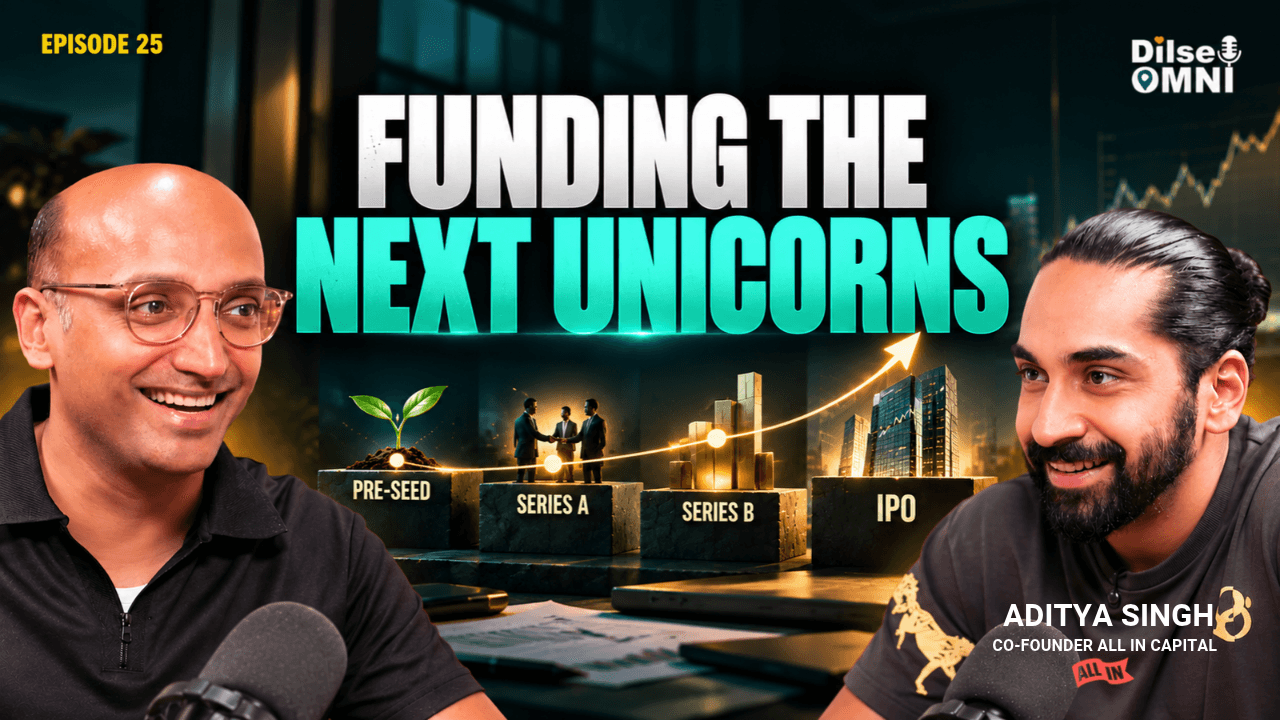
On this episode of Dilse Omni Talks, we covered how to read India's consumer market, what actually happens in a pre-seed pitch room, and why networking is the one compounding skill most founders radically underinvest in.

Future of Marketing is Conversational
Gupshup founder Beerud Sheth on why the click is dying, how conversational AI is rewriting marketing, and why context, not intelligence, is the real moat.

Growth Playbook by Sanjeev Bikhchandani
There are very few people who have genuinely shaped the way India works, loves, and learns — all from one desk, one insight, and one stubborn belief that the internet would change everything before most people even knew what a server was. Sanjeev Bikhchandani is one of those people.
View More
Latest Episodes
The Lead Management Playbook
Nilesh Patel, CEO of LeadSquared talks about the funnels, customer journeys and the lead management.
Decoding Personal AI Agents
On this episode of Dilse Omni Talks, Saurabh sat down with Swapnika to talk about what happens when you stop treating WhatsApp as a messaging app and start treating it as the operating system your entire business already runs on.
Funding The Next Unicorns
On this episode of Dilse Omni Talks, we covered how to read India's consumer market, what actually happens in a pre-seed pitch room, and why networking is the one compounding skill most founders radically underinvest in.
Future of Marketing is Conversational
Gupshup founder Beerud Sheth on why the click is dying, how conversational AI is rewriting marketing, and why context, not intelligence, is the real moat.
Growth Playbook by Sanjeev Bikhchandani
There are very few people who have genuinely shaped the way India works, loves, and learns — all from one desk, one insight, and one stubborn belief that the internet would change everything before most people even knew what a server was. Sanjeev Bikhchandani is one of those people.
View More
Subscribe on your favourite platform



Subscribe on your favourite platform



Subscribe on your favourite platform

Subscribe for
insider insights
Subscribe for
insider insights
Subscribe
for insider insights



Nitin is a Design Entrepreneur and the founder of Indibni® Group. His mission is to foster a self-reliant India through exceptional Indigenous products that impact individuals worldwide.