Fashion has always been about what is next. But in the Gen Z era, “next” does not arrive in two seasonal drops a year. It can emerge from a runway, a celebrity appearance, a stylist’s moodboard, a global street-style moment, Instagram, or even what customers are searching for right now.
That was the central insight in my conversation with Sumit Jasoria, Co-founder and CEO of NEWME. Sumit is building one of India’s fastest-growing Gen Z fashion brands by combining trend intelligence, technology, rapid demand testing, and an agile supply chain that connects online discovery with fast retail execution.
What struck me most was not simply that NEWME uses AI or launches products quickly. It is that the company has redesigned the traditional fashion operating model around a simple reality: certainty is expensive, and speed is a better way to manage uncertainty.
Table of Contents
Fashion Trends No Longer Come From One Place
Why Fast Fashion Has Moved Beyond Seasons
AI Is an Input, Not the Competitive Advantage
The NEWME Fast Fashion Framework: Signal to Scale
Friday FOMO: Test Demand Before You Manufacture at Scale
Why 20 to 30% of Styles Never Get Produced
The 5% Reality: A Small Set of Products Drives the Business
Speed Is the Moat Because Copycats Are Fast Too
What Zara, H&M, and SHEIN Teach Us
The Omnichannel Lesson: Make Demand Visible, Then Act on It
Fashion Trends No Longer Come From One Place
The old fashion hierarchy was relatively clear. Designers created collections, runways introduced them, brands interpreted them, and consumers eventually adopted them. That system was built for long lead times and seasonal calendars.
Today, trend discovery is radically more distributed. Sumit described a world in which a trend may come from:
Runway shows and designer collections
Celebrities and pop-culture moments
Stylists and influencer-led looks
Global and local fashion markets
Instagram and social content
Customer search and browsing behaviour

Fashion signals now emerge across social feeds, global culture, and customer behaviour at the same time.
This means a fashion business can no longer depend on one trend forecaster or one seasonal assortment plan. A commercially relevant trend is often a combination of signals: a colour palette, silhouette, fabric, print, occasion, and styling reference coming together at the right cultural moment.
“Trend identification has already been democratized,” Sumit explained. The ability to spot a trend is increasingly available to everyone. AI can help identify trends, and it can also help create new interpretations of them.
But that does not automatically create a winning fashion company. If every brand can see the same signals, the real question becomes: who can act on the signal first, test it intelligently, and scale only what customers actually want?
Why Fast Fashion Has Moved Beyond Seasons
Traditional retail was built on confidence in forecasts. Teams would predict demand months in advance, lock designs, place large production orders, ship inventory, and hope that the market still wanted the product when it reached the store.
That model made sense when trend cycles were slower. It becomes risky when consumers move from inspiration to purchase intent in days.
NEWME operates with a much shorter planning horizon. Rather than building a massive inventory plan far in advance, Sumit shared that the brand plans fashion only about 30 days ahead.
This is not a lack of planning. It is a more disciplined form of planning. The objective is not to predict the entire season perfectly. The objective is to maintain enough flexibility to respond when the market reveals what is working.
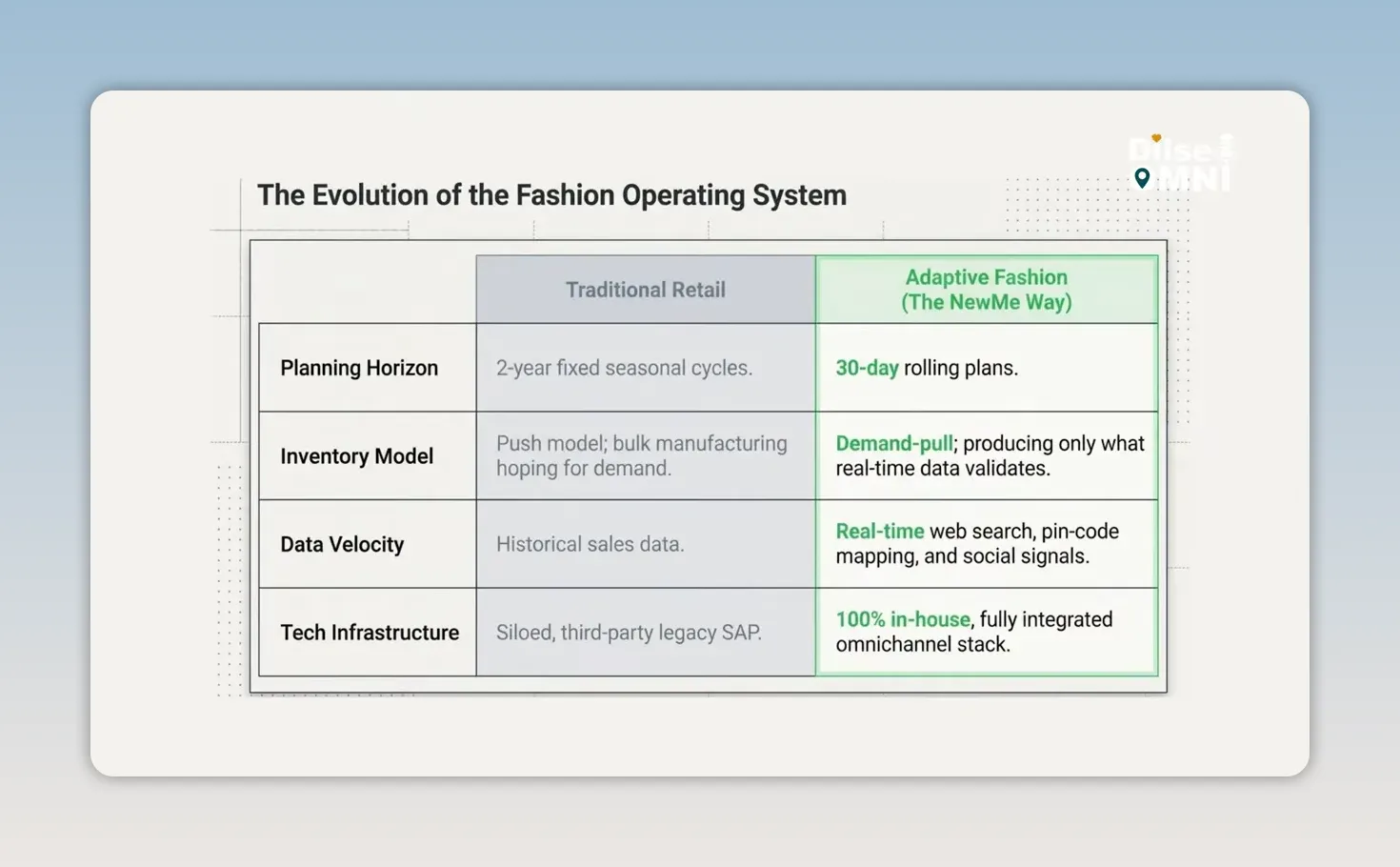
The operating shift is from seasonal prediction and bulk inventory to short-cycle planning, testing, and rapid response.
The Shift in the Fashion Operating System
Traditional Retail | Adaptive Fast Fashion Model |
|---|---|
Long seasonal planning cycles | Short, roughly 30-day planning cycles |
Large upfront inventory commitments | Small initial demand tests before scaling |
Forecast-led decision making | Real-time consumer response informs decisions |
Slow changes once production is locked | Fast iteration through an integrated supply chain |
Technology supports the business | Technology is embedded into trend, demand, and execution decisions |
For me, this distinction matters far beyond fashion. Every omnichannel business is dealing with the same fundamental tension: how much should we commit before we know demand, and how fast can we respond after customers give us a signal?
AI Is an Input, Not the Competitive Advantage
AI has become central to the conversation around retail, fashion, and consumer businesses. But Sumit made an important distinction. AI is useful, but AI alone is not the moat.
“The fight to win is fastest time to market.”
AI can aggregate and synthesize an enormous number of inputs. It can help a fashion company make sense of signals coming from global markets, social media, customer searches, celebrity and stylist influence, as well as historical product performance.
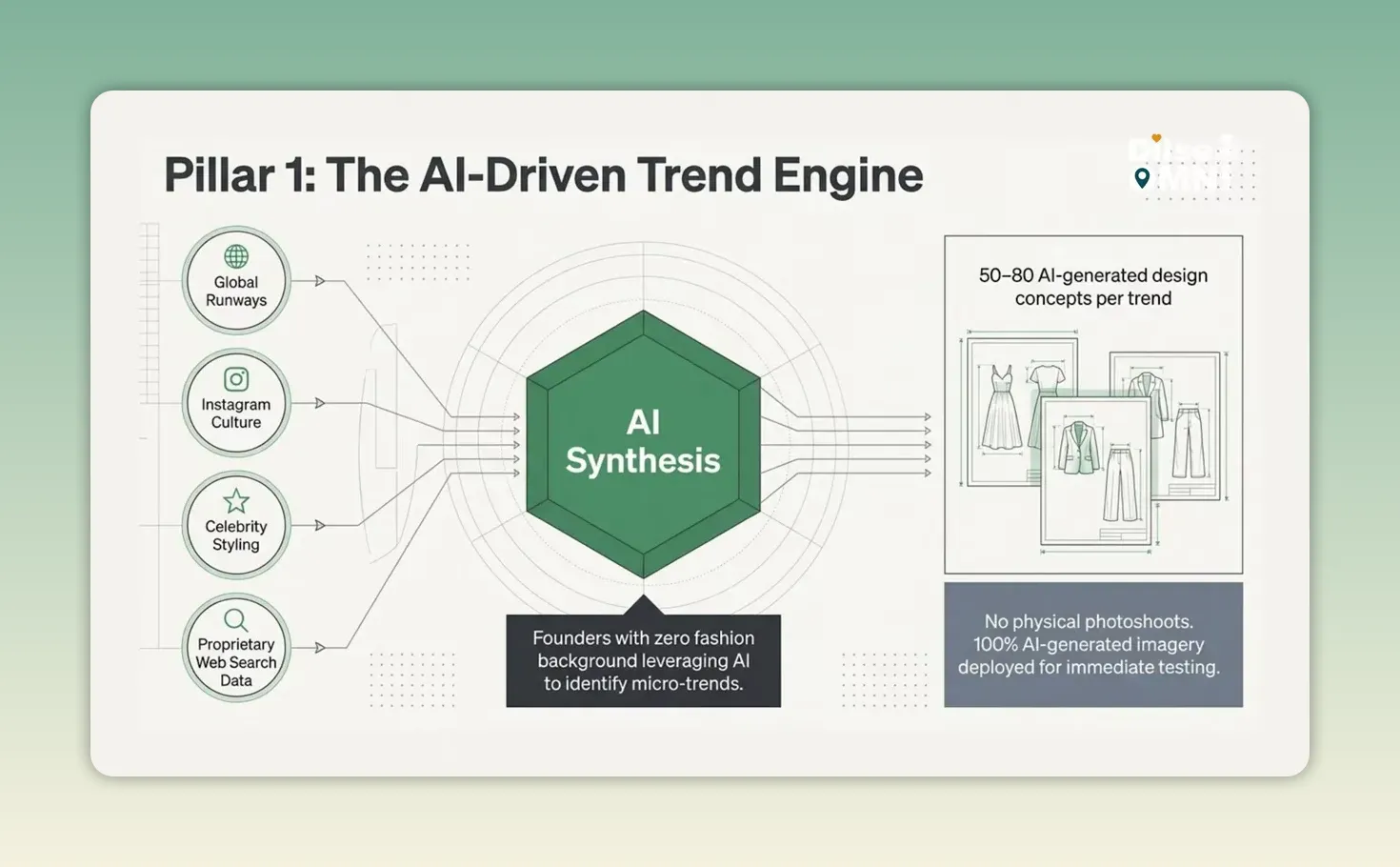
AI can synthesize fragmented cultural and customer signals into product directions worth testing.
At NEWME, the value is not just in gathering all this information. The value lies in translating it into action. A trend has to become a product concept, then a launch, then a real customer response, and then an informed supply-chain decision.
That is why AI should be seen as an engine for better decisions, not a substitute for operating excellence. The brands that win will not merely generate better trend reports. They will have the capability to turn insight into merchandise faster than competitors.
The NEWME Fast Fashion Framework: Signal to Scale
Sumit’s approach can be understood as a five-part fast fashion loop. It is a framework that helps reduce inventory risk while keeping the brand close to real consumer demand.
Capture signals: Monitor runway activity, global fashion, celebrities, stylists, social platforms, and customer searches.
Synthesize the trend: Identify which combinations of colour, pattern, silhouette, and style are beginning to gain relevance.
Launch a small test: Put product ideas in front of customers quickly instead of committing to large inventory immediately.
Read the response: Use early demand to identify the strongest styles and reject weak signals.
Scale the winners: Move successful styles into production rapidly through an integrated supply chain.
“It is not one trend. It is a mix of trend, colours, patterns, and multiple signals that comes together.”
That nuance is important. Fashion teams should not chase isolated inspiration. They should identify the product expression of a trend that customers can actually understand, wear, and buy.
In other words, the opportunity is not simply to be inspired quickly. The opportunity is to close the gap between inspiration, product, demand validation, and replenishment.
Friday FOMO: Test Demand Before You Manufacture at Scale
One of the clearest examples of this operating philosophy is NEWME’s Friday FOMO launch strategy.
The idea is beautifully simple. Instead of manufacturing large volumes based entirely on internal assumptions, NEWME launches a set of styles, observes actual demand, and identifies the top sellers within 48 hours.
The loop works like this:
Trend-led styles are selected: NEWME begins with product ideas informed by the trend engine and consumer signals.
Products are launched digitally: Demand is tested through the brand’s customer-facing channels.
Performance is tracked immediately: Both paid and organic response contribute to the early read on demand.
Top sellers are identified in 48 hours: The market determines which styles deserve further commitment.
Production follows the signal: Winning styles move forward faster through the supply chain.
This is a major departure from the conventional retail approach. Instead of asking, “What should we manufacture in bulk?” the better question is, “What can we launch quickly enough to let customers tell us what to manufacture in bulk?”
That subtle shift changes everything. It lowers the cost of being wrong, helps teams make decisions with real demand data, and prevents inventory from becoming a bet that the brand must later discount its way out of.
Why 20 to 30% of Styles Never Get Produced
A healthy fast fashion model should not try to force every design into production. Sumit shared that nearly 20 to 30% of styles do not even get produced after the initial process.
That is not operational failure. It is the system working exactly as intended.
In traditional retail, weak styles often become a costly problem because the inventory has already been manufactured, shipped, allocated, and displayed. The business then has to use markdowns, promotions, and working capital to manage a decision made months earlier.
In NEWME’s model, an early no is valuable. It prevents capital from getting locked into a style that does not earn customer interest. Teams can move on quickly and focus their energy on the products that have a real chance to win.
“Almost 20 to 30% styles do not even get produced.”
This is a lesson for every product leader. The goal is not to ensure that every internal idea survives. The goal is to build a system where weak ideas fail cheaply and strong ideas receive disproportionate support.
The 5% Reality: A Small Set of Products Drives the Business
Fashion is often a power-law business. A small percentage of products can drive a disproportionately large share of revenue. Sumit pointed to this reality directly: only a small group of winning styles, around 5%, can contribute roughly half of the revenue.
That is why the first 48 hours matter so much. If a business can identify its strongest styles earlier, it can prioritize inventory, marketing attention, supply-chain capacity, and merchandising visibility around what customers are already rewarding.
It also explains why broad assortment alone is not a strategy. A brand does not win by making everything. It wins by finding the few products that create momentum and scaling them before the moment fades.
Speed Is the Moat Because Copycats Are Fast Too
In a digital fashion market, product ideas travel quickly. A winning look can be noticed, interpreted, and copied by many players. This makes the time between trend identification and customer availability the critical competitive window.
Sumit’s point was clear: once a trend has been identified, the business that gets it to consumers the fastest has a meaningful advantage. The winning company is not necessarily the first one to spot the trend. It is the one that brings the right execution to market while consumer interest is still rising.
This is where an integrated supply chain becomes strategic rather than back-office infrastructure. Design, merchandising, digital launch, demand data, production, and fulfilment cannot operate as disconnected departments. They have to work as one responsive system.
What Zara, H&M, and SHEIN Teach Us
Sumit referenced the global fast fashion leaders to illustrate that there are different ways to build this model well.
Zara has long been admired for a data-first, consumer-first approach to fashion. Its strength has been sensing demand and creating a tightly connected model between stores, merchandising, and supply-chain responsiveness.
H&M is another major global fast fashion player, representing the scale and influence of the category.
SHEIN, in Sumit’s view, represents a more technology-first approach. Its advantage comes from the depth of its technology, recommendation capabilities, and ability to use digital signals at scale.
“Zara was always data-first or consumer-first. SHEIN was more technology-first.”
The lesson is not that every brand should imitate one company. The lesson is that successful fast fashion businesses have built distinct operating strengths around the same core principle: stay closer to demand than the traditional seasonal model allows.
The Omnichannel Lesson: Make Demand Visible, Then Act on It
As I reflect on this conversation, the larger omnichannel insight is powerful. Customer demand is not one clean signal sitting in a dashboard. It is fragmented across social content, search, browsing, product engagement, store interactions, purchase patterns, and culture itself.
The brands that will build enduring advantage are those that can bring these signals together, make decisions at speed, and create an operating system capable of responding without creating wasteful inventory risk.
NEWME’s approach demonstrates that the future of fashion is not simply faster production. It is faster learning. The product becomes a hypothesis, the launch becomes a demand test, and the supply chain becomes the mechanism that turns customer response into growth.
I am Saurabh Agrawal and we come with a new episode on Dilse omni talks every fortnight and cover different aspect of omnichannel with amazing speakers.