Technology changes quickly. Marketing technology changes even faster. Yet some companies stay relevant for decades because they do not become attached to the tool. They remain attached to the customer problem.
That was my biggest takeaway from my conversation with Sidharth Gopalakrishnan on Dilse Omni Talks. Netcore has been building marketing technology for roughly 25 years, across every major shift in digital customer engagement, from email to omnichannel journeys, apps, personalization, recommendations, and now agentic marketing.
About the Guest: Sidharth Gopalakrishnan is the COO of Netcore, a leading customer engagement and marketing technology platform, where he drives strategy on AI-led marketing transformation and enterprise partnerships, including Netcore's collaboration with Google Cloud.
I have always admired Rajesh Jain's curiosity and thought leadership. His ability to keep returning to first principles is remarkable. The lesson from Netcore's journey is not simply that the company added channels or acquired products. It is that it kept evolving around the same enduring business question: how can a brand communicate better, retain more customers, and grow profitably?
Table of Contents
The Constant: Solve the Business Problem, Not the Technology Problem
The Four Phases of Netcore's Marketing Evolution
The Full-Stack MarTech Framework: Discover, Engage, Activate
Why Retention and Repeat Purchases Matter More Than Vanity Growth
Agentic Marketing Changes the Basis of Competition
From SaaS to Service as a Software
The Real Future of Marketing Technology
The Constant: Solve the Business Problem, Not the Technology Problem
When I asked Sidharth about Netcore's evolution, he made an important point about Rajesh Jain's approach. The energy is not directed at chasing the latest platform trend. It is directed at solving business problems.
"It is never about the technology or the platform. It is about solving business problems."
That sounds simple, but it is a difficult discipline. Every few years, the market gives us a new acronym, new channels, and new expectations. Email became SMS. SMS became apps. Apps became journeys. Journeys became AI-powered personalization. Now, the conversation is about agents.
But behind every shift are the same questions:
How do we understand customers better?
How do we engage them meaningfully?
How do we make product discovery easier?
How do we increase retention and repeat purchases?
How do we improve lifetime value without endlessly increasing acquisition spend?
Netcore's history is a useful masterclass in building around those questions rather than around a temporary feature advantage.
The Four Phases of Netcore's Marketing Evolution
Sidharth's explanation can be understood as a four-phase evolution. Each phase added a new capability, while preserving the marketing domain expertise developed in the earlier one.
Phase 1: Email Was the Original Digital Marketing Channel
In the early days, email was not just one channel among many. It was the channel. Digital commerce was still in its infancy, apps did not exist, and even websites had not become central to customer journeys.
Email was primarily used for communication and brand building. But even then, the real marketing challenge was clear: how do you make communication more sophisticated, relevant, and personalized?
That became Netcore's first major area of depth. The company built deep expertise in email marketing, personalization, and the mechanics of reaching customers at scale. Email remains an important part of Netcore's identity because the principles of relevance, timing, segmentation, and customer context were established there.
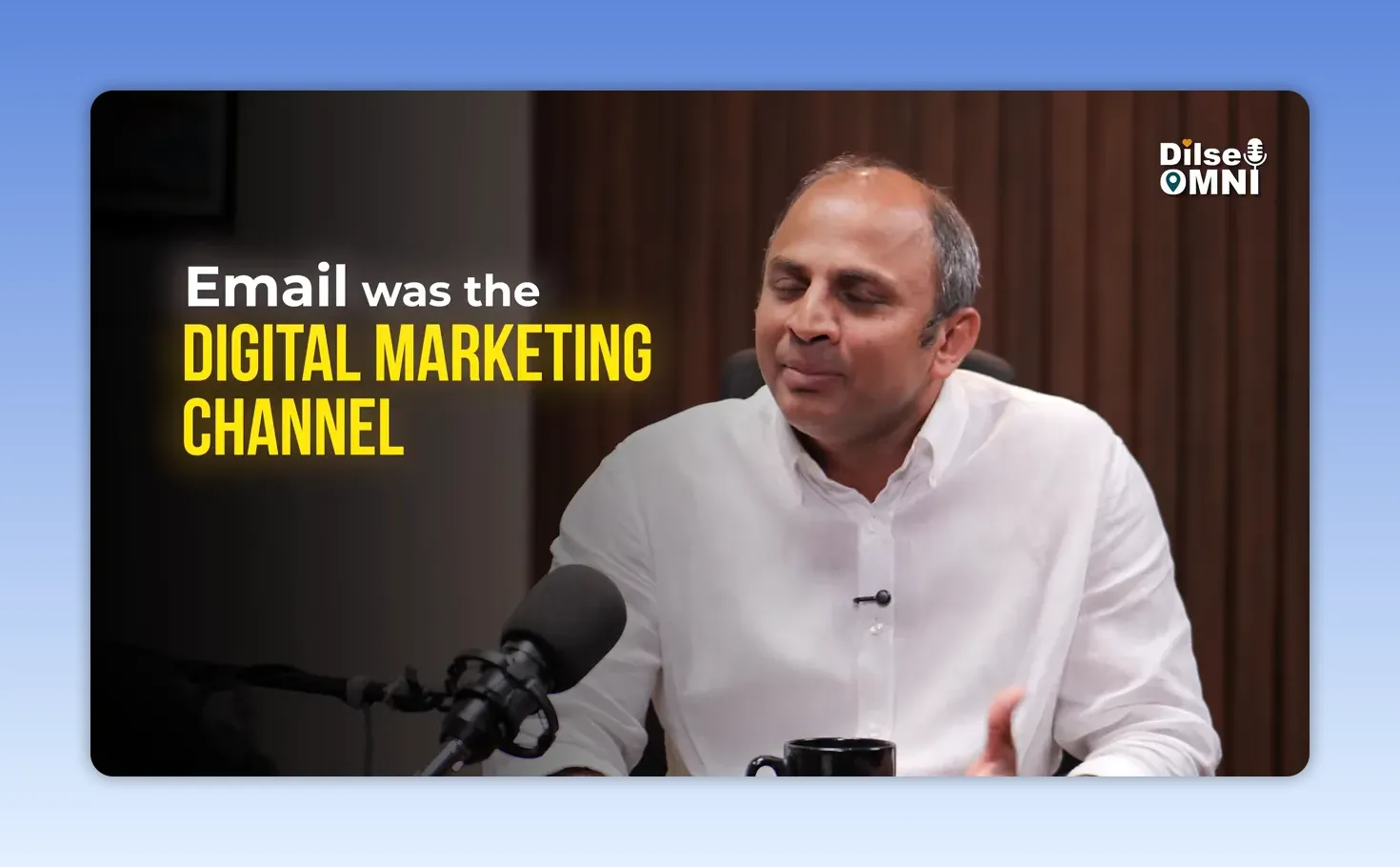
Email established the first playbook for digital customer communication: relevance, personalization, and timely outreach.
Phase 2: From Email to Omnichannel Communication
The next shift was obvious. Customers were no longer spending their time in one place. SMS grew. WhatsApp emerged. New customer-facing touchpoints multiplied.
Brands needed a way to communicate across the channels where customers actually spent time. This was the second phase of Netcore's evolution: moving from email sophistication to multichannel and omnichannel communication.
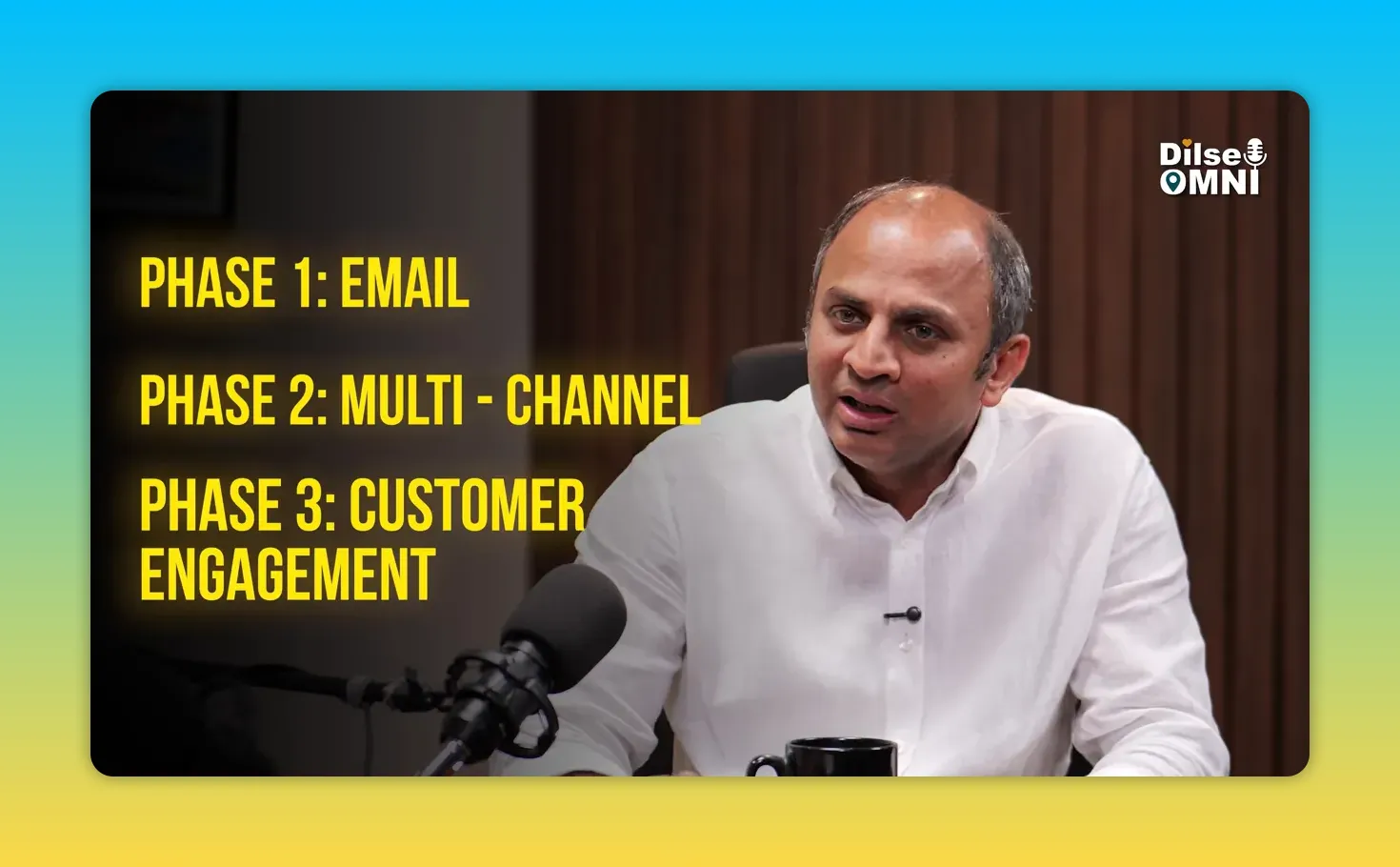
Netcore's early evolution moved from email to multichannel communication and then toward broader customer engagement.
The critical distinction here is that omnichannel marketing is not simply sending the same message everywhere. It is about helping a brand coordinate communication across touchpoints so that the experience becomes more coherent for the customer.
Phase 3: Customer Engagement Became a Platform
By 2013 and 2014, digital apps, transactions, websites, and ecommerce journeys had become much more significant. Marketing had to move beyond outbound communication. Brands needed to understand behavior inside products, websites, and apps.
This was the phase in which what we now call MarTech, or customer engagement technology, became central. Netcore brought its strong marketing knowledge from industries such as banking and financial services, ecommerce, and other consumer businesses into the platform-building journey.
Its foundation was domain expertise. Having handled a significant share of email marketing in the region, Netcore had already seen large volumes of customer communications and marketing behavior. The next logical move was to build technology layers that could support segmentation, journey orchestration, engagement, and personalization at scale.
The lesson for founders and product leaders is clear: technology is stronger when it is built on accumulated understanding of the workflow it is supposed to improve.
Phase 4: Acquisitions Added Intelligence and Experience Layers
From 2018 to 2022, Netcore used targeted acquisitions to extend its product capabilities. In MarTech, this can be particularly powerful because a platform needs several connected capabilities to create meaningful customer outcomes.
These acquisitions were not random expansion. They were focused additions to customer experience and intelligence:
App experience and nudges: helping brands shape the experience inside their applications.
Analytics and recommendation engines: introducing more intelligence into engagement decisions.
Search, browse, and recommendations: strengthening product discovery, particularly for ecommerce.
In 2021, Netcore acquired Unbxd, a company focused on search, browse, and recommendations, particularly in the US and other developed markets. That added an important intelligence layer to the broader customer engagement platform.
Search, browsing, and recommendations make customer engagement more useful because they improve discovery before activation begins.
The Full-Stack MarTech Framework: Discover, Engage, Activate
The best way I found to understand Netcore's present positioning is through a simple three-layer framework that Sidharth described.
Layer | What It Does | Why It Matters | |
|---|---|---|---|
1. Discovery | Improves product discovery across websites and apps through search, browsing, and recommendations. | Customers can find what is most relevant to them. | |
2. Engagement | Supports segmentation, personalization, and customer journey orchestration. | Brands can build relevant, contextual interactions. | |
3. Activation | Connects the engagement engine to channels and partners such as Meta, Google, email, and other communication systems. | Insights and journeys can be converted into real outreach and action. |
These three layers are powerful precisely because they work together. Discovery tells us what a customer is exploring. Engagement helps interpret that behavior and shape the journey. Activation delivers the next best communication or experience through the right channel.
When these systems are connected, a MarTech platform becomes central to a brand's growth engine rather than just another campaign tool.
Why Retention and Repeat Purchases Matter More Than Vanity Growth
One of the most practical insights from the conversation was around profitability. In his previous work at McKinsey, Sidharth saw a metric that mattered deeply for direct-to-consumer brands: a repeat rate of more than 30%.
"Growth everybody shows. The real question is how do we maximize LTV?"
For a long time, abundant funding allowed many brands to focus heavily on acquisition. Once the funding environment changed, the conversation became sharper: how does a business become profitable?
That answer often comes back to retention. A brand cannot sustainably rely only on acquiring new customers. It needs existing customers to return, discover more products, and build a continuing relationship with the business.
This is where the full-stack approach becomes commercially meaningful. Better product discovery can improve conversion. Better journeys can improve engagement. Better activation can bring customers back at the right moment. Together, these capabilities can increase repeat purchases and customer lifetime value.Domain expertise: AI must understand the realities of industries such as banking, financial services, ecommerce, and omnichannel retail.
Real outcomes: The goal is not to deploy AI for the sake of it. The goal is better retention, more repeat purchases, stronger customer journeys, and more profitable growth.
Collaborative AI: Enterprises are building their own AI engines under board-level mandates. Platforms must work with those systems, not pretend they will replace them.
From SaaS to Service as a Software
I asked Sidharth whether Netcore is becoming a services company, platform company, or consulting company. His answer was nuanced: Netcore remains SaaS, but the future is service as a software.
Agentic Marketing Changes the Basis of Competition
The next phase is agentic marketing, and this is where the conversation became especially interesting. Sidharth pointed out that product development cycles have shrunk dramatically. A roadmap that might previously have taken two years can potentially be compressed into six months.
That changes the competitive equation for SaaS businesses. If every new feature can be replicated quickly, features alone will no longer be a durable differentiator.
"Platform functionalities and features are no longer going to be the differentiator."
This does not mean software becomes irrelevant. The technology layer remains essential. But the value shifts toward what the software enables: better decisions, faster execution, stronger adoption, and measurable commercial outcomes.
Sidharth framed the agentic marketing opportunity around three priorities:
It does not mean becoming a conventional managed services player. The core remains technology. Yet technology on its own is underused in many organizations. Sidharth noted that historically, platforms are often deployed but only 20% to 30% of their capabilities get used.
That is a familiar problem across enterprise software. A company buys a powerful platform, but the team lacks the expertise, bandwidth, or operating model to turn those features into business impact.
Netcore's answer is value delivery. That means bringing together:
the software platform,
human marketing and domain expertise,
AI agents that support decisions and execution,
and a sharper focus on the outcomes a brand is trying to achieve.
For banks, ecommerce companies, financial services firms, and omnichannel businesses, this combination can be especially valuable. The marketing environment is too complex for a generic solution. Brands need technology that understands their context and helps their teams make better decisions.
The Real Future of Marketing Technology
My learning from Sidharth is that the future will not be won by whoever claims the longest feature list. It will be won by those who combine intelligence, domain depth, customer understanding, and accountability for outcomes.
Netcore's journey from email marketing to agentic marketing shows the arc clearly. Start with a real customer problem. Build depth in the domain. Add channels when customers move. Add intelligence when behavior becomes more complex. Connect discovery, engagement, and activation. Then use AI not as a replacement for marketers, but as a collaborator that makes great marketing teams more effective.
That is the shift from software deployment to value delivery.
I am Saurabh Agrawal and we come with a new episode on Dilse omni talks every fortnight and cover different aspect of omnichannel with amazing speakers.