When I think about Omnichannel, Growth Marketing, I usually think about customer journeys, media, product loops, and how brands stay relevant across touchpoints. But some conversations force you to zoom out.
My conversation with Sanjeev Bikhchandani did exactly that.
It started with AI, national capability, and the future of jobs. But underneath it sat a deeper lesson about India, entrepreneurship, timing, trust, and the kind of institutions that outlast hype. And if you study the journey of Naukri.com closely, you also see a masterclass in brand building long before growth marketing became fashionable language.
For anyone interested in Omnichannel, Growth Marketing, Saurabh Agrawal, there is a lot to learn here. Not just about AI strategy, but about how enduring companies are built by understanding what the market truly needs, then staying consistent for years.
Table of Contents
The first big question: should India build its own AI?
A practical framework for India’s AI strategy
What this reminded me about Naukri.com
Info Edge’s AI investing tells a second story
Will AI destroy jobs? Sanjeev’s answer was refreshingly honest
The career framework I took away from this conversation
Why this matters for marketers, founders, and operators
The bigger lesson from Sanjeev Bikhchandani
My closing reflection
The first big question: should India build its own AI?
One of the sharpest points Sanjeev made was also the most uncomfortable. India is rapidly becoming a user of AI built elsewhere. That is efficient in the short run, but strategically fragile in the long run.
The trigger for this part of the conversation was simple. If access to powerful models can be restricted internationally, then every country has to ask itself a serious question: Do we want to rent intelligence forever?
Sanjeev’s answer was clear. India should build sovereign capability in AI. Maybe not dozens of foundational models, but certainly enough to avoid complete dependence.
“As a country, do we need our own LLMs? Yes.”
That clarity matters. A lot of discussions on AI get lost in excitement around tools and apps. But Sanjeev pulled the lens back to the infrastructure layer. Foundational AI is not just another startup trend. It is closer to strategic national capacity.
Why this is so hard
He also made the economics brutally clear. Building a frontier large language model is not the kind of project that most startups can take on. The capital required is enormous. The time horizon is long. The outcome is uncertain. You may spend billions and still not know whether the model will work well enough, scale well enough, or generate returns.
“If it takes 20 to 30 billion dollars to build an LLM, startups cannot do that.”
That point is important for founders. Startup energy is real, but it has limits. Venture capital is designed for asymmetric upside, not for decade long moonshots that burn gigantic amounts of capital before the business model is proven.
So who can take that kind of risk?
Governments
Large corporate groups
Cash rich public sector institutions
That is a very different funding architecture from the usual startup story. Which is why Sanjeev’s argument was not anti startup. It was actually precise. Startups will contribute heavily on the application layer, workflows, use cases, and vertical solutions. But the base model layer needs leadership from institutions with deeper balance sheets.
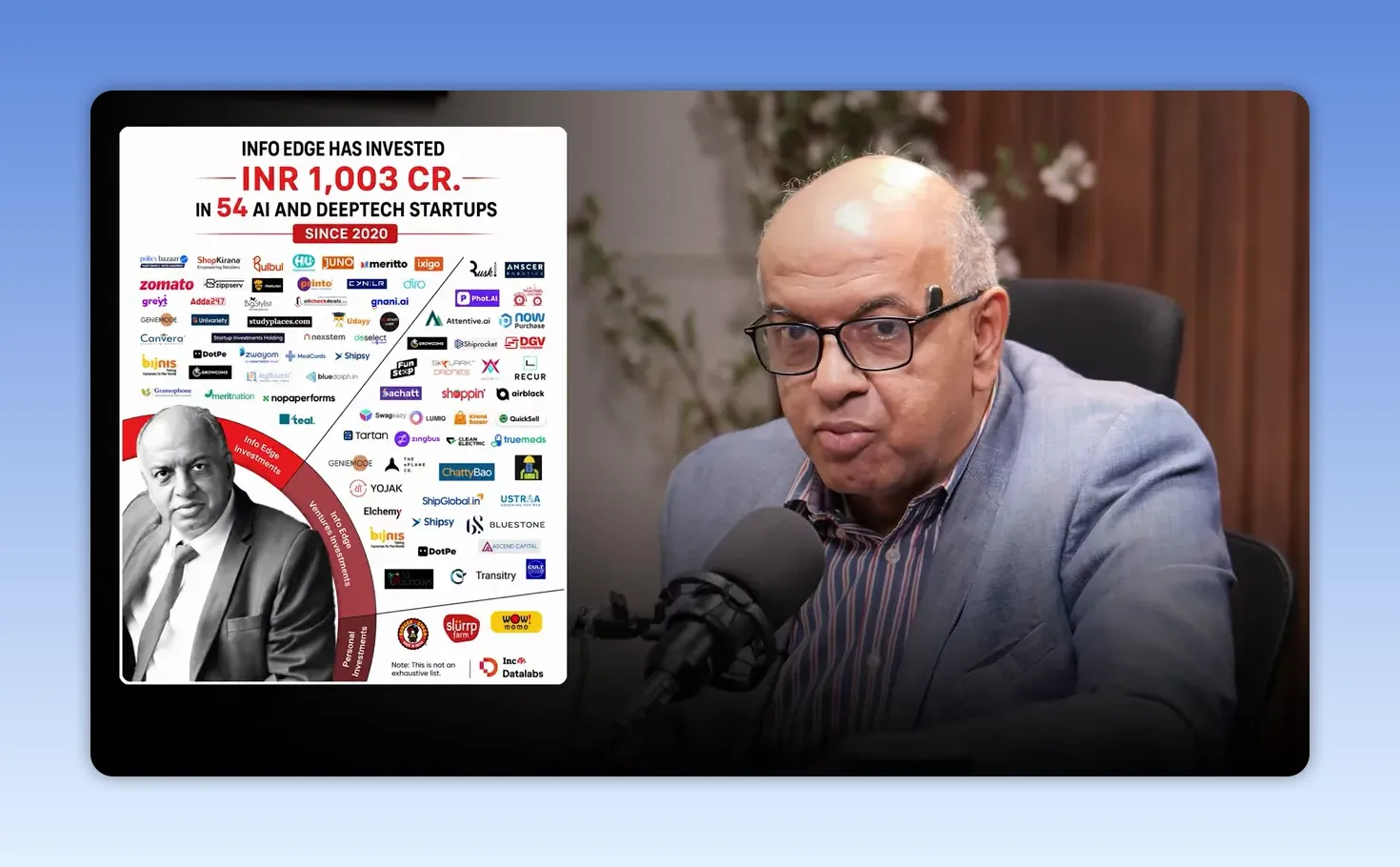
The scale of Info Edge's AI and deep tech bets shows conviction, but it also highlights how much larger frontier model economics really are.
A practical framework for India’s AI strategy
If I were to turn Sanjeev’s thinking into a simple framework, it would look like this:
The 4-layer India AI framework
National intent
The country must decide that AI capability is strategic, not optional.Institutional capital
The foundational layer needs government and large balance sheets.Startup execution
Entrepreneurs should build applications, tools, and vertical products on top.Talent acceleration
The workforce must learn AI fast enough to stay relevant and productive.
This is where I found the conversation especially useful for people in Omnichannel, Growth Marketing, Saurabh Agrawal circles. Growth is never just about channels. It is about systems. AI is exactly the same. Tools matter, but systems matter more.
India already has some of the ingredients. Sanjeev pointed to data, talent, startup activity, and growing awareness at the policy level. The challenge is implementation at scale.
Intent is easy to announce. Execution is hard.
That is true in public policy. It is true in business. And it was certainly true in the early internet era too.
What this reminded me about Naukri.com
Even though this segment was about AI, I kept thinking about Naukri.com.
Why? Because Naukri was built on the same foundational instinct: identify a structural market gap early, then build patiently until behavior catches up.
At one level, Naukri solved a simple problem. Jobs were fragmented. Discovery was inefficient. Employers and job seekers needed a common marketplace. But at another level, Naukri was helping India shift from informal opportunity discovery to a more searchable, transparent, and scalable hiring system.
That is not just a product insight. That is market creation.
And market creation always requires two things:
Clarity of need
Consistency of message
Naukri did both well.
Lesson 1 from Naukri: solve a problem that already hurts
Great growth marketing becomes easier when the pain is real. Naukri did not need to manufacture a category. It entered an existing pain point with a better operating model.
That is one of the cleanest lessons for founders and marketers. If your product is trying too hard to explain why the problem matters, you may be early or you may be forcing the story. But if the pain is obvious, your job is to reduce friction and build trust.
Lesson 2 from Naukri: brand awareness is not vanity if it builds memory
Naukri became a household name because it did not behave like a niche classified utility. It behaved like a brand.
This is where many digital businesses get confused. They over optimize for performance and under invest in memory. Naukri understood that jobs are not a daily purchase behavior for everyone. Which means brand recall matters massively at the moment of need.
When someone thinks jobs, the name should already be waiting in their head.
That is what strong brand awareness does. It lowers search cost in the mind before it lowers search cost in the market.
And when I think about Omnichannel, Growth Marketing, Saurabh Agrawal, this is one of the principles I come back to often. The best omnichannel strategy is not simply being present everywhere. It is creating consistent mental availability across moments, formats, and intent states.
How Naukri drove brand awareness
Naukri’s brand growth worked because the communication was memorable, relatable, and built around aspiration. It tapped into an emotional truth that millions of Indians understood. Career progress is not abstract in India. It changes identity, family confidence, and life trajectory.
That made the brand bigger than a listings platform.
The takeaway is simple. Brand awareness compounds when a campaign does three things well:
It lands on a universal human tension
It is easy to remember and retell
It connects directly back to product utility
Naukri’s communication created recall because it sat at the intersection of ambition and access. That is powerful territory for any growth brand.
Info Edge’s AI investing tells a second story
Sanjeev also shared that Info Edge has invested more than ₹1,000 crore across 54 deep tech and AI startups over the last several years.
That number is significant, not just because it is large, but because it reflects pattern recognition. This is not tourist capital chasing a trend. It is a serious bet that the next wave of value creation will include deep technology and AI driven businesses.
At the same time, he was careful to put that number in perspective. Even ₹1,000 crore is meaningful as venture investment, but it is still nowhere near the capital needed to build frontier foundation models at global scale.
That nuance matters.
The ecosystem needs both:
Large public or institutional bets on foundational capability
Private entrepreneurial bets on applications and commercialization
This is the same dual engine we often see in business growth. One side builds the rails. The other side builds the use cases.
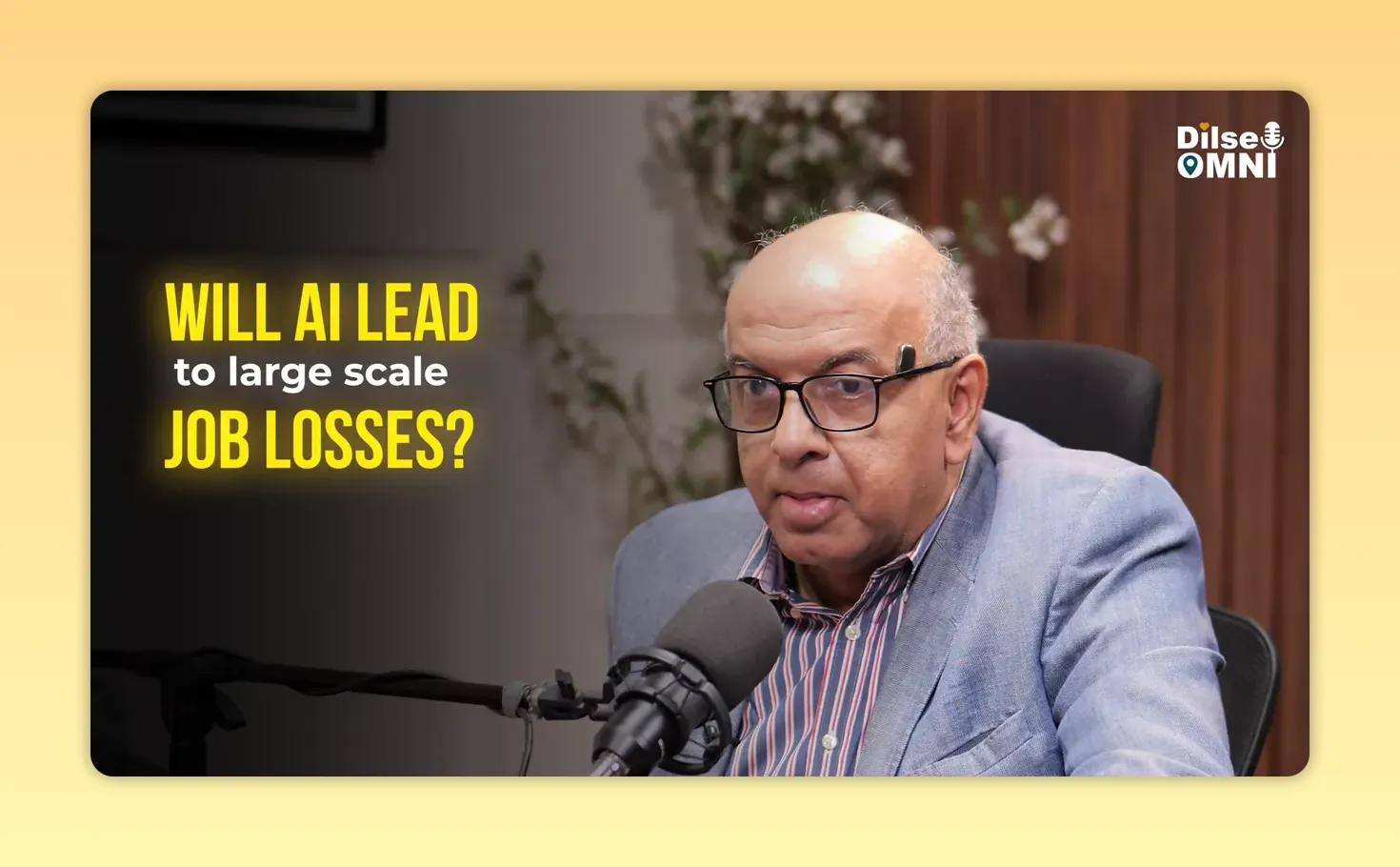
The most credible answers on AI and jobs are often the most honest ones: uncertainty first, then reasoning.
Will AI destroy jobs? Sanjeev’s answer was refreshingly honest
There is a kind of false confidence that often enters AI conversations. People speak in absolutes. Millions of jobs will vanish. Or nothing will change. Both extremes are too neat.
Sanjeev did something more useful. He admitted uncertainty.
“Will AI lead to large scale job losses? My most honest answer is: I do not know.”
That is not weakness. That is intellectual honesty.
But he did not stop there. He reached for history.
The PC story that became a career lesson
When Sanjeev was at IIM Ahmedabad in the late 1980s, personal computers had just begun entering academic environments. Access was limited. The machines were shared. But his batch got exposure early enough to become comfortable using them for practical work.
Later, when he joined a marketing team in corporate India, very few people around him knew how to use PCs properly. He did.
That skill changed his usefulness overnight.
He became the person who could handle spreadsheets, documents, presentations, and work that others were slower to adopt. In other words, technology did not make him redundant. It made him more valuable.
“It became a superpower.”
This is the part I found especially powerful. The lesson is not that every technology wave is painless. The lesson is that adoption is uneven. And in every transition period, the people who learn faster create disproportionate career leverage.
The career framework I took away from this conversation
If I condense Sanjeev’s advice into a usable framework, it would be this:
The AI career insurance framework
Do not obsess over macro fear
Worry less about abstract headlines and more about your own relevance.Learn continuously
Adopt new AI tools regularly instead of waiting for one perfect course.Become the early adapter in the room
Organizations never adapt uniformly. That gap is your opportunity.Turn tools into workflows
Knowing a tool is useful. Knowing where it saves time or improves output is what makes you indispensable.
Sanjeev’s advice to young professionals was practical. Learn one or two AI tools every quarter. Build familiarity. Experiment. Keep moving.
This is not glamorous advice, but it is high signal advice. Careers are rarely secured by dramatic declarations. They are secured by repeated adaptation.
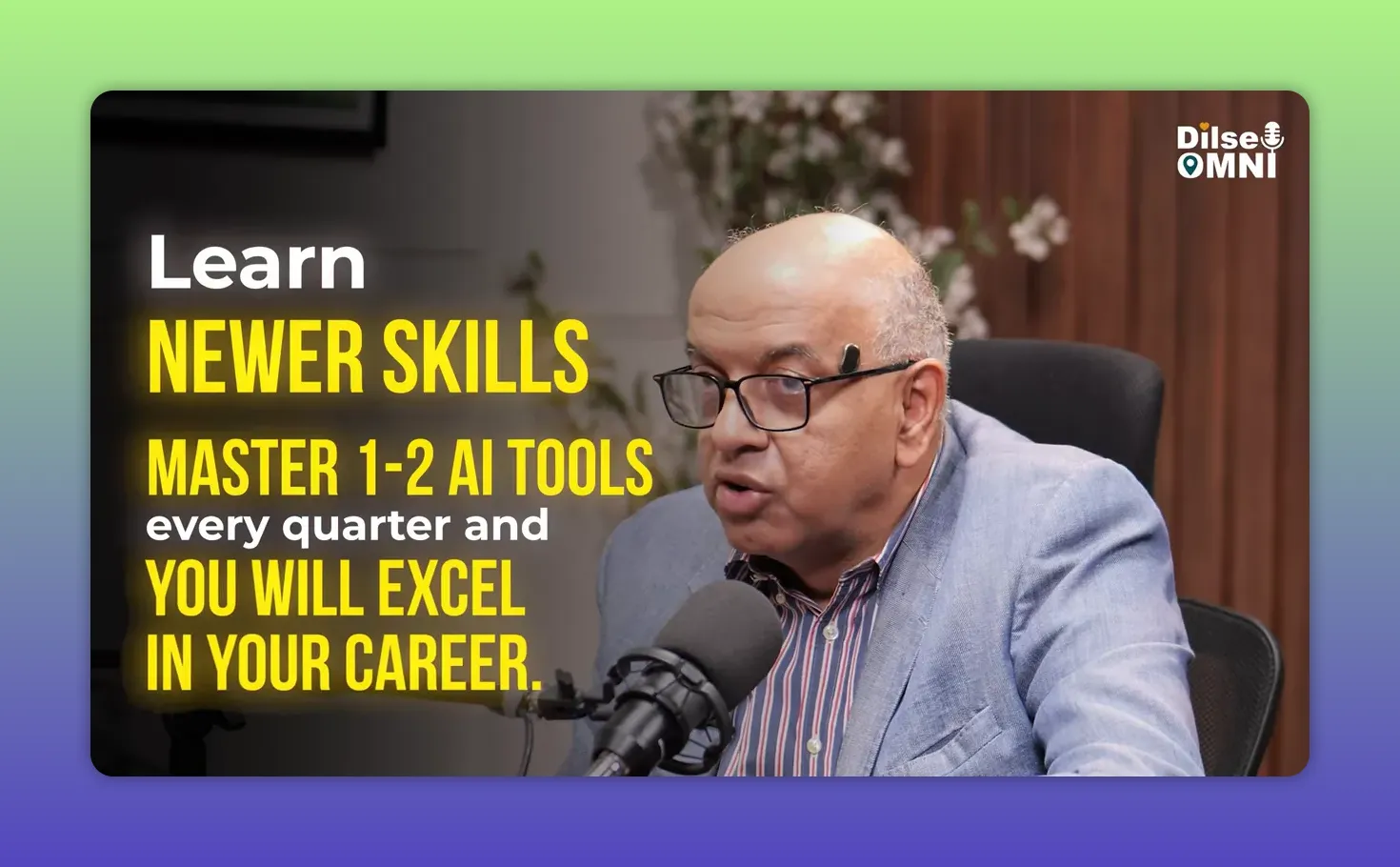
Future proofing is rarely abstract. It usually starts with learning a few tools deeply and using them in real work.
Why this matters for marketers, founders, and operators
There is a reason this conversation belongs in the world of Omnichannel, Growth Marketing, Saurabh Agrawal.
Because the same rule applies whether you are building a brand, a career, or a company.
Adaptation beats anxiety.
In growth marketing, those who learn the new channels early gain leverage.
In omnichannel, those who unify fragmented experiences create defensibility.
In AI, those who move from curiosity to usage become more productive while others are still debating.
That is exactly why Sanjeev’s story landed so well with me. It was not techno optimism for the sake of it. It was grounded optimism. Learn fast. Use the tools. Build useful things. Stay humble about uncertainty.
The bigger lesson from Sanjeev Bikhchandani
If I step back, I see three enduring lessons from Sanjeev’s journey and from what Naukri represents:
Build for structural shifts, not fads
Naukri rode the digitization of job discovery. AI will create similar structural shifts.Brand matters when the need is episodic
Naukri became memorable enough to be recalled when the need surfaced.Early capability becomes long term advantage
That was true for PCs in the 1980s. It is true for AI today.
And maybe that is the real through line between Naukri and AI.
In both cases, the winners are not merely those who notice a trend. The winners are those who build around a durable shift in behavior, infrastructure, and trust.
My closing reflection
I started this conversation thinking I would get answers on India’s AI strategy. I did. India should invest in its own capability. Foundational AI needs institutional leadership. Startups will play a huge role, but mostly on the application side. And nobody should casually assume access to global models will always remain frictionless.
But I also came away with something more personal.
The future does not reward panic. It rewards preparation.
That may be the most useful bridge between Omnichannel, Growth Marketing, Saurabh Agrawal and the wisdom Sanjeev shared. Whether you are building a brand, a startup, a national strategy, or your own career, the game is the same. See the shift early. Build capability before it becomes obvious. Stay consistent longer than most people can.
“Do not worry about others. Focus on yourself.”
That line stays with me.
If you want more conversations like this, you can also explore Dilse Omni for more on growth, AI, and building across channels.
I am Saurabh Agrawal and we come with a new episode on Dilse Omni Talks every forthnight and cover different aspect of omnichannel with amzing speakers.
This article was created from the learnings from the video Can India Build Its Own AI? | Sanjeev Bikhchandani on LLMs, AI Jobs & India's Future.