When we see a brand like Amazon, Myntra, or Swiggy seemingly anticipate what we need next, it is tempting to give all the credit to AI. But AI is only one piece of a much bigger system.
For this Dilse Omni Talks conversation, I spoke with Anand Jain, Co-founder and Chief Product Officer of CleverTap. Anand has spent decades building scalable technology products and helping thousands of brands use customer data, AI, and omnichannel engagement to improve retention and customer experience.
I wanted to get underneath the buzzwords and understand what really powers a modern CRM or retention marketing platform. What does a Customer Data Platform actually do? Is it just a glorified database? How do analytics, journey orchestration, loyalty, personalization, and AI work together without becoming a messy collection of tools?
Anand’s answer was clear: the best customer engagement systems are not disconnected features. They are a tightly integrated loop that turns customer behavior into useful, timely, and relevant action.
Table of Contents
The foundation of retention marketing is customer data
Intent data is what turns activity into understanding
The modern retention marketing stack: a connected loop
Journey orchestration is more than sending messages
Loyalty, offers, and personalization need the same data foundation
AI is not decoration. It should improve every layer.
Inside CleverTap’s TesseractDB
Build, buy, or choose an integrated platform?
The real advantage is end-to-end context
The foundation of retention marketing is customer data
The first lesson from Anand is simple but important: a modern CRM platform needs a strong foundation. That foundation is the Customer Data Platform, or CDP.
A CDP is where a business collects and organizes customer data so it can understand what people are doing, what they care about, and what action may be relevant next. But the idea of a CDP has changed significantly.
Traditionally, customer data meant the basics: name, phone number, email, transactions, and perhaps a few purchase preferences. In the early days, storage and processing were expensive, so companies naturally kept data only for people who had signed up or transacted.
Today, storage is comparatively inexpensive. A sophisticated data platform can capture information long before someone becomes a customer. It can record the behavior of an anonymous visitor browsing a website, exploring categories, opening a product page, or adding something to a cart.
“Everything is saved with extremely high-fidelity information on all the properties.”
Anand Jain
This is why the modern CDP goes beyond a simple customer list. It is not merely a record of who bought. It becomes a living system of behavioral, transactional, and intent signals.
Intent data is what turns activity into understanding
A person’s purchase history tells us what happened. Intent data helps us understand what might happen next.
Anand gave a sharp retail example. Imagine a brand running an ad for premium Japanese denim. A person clicks that ad and browses the denim collection. The original ad copy that brought them in is worth storing because it gives the business context about what sparked their interest in the first place.
That is not just a click. It is a signal.
The same thinking becomes even more powerful in travel. A travel business may notice that someone is searching for hotels two days before a trip. At that stage, the customer may be focused on convenience, price, location, and availability.
But a person browsing two months before a holiday behaves differently. They may compare the size of a swimming pool, whether it is heated, the quality of food, room layouts, or proximity to attractions. The time between browsing and travel is itself valuable intent data.
This is the distinction that matters:
Profile data explains who the person is.
Transaction data explains what they bought.
Behavioral data explains what they did.
Intent data helps reveal what they may want next.
A modern engagement platform needs all four. Without that context, marketing becomes broad, repetitive, and often irrelevant.
The modern retention marketing stack: a connected loop
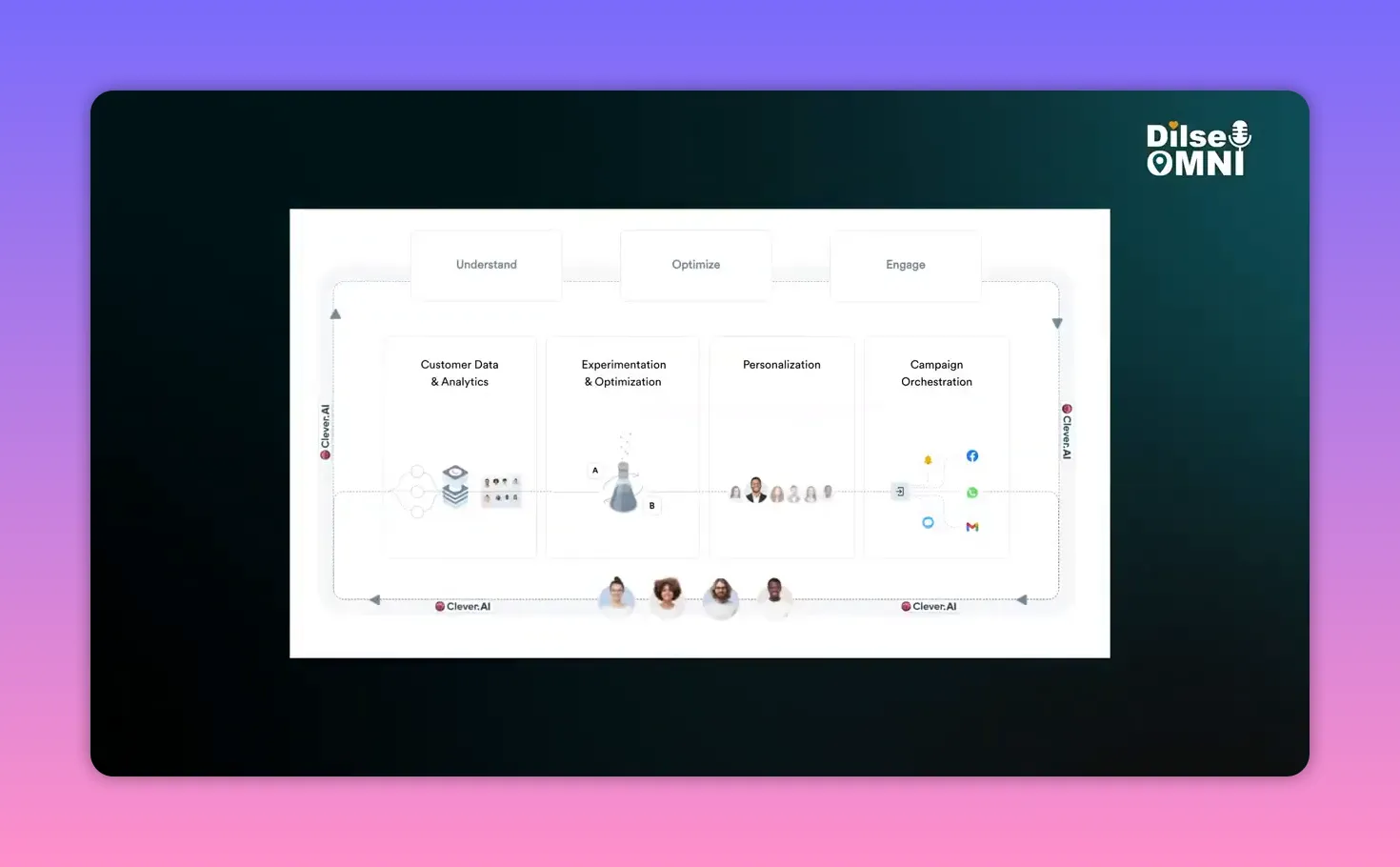
As Anand explained the architecture of a modern customer engagement platform, I found it useful to see it as a connected operating system for retention rather than a set of standalone marketing features.
Here is the framework that emerged from our conversation.
The Customer Engagement Loop
Capture: Collect customer, visitor, transaction, product, campaign, and behavioral data.
Understand: Use analytics to identify patterns, segments, preferences, and intent.
Orchestrate: Decide what message to send, through which channel, at what time, and at what frequency.
Personalize: Match content, product experiences, recommendations, and offers to the individual context.
Reward: Apply loyalty and offer logic, whether that is a flat discount, buy one get one, product-specific incentive, or threshold-based reward.
Learn: Measure how customers respond and feed that response back into the system.

A useful retention platform connects data storage, analysis, activation, and learning instead of treating each as an isolated task.
The key is that the loop must remain continuous. If a brand sends a message, it should know whether the customer opened it, ignored it, clicked through, purchased, or dropped out of the flow. The same applies to in-app experiences and product experiments.
If someone sees a personalized product experience but never proceeds through that flow, that response becomes new data. The platform should learn from it.
“You can send messages all day long. If no one responds, you should know that no one really cares about what you are sending.”
Anand Jain
That statement should make every marketer pause. Volume is not engagement. More notifications, more emails, or more WhatsApp messages do not automatically create better retention. Relevance does.
Journey orchestration is more than sending messages
Messaging is one visible output of a CRM platform, but Anand made an important distinction. Modern platforms do not just send one-time campaigns. They operate a message orchestration engine.
Orchestration means the system can coordinate engagement across WhatsApp, email, SMS, text messaging, and other channels based on the customer’s data and behavior.
It has to answer practical questions that are easy to underestimate:
Which channel should be used for this customer?
How long should the system wait before the next message?
What frequency is appropriate?
Which content belongs in which message?
Should the person receive an offer, a reminder, a recommendation, or no message at all?
What should happen if the customer engages on one channel but not another?
Consider a shopper who views a T-shirt. A well-designed data platform can retain rich product properties such as brand, sub-brand, colour, material, size, when the item was added to the SKU catalog, and much more. Anand noted that CleverTap’s TesseractDB can support up to 2,000 properties with an event.
The point is not to collect data for the sake of it. The point is to preserve enough context that the next interaction feels intelligent. A message about a generic sale is very different from a message that reflects the exact product category, price range, or material a customer was exploring.
Loyalty, offers, and personalization need the same data foundation
Offers and loyalty programs are often handled as separate marketing functions, but they work best when they are informed by the same customer context.
A platform should be able to recognize the difference between a flat discount, a buy one get one offer, a reward tied to a particular product category, or an incentive unlocked after crossing a price threshold. More importantly, it should determine which of these actions makes sense for a particular person.
Not every customer needs a discount. Some need reassurance. Some need discovery. Some need a timely reminder. Some may be most responsive to loyalty recognition. And some should not be interrupted at all.
Personalization is where all these layers come together. It can happen inside a message, but it can also happen within the product experience itself. A brand may personalize a browsing journey, surface different recommendations, or experiment with multiple paths through product A/B testing.
Every one of those experiences should send feedback into the data layer. That is how the system gets smarter over time.
AI is not decoration. It should improve every layer.
When I asked Anand about AI, his answer had a great analogy. AI, he said, is like dhaniya, or coriander. You sprinkle it across everything.
But this is not about adding AI as a cosmetic label on top of old workflows. AI becomes meaningful when it improves real decisions throughout the engagement loop.
With the evolution of large language models and other AI capabilities, platforms can increasingly assist with understanding data, predicting likely outcomes, improving content relevance, and helping marketers act on customer signals at scale.
Still, AI cannot rescue weak data or disconnected systems. If the customer context is incomplete, if engagement tools cannot access the right data, or if each product operates with a different definition of an active customer, the output will remain fragmented.
AI is powerful because it can make a connected system more intelligent. It is not a substitute for building that connected system.
Inside CleverTap’s TesseractDB
Anand described TesseractDB as the core embedded data foundation within CleverTap. It is not positioned as a separate CDP product that needs to be stitched onto the rest of the engagement system. Instead, it is built into the platform.
The name has a fun origin. The engineering team had plenty of Marvel fans, and the Tesseract reference stuck. CleverTap even uses a small blue Tesseract visual in its analytics experience.
Behind the playful name is a serious product principle: the data layer should retain the breadth and fidelity needed for analytics, segmentation, prediction, personalization, and activation.
The data platform needs to handle events and their context, not merely customer profiles. If every product interaction includes meaningful properties, the brand is better equipped to build relevant experiences later.
Build, buy, or choose an integrated platform?
One of the most practical parts of our discussion was Anand’s view on the build versus buy decision. He has been building technology for around 30 years, and his advice was direct.
“Unless what you are building is core to what you are actually selling, do not try to build it.”
Anand Jain
Building an in-house CDP may begin as an exciting initiative. But unless it is central to the company’s product and competitive advantage, it can quickly become a side project. Side projects often lose budget, focus, maintenance, and the specialist attention needed to keep pace with rapidly evolving technology.
Anand’s point was not that every company should buy from one specific vendor. The point was that organizations should evaluate dedicated providers that spend all their time solving these problems.
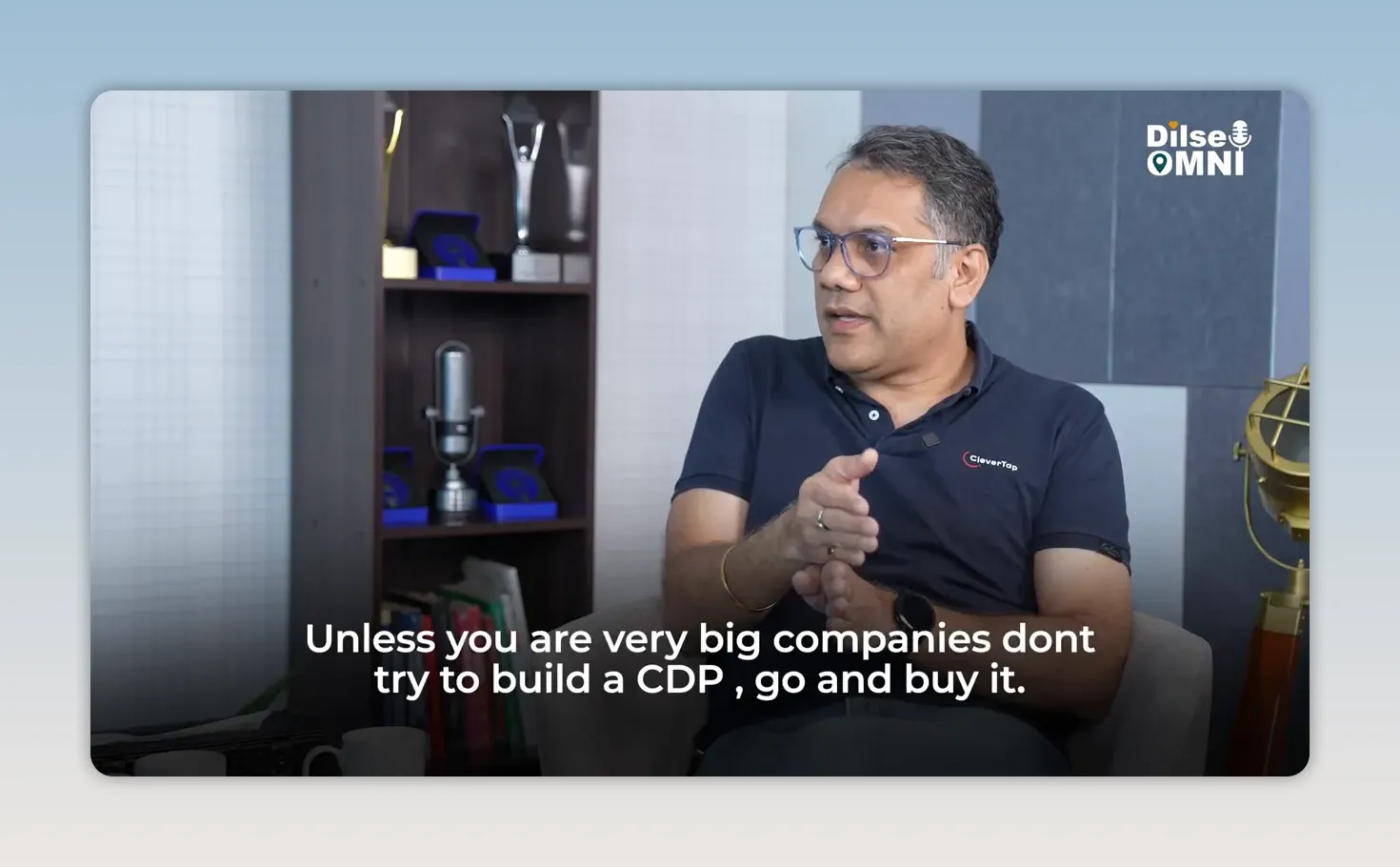
For most businesses, the real decision is not whether a CDP is important, but whether maintaining one in-house deserves constant specialist investment.
There is a second decision too: should a company buy a standalone CDP and assemble the rest of the stack around it?
Anand used a memorable Sholay analogy. A CDP may be able to identify the highest-potential customer segment, much like Thakur can see Gabbar. But if it cannot act on that insight through messaging, experimentation, personalization, loyalty, and journey orchestration, it lacks the arms to do anything with its knowledge.
When separate systems are stitched together, data may move from one tool to another, but context often does not. A CDP may store hundreds of customer properties, while a prediction tool receives only a limited subset. Different products may define active users differently. Teams then spend time resolving integration gaps instead of improving customer experiences.
The real advantage is end-to-end context
The final takeaway is that customer engagement is not about a single database, channel, or AI feature. It is about preserving context from the moment someone discovers a brand to the moment they become loyal.
A high-performing retention platform should help a business:
Capture rich customer and visitor behavior.
Understand the intent behind that behavior.
Analyze patterns and create meaningful segments.
Coordinate journeys across channels.
Deliver personalized messages, offers, and experiences.
Measure the response and continuously improve.
That is how brands begin to feel predictive. Not because AI magically knows everything, but because their systems connect data, decisions, and action in a disciplined loop.
I am Saurabh Agrawal and we come with a new episode on Dilse omni talks every fortnight and cover different aspect of omnichannel with amazing speakers.