Email has been declared old, overcrowded, and nearly irrelevant more times than I can count. Yet it remains one of the most powerful commerce channels in the world. In North America especially, email is not a secondary or tertiary channel. It is still a primary commerce channel.
That was the starting point of my conversation with Siddharth Gopalkrishnan, and it quickly became clear that the future of email is not about sending more campaigns. It is about transforming the inbox from a place where people read messages into a place where they can actually take action.
About the Guest: Sidharth Gopalakrishnan is the COO of Netcore, a leading customer engagement and marketing technology platform, where he drives strategy on AI-led marketing transformation and enterprise partnerships, including Netcore's collaboration with Google Cloud.
I had recently gone through Netcore's Email Benchmark Report, built on learnings from roughly half a trillion emails. I read it more than once, and my team even wrote about it because of how relevant the findings felt for modern marketers. The big insight was simple: email may be an old channel, but it is evolving rapidly.
Table of Contents
Email Is Still a Serious Commerce Channel
What Makes an Email Feel Like an App?
The No-Redirect Principle
The Interactive Email Framework: From Open to Action
Why Open Rates Are No Longer Enough
Understanding Click Without Open
From Email Analytics to App-Like Analytics
Neo Mails: Making Email Habitual and Fun
How AI Changes the Role of the Email Marketer
Practical Questions Every Marketer Should Ask
The Future of Email Is Actionable
Email Is Still a Serious Commerce Channel
There is a tendency in marketing to chase the newest channel and write off the older ones. WhatsApp, RCS, push notifications, social commerce, and AI agents are all important parts of an omnichannel strategy. But we should not evaluate channels emotionally. We need to assess them objectively based on what they are best equipped to do.
Email has a clear place in both brand building and commerce. Brands such as American Express, Myntra, and several BFSI organizations have shown how high-value email experiences can drive engagement at scale.
Email also has a major strategic advantage: it is deeply measurable. While SMS largely offers delivery data, and WhatsApp provides delivery, opens, clicks, and some interaction metrics, email can increasingly resemble web analytics or app analytics.
“Email which can have the functionality of an app.”
This is Siddharth’s simplest and most useful explanation of what AMP email enables.
What Makes an Email Feel Like an App?
Traditional email is static. A customer sees a message, reads it, and clicks a button that redirects them to a website or app. That redirection may seem minor, but every extra click creates friction. And friction creates drop-offs.
An AMP email changes that equation. AMP, or Accelerated Mobile Pages for email, allows marketers to create interactive experiences directly within the inbox. Instead of pushing the customer out to complete an action elsewhere, the action can happen inside the email itself.
Think of the difference this way:
Traditional email: Read email, click link, wait for page load, complete task on a website or app.
AMP email: Read email, browse, fill a form, select an option, submit information, or complete a task within the inbox.
The objective is not to make email complicated. It is to remove the unnecessary journey between intent and action.
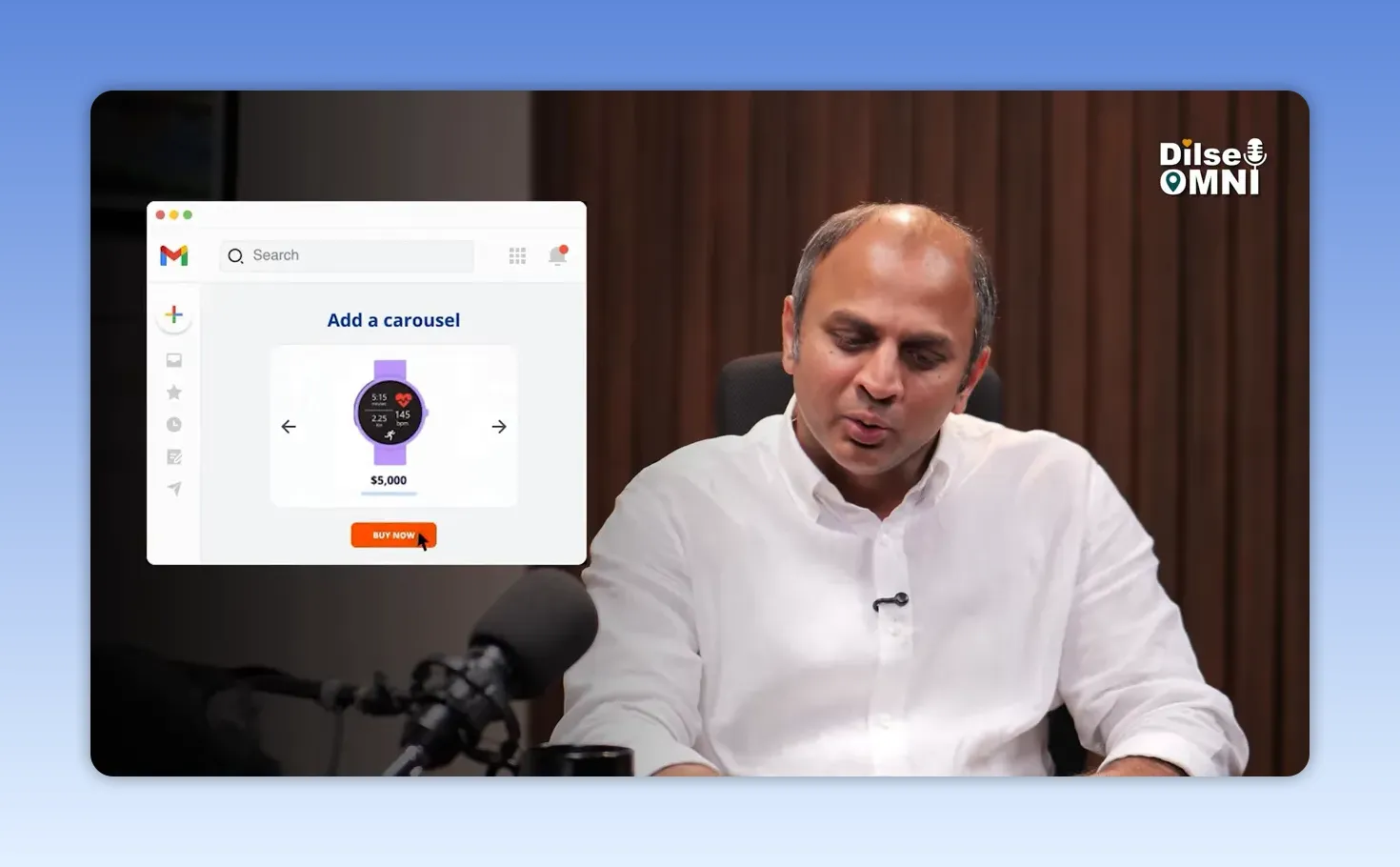
Interactive forms can collect customer feedback without sending people away from the inbox.
The No-Redirect Principle
One of the strongest lessons from our conversation was that redirection is often the enemy of conversion. If a person has already opened your email and is ready to act, making them leave the inbox creates another opportunity for them to abandon the journey.
Siddharth shared a powerful banking example. Imagine a customer receives an email about opening a fixed deposit. With an interactive AMP email, the customer can enter the required information, complete KYC-related steps, and allow the email experience to connect through APIs to the bank’s systems. The customer does not have to leave the inbox to begin or complete the journey.
This same principle applies across industries:
A retailer can show a product catalog within the email.
An insurer can capture a vehicle number and offer the next relevant insurance product.
A service brand can collect feedback, preferences, or lead details in the email itself.
A bank can turn a static statement or policy communication into a contextual lead-generation opportunity.
When an insurance policy email is opened, for example, it already has attention. If the experience is static, that attention goes unused. But if the email allows the customer to add a car number or vehicle detail, the brand can create a relevant next step, such as a vehicle insurance offer. A routine communication becomes a high-intent engagement moment.
“It should not be a redirection, otherwise it is one more click and 70 to 80 percent drop-off.”
The Interactive Email Framework: From Open to Action
For marketers, the practical question is not simply whether AMP is interesting. The real question is how to design an email that earns attention and turns it into meaningful action.
I would frame Siddharth’s approach as a four-part interactive email framework:
1. Create a Reason to Engage
The subject line and the email header should make it immediately clear that there is something useful, playful, or actionable inside. If the email contains a game, quiz, product selector, calculator, form, or offer, make that visible upfront.
2. Enable an In-Email Action
Give the customer one clear action they can perform without leaving the inbox. This could be browsing products, selecting a preferred category, rating a service, completing a form, spinning a reward wheel, or submitting a lead.
3. Use Data to Personalize the Next Step
The information collected should trigger a relevant follow-up. A vehicle number can lead to an insurance recommendation. A product preference can lead to a tailored catalog. A feedback score can trigger service recovery or a loyalty offer.
4. Measure Completion, Not Just Clicks
The metric should not end at opens or click-through rates. Measure whether people began the interactive experience, how long they engaged, what they selected, and whether they completed the action.
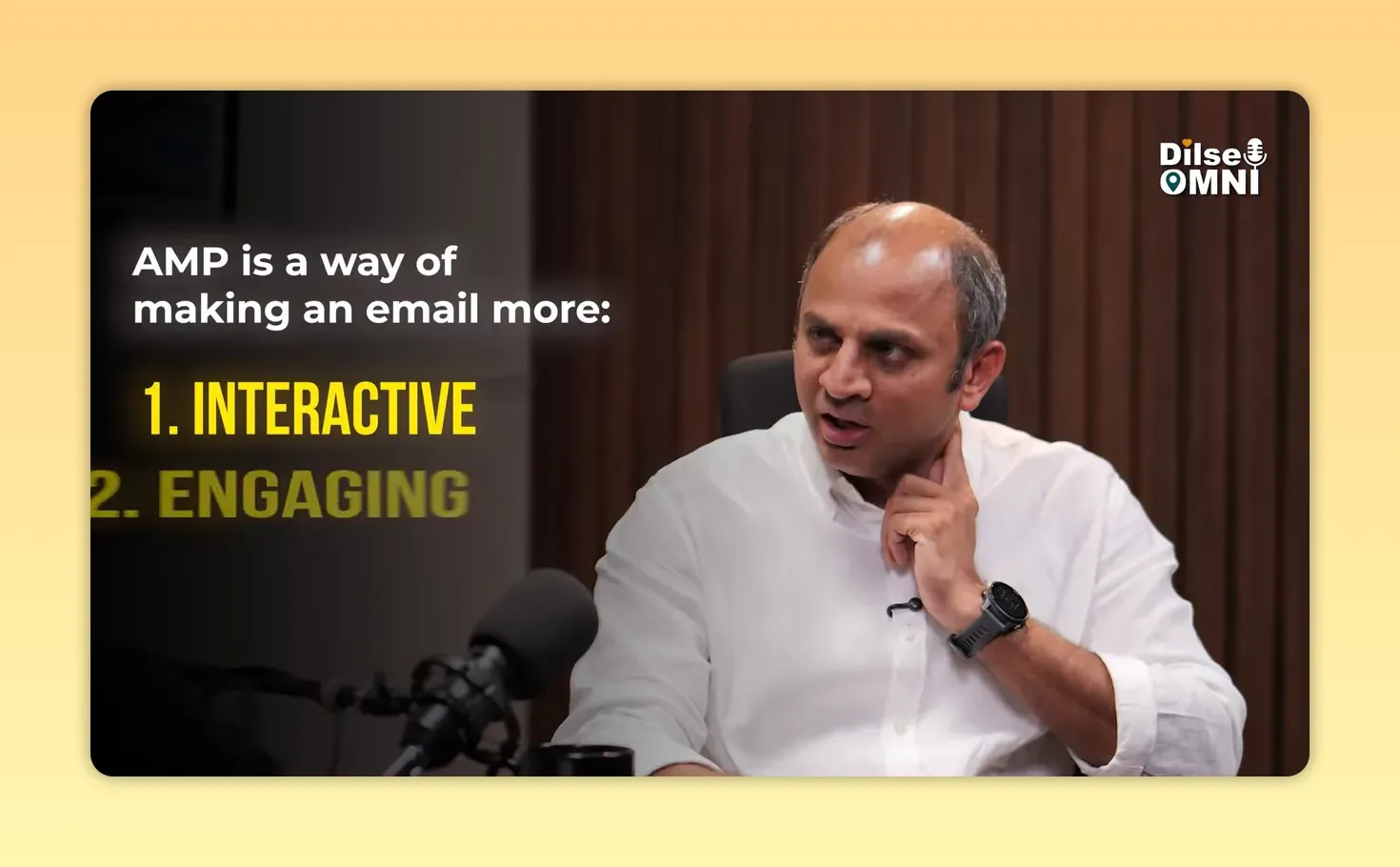
The core value of AMP email is straightforward: make communication interactive and make engagement measurable.
Why Open Rates Are No Longer Enough
One of the most important parts of this discussion was around email measurement. For years, marketers have relied heavily on open rates. But open rates are increasingly imperfect because of privacy features and machine-generated activity.
For example, Apple Mail and similar environments may trigger tracking pixels automatically. Since an email open is typically recorded when a pixel fires, a marketer may see a high open rate even when the customer has not consciously opened or seen the message.
This is where the distinction between machine opens and human opens matters.
A bot or machine open does not necessarily mean fraud. It simply means that the activity may not represent an actual customer seeing the email. If your campaign is designed for brand building, then an open that happened without a human impression should not be treated in the same way as a genuine engagement.
The solution is to go deeper into the data and separate the cohorts wherever possible. Sophisticated email engines can identify patterns associated with machine opens versus human activity, helping brands avoid making decisions based on inflated top-line open rates.
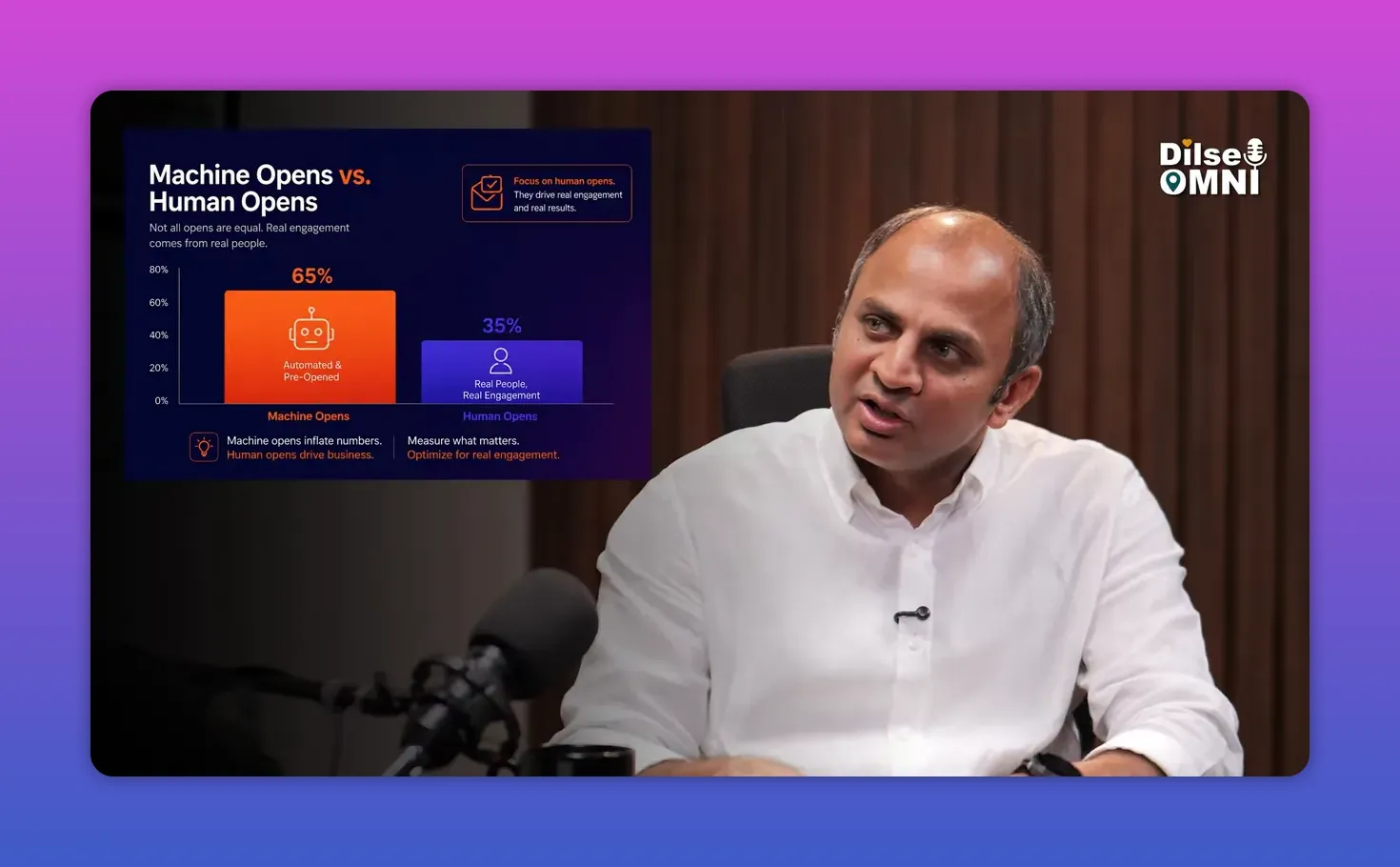
A high open rate is not always a human impression, which is why email reporting must separate machine activity from genuine engagement.
Understanding Click Without Open
Another metric that caught my attention was click without open. At first, it sounds contradictory. How can someone click an email without opening it?
The answer lies in how privacy systems and tracking pixels work. A machine may register an open by firing a pixel, while a real customer later clicks on the email without that open event being reliably captured in the same way. In other cases, the reported open may be artificial, while the click represents a much clearer sign of human intent.
This creates a more nuanced analytics model:
Open rate: Useful, but potentially influenced by automatic pixel activity.
Click-through rate: A stronger sign of engagement, though still not the full story.
Click without open: A signal worth investigating to understand tracking gaps and real customer behavior.
In-email engagement: Time spent, interactions completed, elements clicked, and forms submitted.
The larger lesson is that marketers need to stop treating every open as equal. The right question is not, “How many opens did we get?” It is, “How much genuine customer attention and action did we generate?”
From Email Analytics to App-Like Analytics
This is where interactive email becomes truly interesting. Once an email contains an in-message experience, marketers can measure behavior much more like they measure activity inside an app.
You can understand:
How many people started an activity.
How long they engaged with the experience.
Which elements they clicked.
Where they dropped off.
Which actions led to conversion.
Which customer cohorts responded best.
Siddharth shared that interactive email experiences can bring five to six times more people into the engagement flow. More importantly, when customers begin an activity inside an email, completion rates can reach as high as 80 percent in some cases.
That changes the role of email in the customer journey. It is no longer just a traffic driver to a landing page. It becomes a conversion surface in its own right.
“You suddenly have much better analytics on engagement within the email.”
Neo Mails: Making Email Habitual and Fun
Siddharth also spoke about the emerging idea of neo mails. The premise is compelling: can email become something customers are genuinely excited to interact with, rather than merely something they clear from an inbox?
The best digital experiences often become habitual because they are useful and enjoyable. A neo mail can use gamification, action ads, interactive cards, rewards, or simple micro-experiences to create that habit.
A possible sequence could look like this:
Build excitement: Use an engaging header, game, quiz, or reward mechanic.
Create participation: Add an AMP component that lets the customer play, choose, submit, or explore.
Drive commerce: Connect the interaction to a personalized catalog, offer, product recommendation, or service action.
Learn and optimize: Use engagement data to improve the next interaction.
Over time, this could even make email inventory more valuable. If brands build a strong, high-engagement email property, there may be opportunities to bring relevant advertisers into that environment. Email begins to look less like a cost center and more like a monetizable engagement asset.
How AI Changes the Role of the Email Marketer
AI is not making email marketing less important. It is raising the standard for what email can do. The future is not about blasting more messages with automated copy. It is about designing intelligent, responsive experiences that use customer context well.
AI-led marketing can help brands identify the right audience, predict the most relevant next action, personalize content, and orchestrate journeys across email, WhatsApp, RCS, push notifications, and other channels.
But email’s unique opportunity is its ability to combine reach, richness, interactivity, and measurement. The inbox can become a place where AI-guided experiences help customers make decisions with less friction.
That is why CRM and lifecycle marketing teams need to rethink their operating model. Their job is not limited to campaign calendars and newsletters. It is increasingly about designing progressive customer journeys where every message has a useful purpose.
Practical Questions Every Marketer Should Ask
Before investing in interactive email, I believe every marketing team should ask a few disciplined questions:
Which high-volume emails are currently static but have meaningful customer attention?
Where does a website redirect create friction or abandonment?
What is the smallest valuable action a customer could complete within an email?
Can we turn a service communication into a contextual recommendation or lead-generation moment?
Are we measuring real human engagement, rather than only top-line opens?
Which channel is best for this journey stage: email, WhatsApp, RCS, push, or a combination?
The point is not to force AMP into every campaign. Every channel has a role. Email should be used where it can create meaningful engagement, enable commerce, support brand building, or reduce customer effort.
The Future of Email Is Actionable
The biggest takeaway from my conversation with Siddharth is that email is being reinvented from within. The future is not a more polished static template. It is an email that behaves more like a lightweight app: interactive, personalized, measurable, and connected to the customer journey.
For brands, this means moving beyond vanity metrics and treating the inbox as a real product surface. The winning emails will be the ones that make a customer’s next step obvious, easy, and worth taking.
Old channel? Yes. Outdated channel? Absolutely not.
I am Saurabh Agrawal and we come with a new episode on Dilse omni talks every fortnight and cover different aspect of omnichannel with amazing speakers.