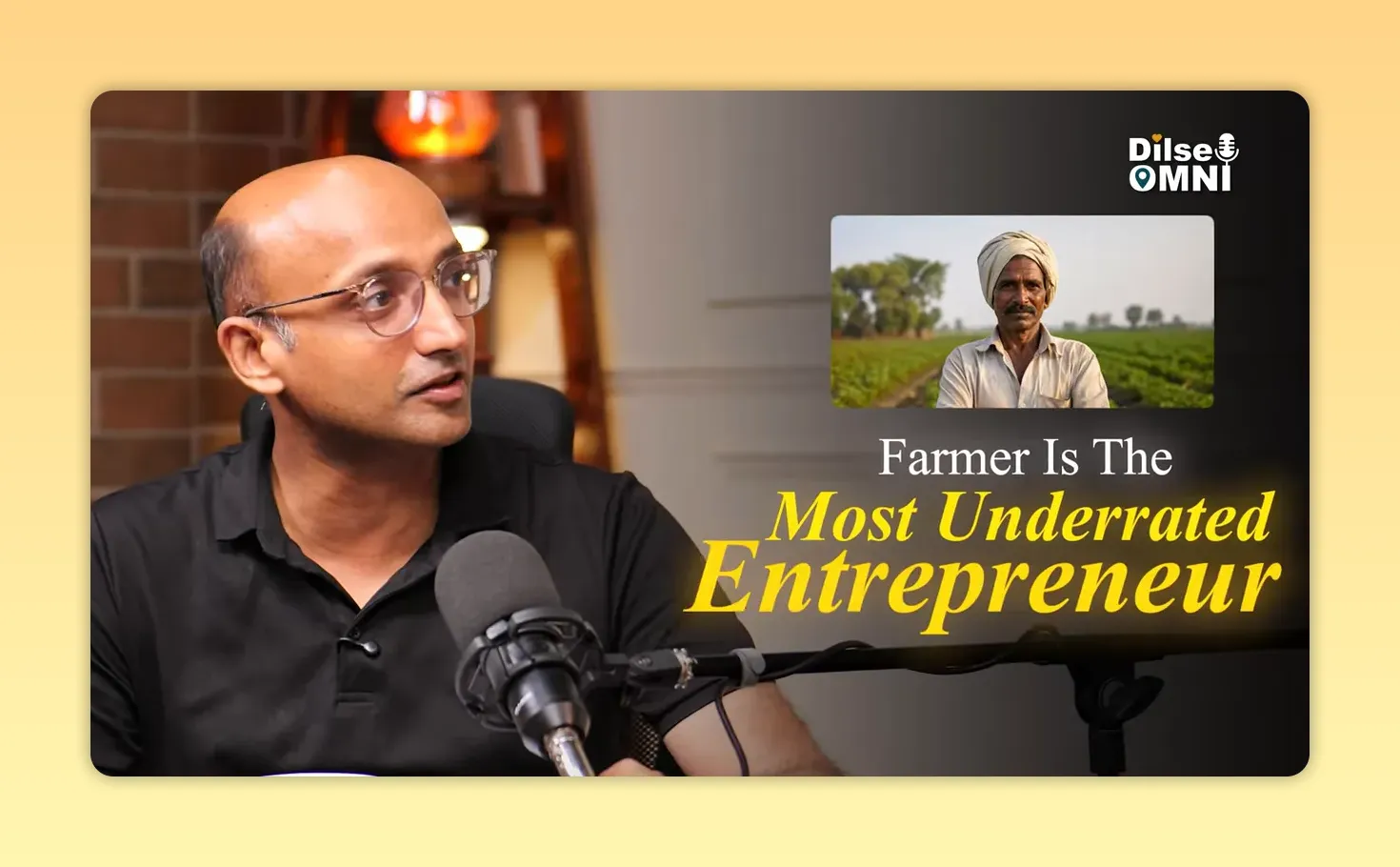
When I invited Nitin Puri to Dilse Omni Talks, I wanted to explore an idea he had shared that stayed with me: what if the farmer is our most underrated entrepreneur?
Nitin is the founder of KisaanSay, a farmer-first food brand working with farming communities to bring authentic, high-quality products to consumers. An IRMA alumnus, he is passionate about building better value chains and strengthening the connection between the people who grow our food and the people who buy it.
I had been following his insights on agriculture for over a year. But this conversation sharpened the question for me. We readily recognise entrepreneurship in someone building a consumer brand. Do we recognise it equally in someone managing an entire crop cycle, carrying weather risk, and then facing an uncertain market?
Nitin’s answer became a masterclass in the difference between creating value and being able to capture it.
Table of Contents
The ₹100 Question That Changes the Conversation
Why Farming Is Entrepreneurship, Not Just Production
The Missing Capabilities Sit Beyond the Farm
A Simple Framework: Capability → Access → Share
Native Wisdom Is a Business Asset
From Respecting Farmers to Building a Business Around Them
The Omnichannel Lesson: Access Must Serve a Purpose
The Question I Took Away
The ₹100 Question That Changes the Conversation
Nitin began with a striking contrast. In the figures we discussed, roughly 46% to 47% of India’s population was involved in agriculture, while the sector contributed about 18% of GDP. For him, that imbalance pointed to a deeper problem: farmers were not realising the full economic value of their work.
He then brought the discussion down to a familiar transaction.
“Out of ₹100, the farmer gets only ₹30.”
That was Nitin’s illustration of the gap between what a consumer pays at a grocery store or online and what reaches the farmer. It is not a product-by-product accounting rule. But it is a powerful starting point for understanding the challenge.

Nitin’s ₹100 illustration makes the gap between consumer spending and the farmer’s share immediately visible.
My takeaway was not that everything beyond the farm has no value. The discussion was about the farmer’s limited ability to participate in those later stages. Growing the product is one part of the journey. Reaching a retail shelf, building recognition, and communicating with the consumer are different capabilities.
If a farmer has access only to the first part, there is a limit to how much of the final selling price they can influence.
Why Farming Is Entrepreneurship, Not Just Production
We often associate entrepreneurs with uncertainty, persistence, and the ability to make decisions without guaranteed outcomes. Nitin described farming in precisely those terms.
A farmer plants, nurtures, harvests, and takes a crop to market. The work happens over months, with exposure to conditions that cannot simply be controlled through better planning.
Nitin used the example of two crop cycles of roughly 125 days each. That is around 250 days of sustained work and exposure to risk. This was an illustration, not a universal calendar for every crop, but the business reality was clear.
Time is committed: A crop requires months of attention before it reaches the market.
Outcomes remain uncertain: Rain, storms, and drought can disrupt the result.
Execution matters: Planting is only the beginning. Care, harvesting, and taking the crop to market all follow.
The return is not assured: Completing the production cycle does not guarantee a fair share of consumer spending.
Listening to Nitin, I felt that calling farmers entrepreneurs is not an act of generosity. It is a more accurate description of the responsibility they already carry.
The uncomfortable question is why that responsibility does not consistently translate into greater economic participation.
The Missing Capabilities Sit Beyond the Farm
Nitin’s explanation was direct: many farmers do not have the means to add further value to their products or reach the retail market. They also lack access to the knowledge and capabilities involved in marketing, branding, promotion, and social media.
These are not small gaps. They determine how a product moves from being something produced to being something a consumer recognises and chooses.

A farmer may understand the crop deeply while having little visibility into how the finished product is positioned. That creates a dependence on others for almost everything that happens after production.
Nitin was also candid about the consequences of this dependence. In his assessment, farmers have faced generations of unfair treatment in the market. His concern was not simply that the chain is long. It was that farmers have too little influence over it.
The distinction matters: a lack of market access is not the same as a lack of entrepreneurial ability.
For those of us working in branding, ecommerce, or omnichannel growth, this is a useful correction. Capabilities we treat as normal business infrastructure may be precisely what a producer cannot access.
A Simple Framework: Capability → Access → Share
Nitin did not present a named framework. But I found it useful to organise his explanation into three connected questions. This is my synthesis of the business lesson, rather than a formal KisaanSay model.
Capability | Market access | Economic share |
|---|---|---|
Can the farmer participate in value addition beyond growing the crop? | Can the product reach retail and consumers with effective branding and communication? | Does that participation help the farmer retain more of the final consumer spend? |
Production knowledge → Value-adding capabilities → Consumer connection → Better participation in value.
The framework helps separate the problem into practical parts.
1. Capability: What is missing beyond production?
The first question is not whether the farmer works hard enough. It is whether they have the means to participate beyond the farm. Nitin’s diagnosis shifts attention from effort to the capabilities surrounding that effort.
2. Access: Who understands and reaches the consumer?
Retail access, marketing, and branding connect a product to demand. Without that connection, the farmer remains distant from the market that determines the product’s final value.
3. Share: Who benefits from the connection?
A consumer-facing brand may create opportunities, but Nitin’s ambition goes further than putting a name on a pack. The important question is whether farmers receive a better share of the consumer pie.
That final test keeps the model farmer-first rather than merely farmer-themed.
Native Wisdom Is a Business Asset
One of the most memorable parts of our discussion was Nitin’s insistence that the missing ingredient is not intelligence.
“The farmer’s native intelligence, their native wisdom, is very strong.”
His conviction came from years of exposure. He spoke about studying near villages in Kurukshetra, learning at IRMA, understanding the story of Amul, and travelling across India to meet farmers during a career spanning roughly 25 years.
Those experiences had challenged the assumption that formal education is the only meaningful measure of capability.
Nitin described rural life as an environment full of varied, unstructured situations. His argument was that navigating such an environment develops practical judgement, adaptability, and the ability to deal with people.
He expressed this forcefully through comparisons of IQ and EQ. I took that as his deeply held assessment from experience, rather than a measured ranking of rural and urban intelligence.
The broader lesson is worth retaining: we should not mistake unequal access to formal opportunities for unequal potential.
Farmers bring indigenous knowledge, tradition, culture, and lived understanding. Yet those strengths do not automatically translate into an ability to negotiate the consumer market. That is the disconnect Nitin wants to address.
From Respecting Farmers to Building a Business Around Them
As Nitin connected these ideas, the motivation behind KisaanSay became clearer to me.
On one side were farmers carrying knowledge, effort, and risk. On the other was a consumer market requiring branding, promotion, retail access, and a different set of business capabilities.
The opportunity was to build a bridge between them.
Nitin described wanting a brand that would help farmers earn a larger share of consumer spending. That is an important shift in perspective. The farmer is not simply the origin of the product story. The farmer’s economic participation becomes part of the purpose of the business.
His exposure to IRMA and Amul also provides context for that thinking. The related discussion on lessons from Dr. Verghese Kurien and the seed behind KisaanSay explores that influence further.
What stayed with me was the order of the problem-solving. Nitin did not begin by dismissing what farmers already know. He began by recognising it, then asking which missing business connections could help that knowledge earn a better return.
The Omnichannel Lesson: Access Must Serve a Purpose
On Dilse Omni Talks, we frequently discuss how brands connect with customers across channels. This conversation brought that topic back to a more fundamental question: who gets access to those channels in the first place?
For an established brand, market access can sound like an expansion problem. For a farmer, it may be the missing connection between production and participation in the final sale.
That is my omnichannel takeaway from Nitin’s argument. Distribution and communication should not be discussed only as ways to sell more. They can also be examined as ways to connect capable producers with markets they cannot easily reach alone.
The business challenge is to make that connection useful to the consumer while keeping the producer’s interests central.
The Question I Took Away
I began by asking Nitin why farmers are underrated entrepreneurs. I came away thinking that we often recognise entrepreneurship only when it appears in a familiar setting: a company, a brand, or a founder’s pitch.
Farming asks us to recognise it elsewhere.
The risk is there. The judgement is there. The knowledge is there. What may be missing is the infrastructure and market connection needed to turn those strengths into a fairer economic outcome.
The challenge is not merely to appreciate farmers more. It is to build value chains in which their contribution earns them a better share.
I am Saurabh Agrawal and we come with a new episode on Dilse omni talks every fortnight and cover different aspect of omnichannel with amazing speakers.