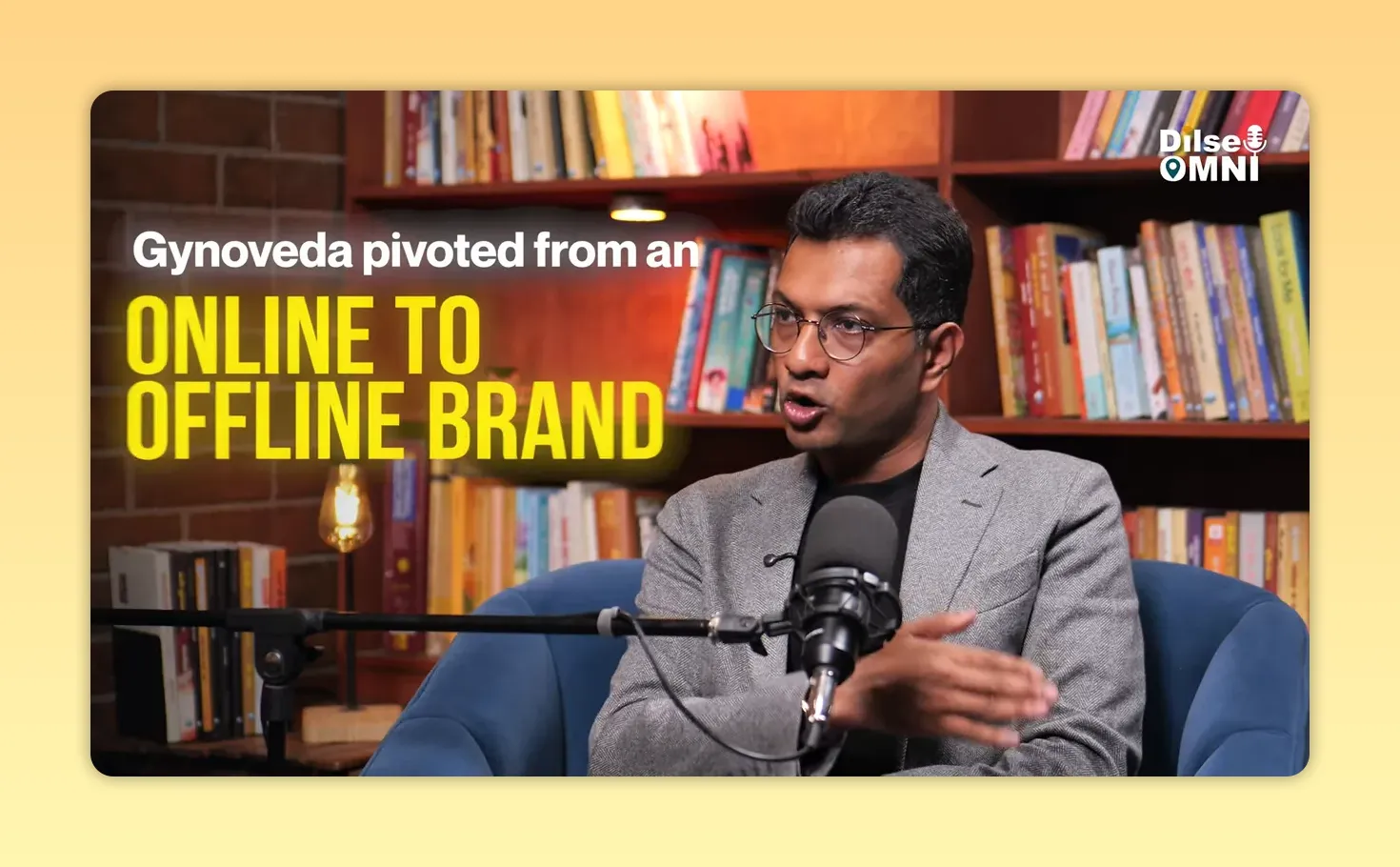
In this episode of DilSe Omni, Ankur Khaitan, Principal at Fireside Ventures, shares how India's leading venture capital firms evaluate consumer brands, why omnichannel has become non-negotiable, and what founders must do to build iconic businesses in the next decade.
I came into this conversation wanting to understand a question that keeps coming up for D2C founders: when should a digitally native brand open physical stores? The answer from Ankur was refreshingly clear. Offline is not a badge of ambition. It is a channel decision rooted in what the customer needs at a particular moment.
Some businesses can begin online and grow rapidly through digital discovery. But eventually, the customer may need trust, consultation, touch, reassurance, or a more human interaction before making a decision. That is when offline stops being an expansion vanity project and becomes a real strategic advantage.
Table of Contents
The Real Question Is Not Online Versus Offline
Gynoveda: When Empathy Determines the Right Channel
Physical Retail Is Also a Product Experience
A Practical Framework: The Customer, Cluster, Control Model
When Should a Brand Consider Franchising?
Don’t Mistake Speed for Readiness
The Real Question Is Not Online Versus Offline
We often frame the conversation incorrectly. We ask whether online is better than offline, or whether an online-first brand should go offline. But brands that win in omnichannel do not treat channels as competing silos. They treat them as parts of one customer journey.
As Ankur put it:
“It is not about online versus offline really, but more importantly how are the two complementing each other.”
That distinction matters. A website may create awareness, educate a customer, capture demand, and start the relationship. A store or clinic may provide the experience that closes the purchase, deepens trust, or makes the customer comfortable enough to return. Then online can continue to support reorders, communication, community, and retention.
For founders, the question should be: where does the customer want to interact with us, and why?
This takes us beyond channel metrics and into customer behaviour. If the purchase involves a high-consideration product, personal care, health, a costly item, or a category where customers want to feel and compare, a physical environment can reduce friction in ways a screen cannot.
The strongest omnichannel shifts happen when the business follows the customer’s preferred interaction, not a channel trend.
Gynoveda: When Empathy Determines the Right Channel
The Gynoveda journey is a powerful example because it challenges the default belief that every modern health business should remain digital-first. Gynoveda began online, but after establishing its first clinic, it scaled rapidly to roughly 60 to 65 clinics in three years. That kind of expansion in healthcare is highly unusual.
The core insight was not simply that clinics could scale. It was that the consumer wanted a different kind of experience.
For sensitive healthcare conversations, people want to be heard without judgment. They want empathy. They want a comfortable environment. They want the confidence of building a relationship with a gynaecologist or doctor. In that context, an offline consultation is not a legacy operating model. It is the right product experience.
“Consumers want to interact in a non-judgment, empathy way. They want to be heard in an environment where they are comfortable.”
This is why Gynoveda’s move from an online-only approach towards a largely offline model makes strategic sense. The company did not abandon digital because online had failed. It used the learning from digital to understand the point at which a real-world interaction became essential to customer trust.
There is a broader lesson here for health, wellness, and service businesses: empathy can be operationalised. It influences how you design your spaces, train your teams, structure consultations, communicate with customers, and build repeat behaviour. When a brand makes people feel safe and understood, that emotional value can become a durable competitive advantage.
Physical Retail Is Also a Product Experience
The same logic applies outside healthcare. Ankur referred to The Sleep Company, where the physical channel enables customers to look, feel, and touch the product before making a purchase decision. Mattresses are inherently experiential. A product page can explain technology, materials, and offers, but it cannot completely replace the confidence that comes from trying the product in person.
In categories like sleep, jewellery, fashion, furniture, beauty, and premium consumer goods, retail can help a brand convert consideration into conviction. It can also increase trust in a relatively young brand.
Several Indian consumer businesses have gone offline early in their journeys. GIVA has built a meaningful offline presence in jewellery. Orah, in the lab-grown diamond space, began offline. The Souled Store is another example of a brand that expanded successfully into physical retail. Newer brands such as Gully Labs are also choosing to explore offline much earlier than brands did five years ago.
Younger Indian brands are increasingly treating physical retail as an early learning channel rather than a late-stage add-on.
The point is not that every D2C business must open stores quickly. The point is that a founder must understand the specific role a store plays. Is it discovery? Trust? Product trial? Consultation? Community? Faster conversion? Higher basket size? Repeat purchase? Without that clarity, retail becomes expensive real estate with no clear job to do.
A Practical Framework: The Customer, Cluster, Control Model
Our discussion led me to frame Ankur’s thinking into a simple three-part model for offline expansion.
1. Customer: Is offline solving a real customer need?
Begin with the customer, not with an expansion target. Ask whether an in-person interaction creates meaningful value that digital alone cannot provide.
Does the customer need to touch, try, compare, or experience the product?
Does the category require consultation, trust, or privacy?
Does physical presence improve conversion or reduce hesitation?
Can a store create a stronger relationship that improves retention?
Gynoveda’s answer was yes because healthcare conversations required comfort and confidence. The Sleep Company’s answer was yes because the product benefits from physical trial.
2. Cluster: Can the brand make one city work deeply?
Ankur strongly believes in a cluster-based approach. It is easy to assume that one successful store in Bengaluru can be copied into Delhi. But cities have distinct customer contexts, and replication should be tested within a market before expanding across markets.
“Can I have multiple stores in the same city without cannibalization?”
This is a far more useful question than asking whether a single store is profitable. A true retail playbook emerges when a brand understands how multiple locations work together in the same city.
A city cluster helps a founder test whether online activity can drive local footfall, whether store presence improves digital conversion, whether customers move across channels, and whether new outlets add demand rather than merely split existing demand.
Track the everyday operating metrics that reveal this relationship: footfall, store conversion, average basket size, inventory turns, customer acquisition source, online-to-store journeys, store-to-online reorders, and overlap between catchment areas.
Before signing a lease, a founder needs a clear thesis for what offline will change in the customer journey.
3. Control: Build the operating engine before delegating it
The first few stores are not merely revenue points. They are learning laboratories. Ankur’s view was direct: ideally, the first 50 stores should be company-owned and company-operated, provided the company has the capital to support that approach.
Why? Because the real playbook for scale gets built somewhere between 10 and 50 stores. That is where the operational gaps become visible. Training breaks. Standardisation weakens. Customer experience becomes inconsistent. Inventory decisions get harder. Technology systems are tested under real conditions.
“A true playbook for scale gets built out in that 10 to 50 stores where things will break.”
There is no substitute for founder and operator proximity during this stage. The closer the business is to the store reality and the consumer reality, the stronger the engine it can eventually scale.
When Should a Brand Consider Franchising?
Franchising is often attractive because it can reduce the capital burden of expansion. In a franchise-owned, company-operated model, the franchise partner may fund the capital expenditure while the brand continues to manage the operation. In a franchise-owned, franchise-operated model, the partner takes on even more responsibility.
But reduced capital requirements come with a trade-off. The franchisee must generate returns on their investment and earn profits. That affects the margin pool available to the brand.
Ankur’s lens is practical: a franchise model has to work financially for both sides over the next three to five years. It cannot be a model that looks attractive only in a launch spreadsheet.
For the brand: Can it protect experience, standards, and attractive unit economics?
For the franchise partner: Can the store reach payback and generate a meaningful profit?
For the customer: Will the experience remain consistent across locations?
This is the fine line. A brand must create an outcome for itself while setting franchise owners up to stay committed to the business. If the partner does not benefit meaningfully, the system eventually weakens.
Don’t Mistake Speed for Readiness
The desire to expand is natural. A successful first store can make the next ten feel inevitable. But early retail growth should be treated as a disciplined process of validation, not a race to accumulate pin codes.
Start with a clear customer insight. Test a cluster. Build the operational muscle. Understand how online and offline reinforce one another. Then decide whether the model is robust enough to scale from one store to 50, and from 50 to 100.
For consumer brands in India, omnichannel is increasingly non-negotiable. But omnichannel does not mean being everywhere. It means being present in the right place, with the right experience, at the right point in the customer journey.
That is the real offline expansion playbook: do not open retail stores simply because other brands are doing it. Open them when the store gives your customer something they cannot get anywhere else, and when your organisation is ready to deliver it consistently.
I am Saurabh Agrawal and we come with a new episode on Dilse omni talks every fortnight and cover different aspect of omnichannel with amazing speakers.