India’s retail story is entering a defining decade. We are already a $1 trillion retail market, and the journey to nearly $2 trillion by 2030 is no longer a distant prediction. The more useful question is this: where will the next trillion dollars come from?
In my conversation with Aastha Almast, Co-founder and COO of New Shop, we explored that question from the ground up. Aastha brings an unusually broad lens to retail, shaped by her career across acting, finance, corporate leadership, luxury retail, and entrepreneurship. Today, she is helping build one of India’s leading convenience retail platforms.
What emerged was less a conversation about whether quick commerce wins or offline retail wins, and more a masterclass in how India must build a connected retail ecosystem. The opportunity sits at the intersection of organized retail, convenience stores, product innovation, regulation, franchising, data, and real estate.
Table of Contents
The biggest retail revolution of our generation
Quick commerce: friend or foe?
Why 85% of Indian retail is still unorganized
The regulatory burden hiding in plain sight
Why new-age brands struggle to move offline
The $60 billion convenience retail opportunity
New Shop’s 10,000-person store thesis
Growth constraint one: products built for convenience
Growth constraint two: retail real estate
What will organize Indian retail?
The biggest retail revolution of our generation
Aastha made a powerful point early in our discussion: India’s organized retail revolution could be the biggest retail transformation our generation sees. That is because retail growth is not going to come from one format alone.
“Modern retail revolution is the biggest revolution of this generation.”
Aastha Almast

India’s next retail chapter is a structural shift across formats, not a single-channel story.
India has more than 25 evolving retail formats. These span large hypermarkets, supermarkets, cash and carry formats, membership or club stores, specialty formats, convenience stores, e-commerce, and now quick commerce. Each format solves a different customer problem.
A hypermarket serves planned, large-basket purchases. A supermarket serves a more regular household mission. A convenience store handles immediate consumption. Quick commerce addresses urgency from a digital interface. The mistake is to frame these as mutually exclusive formats when the real consumer journey moves fluidly across all of them.
That is why I found Aastha’s central idea so important:
“There is no online-offline dispute anymore. It is omnichannel. That is the only way forward towards growing.”
Aastha Almast
Quick commerce: friend or foe?
Quick commerce has become one of the most visible new entrants in Indian retail. It has changed expectations around speed, availability, and convenience. But should offline retailers see it as a threat?
Aastha’s perspective is more nuanced. India is still in an early stage of retail evolution. A format that did not work earlier may work today because consumer behavior, technology, regulations, supply networks, and urban density have all changed. Equally, no single format needs to eliminate another for the market to grow.
Quick commerce and e-commerce have created more exposure to modern retail behavior. They have also helped validate the underlying consumer need for availability and convenience. Offline convenience retail can meet that need differently, through physical proximity, immediate access, discovery, and human interaction.
The opportunity is to build a retail system in which every channel is useful for the mission it serves. A consumer may order a planned basket online, use quick commerce for urgency, and walk into a neighborhood store for an immediate need. The winning retail strategy is not channel loyalty. It is customer relevance.
Why 85% of Indian retail is still unorganized
India’s market remains deeply fragmented. Around 85% of retail is still unorganized, which explains both the scale of the opportunity and the difficulty of building modern retail businesses.
Historically, offline retail has faced limited access to capital, significant regulation, and high entry barriers. Foreign direct investment restrictions have constrained traditional offline retail in ways that newer digital formats have not always faced. Offline retail is also heavily regulated at multiple levels.
For many years, only a small group of large business families had the capital, infrastructure, relationships, and tolerance for the operational complexity of retail. That made retail entrepreneurship difficult for founders without a legacy background.
But that is changing. As more entrepreneurs build in the category, innovation enters the system. New operating models, franchise networks, data-led assortment, technology, and modern supply chains begin to challenge old assumptions.
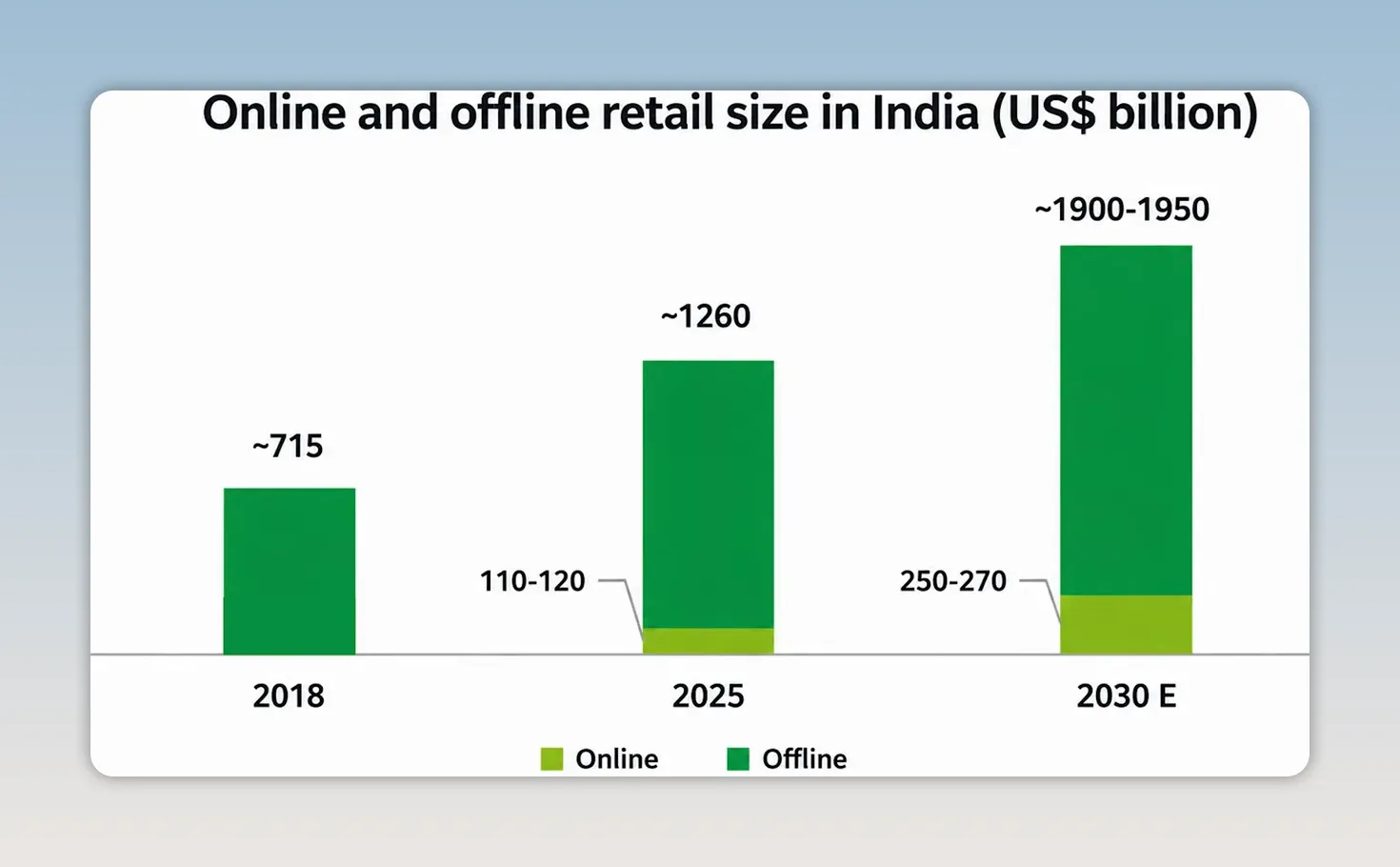
Offline retail remains the largest part of India’s retail economy, even as digital channels continue to expand.
The regulatory burden hiding in plain sight
One of the most revealing parts of our conversation was about regulation. Retail is not just about opening stores and serving customers. It is also about complying with a dense network of operational rules, many of which can feel disconnected from the realities of a modern retail business.
Aastha gave the example of weights and measures compliance. Retail stores must maintain prescribed equipment, and inspectors can check products for their declared weight. If a packaged product states 95 grams but is found to be 94 grams, the liability can become serious. The brand may be penalized, but retail company directors can also face major consequences.
This is particularly difficult for retailers carrying FMCG products from smaller and newer brands. Packaging compliance matters. Product information often needs to be printed as part of the packaging itself, not merely added later with a sticker. When a retailer sees potential fines, litigation costs, and criminal liability, caution becomes rational.
This is why it is unfair to simply ask why stores do not carry more new-age brands. The retailer is not only making a merchandising decision. The retailer is managing compliance risk.
Why new-age brands struggle to move offline
New Shop actively promotes local brands, SMEs, and direct-to-consumer brands. Yet Aastha explained that these are often the brands most likely to face offline readiness issues.
Many D2C brands are designed first for e-commerce. They may not anticipate the packaging, compliance, shelf-readiness, and product-format requirements needed to scale in physical retail. Yet offline is where a substantial part of the growth opportunity still lies.
For founders, this leads to a practical lesson: building a great online product is not the same as building an omnichannel-ready product. A brand must design for every place where a customer can discover, purchase, and consume it.
The Omnichannel Readiness Framework for Brands
I would simplify Aastha’s operational insight into a four-part framework:
1. Compliance: Ensure legal declarations, weights, product information, and packaging requirements are accurate before entering physical retail.
2. Consumption occasion: Identify whether the product is consumed immediately, within an hour, or stored for later use.
3. Convenient pack architecture: Build the right pack sizes and price points for the format, not only for online shipping or large baskets.
4. Channel collaboration: Use retailer data and feedback to refine SKUs, assortment, and replenishment.
This is not simply a packaging checklist. It is a growth system. The best brands will create channel-specific products without losing the core of their brand identity.
The $60 billion convenience retail opportunity
Convenience retail is one of the most exciting pockets of this larger transformation. Globally, the convenience retail category is growing at double digits and is already close to a $2 trillion market. It is projected to cross $3.11 trillion by 2030, with Asia Pacific leading much of that growth.
India’s convenience retail opportunity could reach roughly $56 billion to $60 billion. The exact current size is difficult to measure because so much of the market remains unorganized. But global comparisons make the whitespace clear.
South Korea: approximately one convenience store for every 700 people.
United States: approximately one convenience store for every 2,000 people.
China: approximately one convenience store for every 5,000 people.
India: an opportunity for approximately one convenience store for every 10,000 people.
These comparisons are not templates to copy blindly. India has its own density, income profiles, supply chains, consumption habits, and real estate constraints. But they demonstrate how much organized convenience infrastructure India can still build.
New Shop’s 10,000-person store thesis
Aastha explained the simple but rigorous thesis behind New Shop’s expansion: each store should be able to serve at least 10,000 people in its catchment area. That level of local demand creates the path to store profitability.
“One convenience store for every 10,000 people in India. That is the thesis we follow every time we open our store.”
Aastha Almast

A disciplined catchment thesis turns expansion from a store-count ambition into a profitability model.
New Shop has opened more than 300 stores, with no shortage of prospective franchisees who want to become New Shop owners. This is an important distinction. The limiting factor is not only capital or franchise demand. The more fundamental constraints are supply and real estate.
Growth constraint one: products built for convenience
The first growth constraint is the lack of suppliers and brands building specifically for convenience retail. A store format cannot reach its potential if its assortment has been designed for an entirely different consumption mission.
In a convenience store, products are often consumed within the first hour of purchase. That favors smaller packs over large family packs. It favors portability, immediate consumption, and frequent replenishment.
Energy drinks are a useful example. They are among the most popular SKUs in convenience stores, yet India has only a handful of available energy drink brands compared with markets where refrigerated shelves may offer 40 or more choices.
The conclusion is not that India needs more products for the sake of it. The need is for purposeful product innovation. Retailers and brands must use real demand data to identify gaps, then create products and SKUs that fit the occasion.
New Shop is working with international brands to encourage manufacturing in India and is sharing data with brands at scale. That data can support exclusive SKU development, better pack mixes, and a more relevant assortment for the convenience consumer.
Growth constraint two: retail real estate
The second constraint is real estate. In mature retail markets, commercial real estate is often classified and marketed with clear understanding of the retail format it can support. A property may be suitable for a supermarket, grocery store, convenience outlet, specialty retailer, or another format.
India still needs much more sophistication in this area. Retailers, including dark-store operators, must repeatedly solve the question of where a format can operate efficiently. Real estate discovery, catchment quality, access, local demand, store size, and permitted use all matter.
Aastha put it simply: retail and real estate go hand in hand. India needs stronger retail infrastructure and better organization of consumer-facing spaces. This will not only help convenience chains. It will help every retail format, from neighborhood stores to specialty retail and dark stores.
What will organize Indian retail?
The next phase of Indian retail will not be organized by one company or one technology. It will be organized by an ecosystem.
We need founders who enter retail with fresh operating models. We need regulators who understand the unintended burden of outdated rules. We need brands that build for physical shelves as deliberately as they build for digital platforms. We need real estate partners who understand retail catchments. And we need retailers willing to share data and build with suppliers.
Quick commerce is part of this future, but it is not the whole future. Convenience stores are part of it, but they too are not the whole story. The real opportunity is an omnichannel retail system where formats coexist, brands become more accessible, and consumers get what they need in the channel that best serves the moment.
That is what makes India’s journey from $1 trillion to $2 trillion so compelling. The growth is not merely about more transactions. It is about building the infrastructure, innovation, and trust that allow retail to become meaningfully more organized.
I am Saurabh Agrawal and we come with a new episode on Dilse omni talks every fortnight and cover different aspect of omnichannel with amazing speakers.