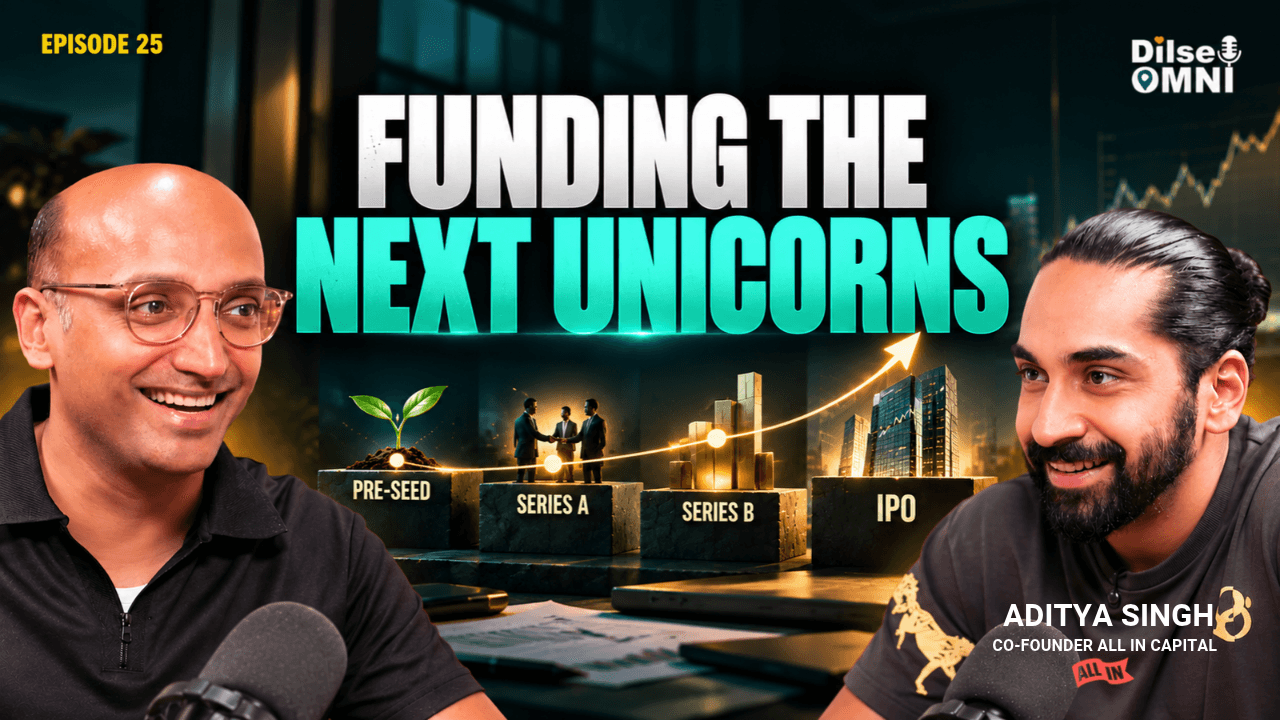
In this episode of DilSe Omni, Ankur Khaitan, Principal at Fireside Ventures, shares how India's leading venture capital firms evaluate consumer brands, why omnichannel has become non-negotiable, and what founders must do to build iconic businesses in the next decade.
I began our conversation with a question about unlearning. When investors meet founders, what assumptions get challenged? What makes someone pause and say, “I had not imagined this was possible”?
Ankur’s answer took us from the speed of physical retail expansion to unexpected shopping baskets, healthcare referrals, and groups of friends buying fashion together. For me, it became a masterclass in a simple principle: the customer’s reality is often more interesting than the brand’s assumptions.
And increasingly, offline retail data is helping us see that reality
Table of Contents
Lesson 1: Question What You Think Retail Can Do
Lesson 2: Offline Analytics Changes the Question
Lesson 3: A Shopping Basket Needs a Human Explanation
Lesson 4: Turn Insight into Better Store Decisions
Lesson 5: Do Not Confuse What Is Measurable with What Matters
Lesson 6: Stores Are Becoming Social Destinations
My Takeaway: Build an Observe, Understand, Act Loop
Lesson 1: Question What You Think Retail Can Do
Ankur’s first surprise was the pace at which businesses were expanding offline.
“I never thought that retail can expand so fast.”
Ankur Khaitan
He pointed to healthcare clinics as an example of businesses expanding with a retail-like approach. The speed at which some businesses had established and grown their physical presence had challenged his earlier expectations.

What stayed with me was his willingness to acknowledge that surprise. In venture capital, as in brand building, experience gives us useful patterns. But those patterns can also become assumptions about what a business should look like or how quickly it should grow.
The lesson is not that every offline business can scale rapidly. It is that an old belief about retail should not prevent us from understanding what a founder is actually building.
Before judging the opportunity, examine whether your mental model still fits the market. That is as relevant to a founder deciding on expansion as it is to an investor evaluating the business.
Lesson 2: Offline Analytics Changes the Question
Ankur’s second surprise was the depth of analytics now possible inside physical retail.
Online businesses have long relied on structured data to understand customer behaviour. His point was that offline environments can also generate meaningful insights, changing the role stores play in an omnichannel business.
He mentioned location intelligence platforms and tools such as Tango Eye as examples of the capabilities prompting him to explore further. But the important idea was not a particular technology. It was the shift in perspective that better information enables.

“You are shifting your focus from channel first to a consumer first.”
Ankur Khaitan
A channel-first business asks how to improve its online operation or its stores. A consumer-first business asks what it is learning about people across those interactions.
That distinction matters. The customer who enters a store may never have engaged with the brand online. Their visit is not a less valuable relationship simply because it began physically.
Similarly, someone who leaves without purchasing may still offer a useful insight or, where they are open to further engagement, an opportunity to build a relationship. The transaction is important, but it is not the whole customer journey.
Lesson 3: A Shopping Basket Needs a Human Explanation
Our discussion became particularly interesting when Ankur described merchandise correlations: understanding what else someone is likely to buy when they purchase a particular product.
These patterns can inform bundles, offers, and discount models. But I shared an example that showed why the explanation behind a pattern matters just as much as the pattern itself.
Someone working in convenience retail had told me about an unexpected association between chocolates and cigarettes.

The familiar assumption would be cigarettes and chewing gum. Instead, the explanation she offered was about the shopping occasion. A father would enter the convenience store with his child, buy cigarettes, and the child would pick up a chocolate.
The products were not necessarily complementary. They appeared together because two people, with different needs, were part of the same visit.
That is the distinction I want founders to notice. A basket tells you what was purchased together. Understanding the occasion helps explain why.
This was an observation about shopping behaviour, not a recommendation to promote those products together. Its value lies in showing how easily a brand’s intuitive explanation can miss the actual human context.
A Three-Question Framework for Basket Insights
My way of translating that exchange into a practical framework is to ask:
What is happening? Identify the products appearing together.
What situation explains it? Consider who is visiting, who accompanies them, and what occasion brings them in.
What decision should change? Use that understanding to reconsider assortment, placement, inventory, or an appropriate offer.
The discipline is to avoid jumping straight from correlation to promotion. First understand the customer situation.
Lesson 4: Turn Insight into Better Store Decisions
Ankur took the discussion beyond bundling. Customer behaviour can influence what merchandise belongs in a store, how aisles are planned, and how inventory is organised.
These are not separate operational details. They are different expressions of the same question: does the store reflect how its customers actually shop?
A useful way to organise those decisions is through four lenses:
Assortment: What should this store carry for the people entering it?
Layout: How should aisles and merchandise be arranged around their behaviour?
Inventory: What needs to be available to support those shopping patterns?
Engagement: How can the relationship continue when someone is open to hearing from the brand?
What I appreciated was the movement from insight to action. Analytics becomes meaningful when it changes a decision, not merely when it produces an interesting observation.
For an omnichannel brand, the opportunity is also broader than serving an existing digital customer offline. Stores can introduce the brand to entirely new people. Some purchase immediately. Others may return later.
That makes the physical store both a place of commerce and a place of learning.
Lesson 5: Do Not Confuse What Is Measurable with What Matters
At this point, I shared a personal experience with Pristyn Care.
My father needed treatment for a cataract. Through a friend’s recommendation, we experienced a coordinated process: a car picked him up for the doctor’s visit, waiting was minimal, and there was support with the insurance arrangements. The operation-day experience was also smooth.
What happened afterwards was just as revealing.
My mother told six people. My father told five. The friend who had recommended the service had, by my account, helped bring roughly 30 to 40 people from our residential communities to it.
“Sometimes we really underestimate the power of word of mouth.”
Saurabh Agrawal
For me, the lesson was that a good experience does not remain confined to the person receiving it. It becomes a story that travels through families, friendships, and communities.
We can spend considerable effort understanding what happens inside a store through data and cameras, while overlooking the conversations that happen afterwards.
Those conversations may be less visible in a dashboard. That does not make them less important. My family’s experience reminded me that removing practical friction can give people something specific and memorable to recommend.
Lesson 6: Stores Are Becoming Social Destinations
Ankur then added another dimension: new-age brand stores can become part of a social outing.
He described six Gen Z friends visiting a NEWME store together. Shopping becomes part of spending time with one another, exchanging opinions, and expressing a shared fashion identity.
I added that they might be shopping for an event or looking to coordinate their outfits. The purchase is connected to something happening in their lives, not simply a need for another item of clothing.
As Ankur noted, seeking friends’ opinions is not new. What is changing is the potential to combine that familiar behaviour with richer analytics and more relevant merchandise.
The implication for brands is important: the individual transaction may sit inside a group experience. Understanding only the purchaser can mean missing the people influencing the choice and the occasion giving it meaning.
My Takeaway: Build an Observe, Understand, Act Loop
I would bring this masterclass together through a simple framework: Observe, Understand, Act. This is my synthesis of the conversation, rather than a named model from Ankur.
Observe: Notice expansion patterns, baskets, visits, referrals, and group shopping behaviour without forcing them into existing assumptions.
Understand: Look for the human context behind the signal. Who is involved? What are they trying to do? Why does the experience matter?
Act: Translate that understanding into better assortment, layout, inventory, service, and engagement decisions.
The connection across all these examples is curiosity. Investors need it when listening to founders. Founders need it when interpreting customer behaviour. Store teams need it when translating insight into experience.
The strongest omnichannel mindset is not simply “be present online and offline.” It is keep learning about the same human being, wherever the interaction happens.
I am Saurabh Agrawal and we come with a new episode on Dilse omni talks every fortnight and cover different aspect of omnichannel with amazing speakers.