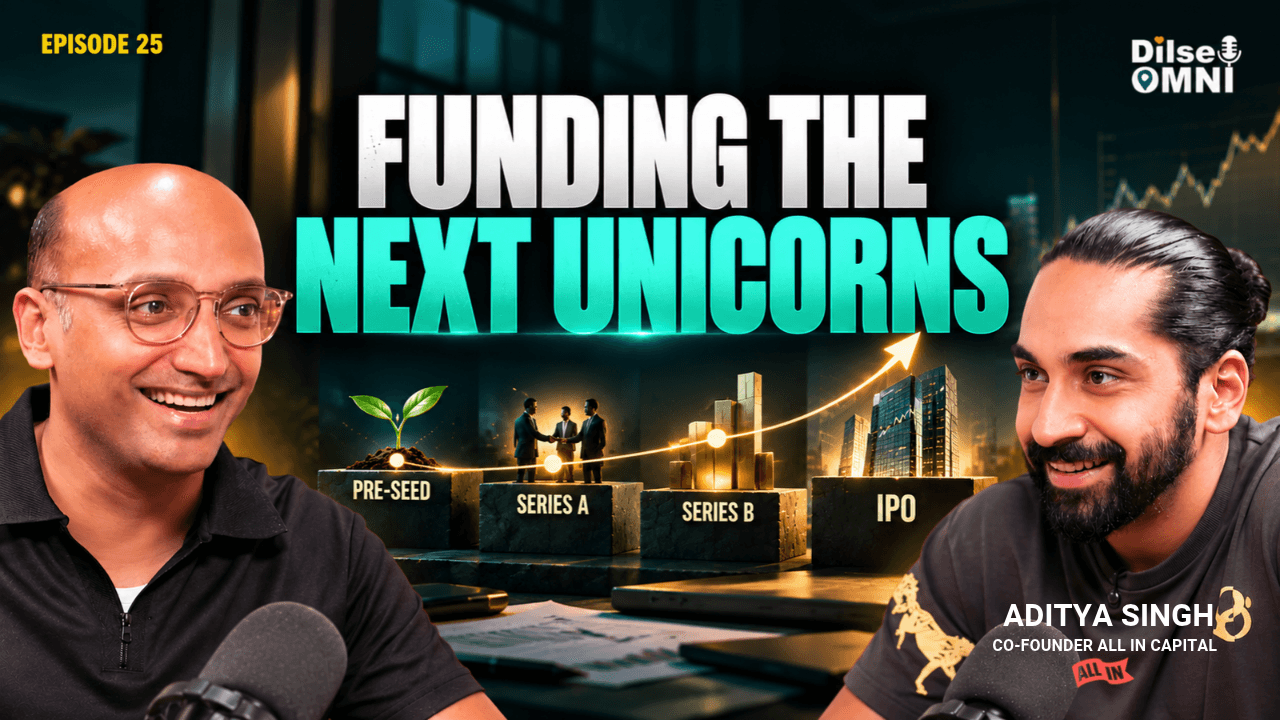
Can a smaller team serve a much larger market? That question stayed with me after my conversation with Swapnika Nag on Dilse Omni Talks.
Swapnika is the Founder and CEO of Periskope and PerisClaw. Periskope automates WhatsApp operations for more than 5,000 businesses across 100 countries, while PerisClaw is an AI executive assistant that runs on your own WhatsApp number. An IIT alumna and former McKinsey consultant, she builds both companies with her husband and co-founder, Bharat, who previously worked at Bain.
What made our discussion interesting was her practical approach. We spoke about consulting careers, AI agents, professional networks, model selection, and the human side of building a company. Underneath those topics was one consistent lesson: learn quickly, stay close to the work, and measure value rather than activity.
Table of Contents
1. Consulting Trains You to Become Useful Quickly
2. A Practical Framework: Learn, Move, Prove
3. AI Changes Consulting Economics, Not Just Consulting Jobs
4. Networks Matter Most When Trust Becomes Action
5. Twelve People, Supported by Many AI Agents
6. Choose Models for the Work, Not the Brand
7. Distribution and Identity Need More Attention
8. Build a Company That Leaves Room for Life
1. Consulting Trains You to Become Useful Quickly
I asked Swapnika which consulting lessons had translated into building an AI company. Her first answer was the ability to figure things out under pressure.

At McKinsey, she worked across pharmaceuticals, medical technology, and financial services. She recalled boarding a flight to Australia and using those roughly 15 hours to understand medical technology and the country’s procurement environment.
Another story made us laugh. At breakfast before a pharmaceutical assignment in Pune, a partner asked whether she knew what an API was. Her mind went to software. In that context, it meant an active pharmaceutical ingredient. A quick explanation of APIs and excipients followed, then came the expectation to get going.
The point was not that expertise did not matter. Experienced colleagues were available. The expectation was that she would take responsibility for becoming useful.
That translates directly into entrepreneurship. A founder cannot permanently declare sales, technology, or marketing to be somebody else’s problem.
“You have to figure it out.”
Swapnika Nag
She and Bharat take pride in understanding the work across their company. Their team runs much of it, but the founders believe they could step in if necessary. I took that as a distinction between delegation and abdication: understand the work well enough to guide it, without insisting on doing everything yourself.
2. A Practical Framework: Learn, Move, Prove
I would organise Swapnika’s consulting lessons into three connected disciplines. This is my synthesis of her approach, rather than a framework she formally named.
LEARN: Build enough understanding to act. Get familiar with the customer, problem, and workflow instead of waiting for complete certainty.
MOVE: Put an initial version into the world. Swapnika described building the first version of Periskope in three days and an initial PerisClaw version in a few weeks.
PROVE: Deliver a useful customer outcome. Judge progress by the value created, not simply by whether a feature shipped.
Her team’s problem-solving culture reflects this. If email deliverability drops, someone does not arrive with only the bad news. They bring a hypothesis, possible fixes, an experiment, and a commitment to report the result.
The operating loop is simple:
Problem → Hypothesis → Proposed solution → Experiment → Result
Her third consulting lesson was value orientation. She pushed back on the caricature of consultants who deliver gyan and disappear. In her experience, fees increasingly connect to outcomes such as revenue improvement or cost reduction.
That shaped how the founders served early customers. They helped brainstorm and build working systems rather than handing over software and leaving customers to discover its usefulness.
3. AI Changes Consulting Economics, Not Just Consulting Jobs
When I asked how AI would affect consultants’ jobs, Swapnika’s response was more optimistic than the usual replacement narrative.
She sees two forces operating together.
Delivery becomes leaner. AI-assisted research and analysis allow smaller teams to do work that previously required more people. Customers consequently expect more competitive pricing.
The addressable market expands. Businesses want help with AI transformation, while lower delivery costs make previously unaffordable consulting services accessible to more mid-market companies.
That second point matters. If we look only at fewer people per assignment, we miss the possibility of serving many more assignments.
The opportunity is not simply to deliver the same engagement more cheaply. It is to serve customers the old cost structure excluded. That is a useful question for any service business assessing AI.
Consulting or an AI startup?
I gave her a choice for her younger self: join McKinsey or Bain, or build an AI company?

Her answer was to spend one or two years in consulting, then build. She believes the transferable skills make the founder journey somewhat easier, although certainly not easy.
She was equally candid about consulting’s stress and her own desire to get her hands dirty. Her advice was a personal recommendation for an aspiring builder, not a claim that everyone needs a consulting credential.
4. Networks Matter Most When Trust Becomes Action
Despite all those professional lessons, Swapnika described the McKinsey alumni network as the most valuable thing she took from the firm.
The community includes founders, investors, and experienced operators. Its usefulness became clear through examples beyond business introductions.
When she needed help navigating an issue in Andhra Pradesh, introductions connected her to relevant officials within about 45 minutes. During her parents’ cancer treatment, the network helped her find oncology recommendations and secure a next-day appointment for her mother.
She acknowledged that this access is a privilege. What struck me was the willingness of people to respond when someone needed help.
I added that networks have two directions: giving and receiving. Their business relationships reflected that reciprocity too. Alumni-founded businesses became Periskope customers, while Periskope bought services from within the same ecosystem, including employee insurance from Plum.
A useful network is not a collection of contacts. It is a community in which people act for one another.
5. Twelve People, Supported by Many AI Agents
Swapnika’s company had a team of 12 at the time of our discussion, with an intention to remain small. When I asked about agents, she laughed. She personally runs around 10 to 12, with Bharat running others.

These were not abstract demonstrations. They supported recurring work:
Content research: Running around 500 prompts each week to identify brand visibility, competitor rankings, and content gaps.
Social listening: Monitoring Reddit and X for relevant conversations and drafting responses for approval.
Sales prospecting: Researching targeted businesses, such as UK conveyancing companies, and returning potential contacts.
Product and coding: Supporting development and product workflows.
Quick approvals happen through WhatsApp. Team conversations also happen through Slack, where much of the team already works.
The lesson I took was to bring agents into existing workflows rather than creating another place for people to check. Our deeper exploration of WhatsApp as an AI executive assistant develops that idea further.
She also described using an agent to reconcile launch-access requests against an existing database and follow up with people who had not received access. It was a specific backlog with a defined outcome, exactly the kind of task that makes agentic AI tangible.
6. Choose Models for the Work, Not the Brand
Swapnika distinguished between tools and models. Her team uses Conductor to bring development sessions across repositories together and support collaboration between the founders.
For underlying models, her position was clear:
“There is no loyalty.”
Swapnika Nag
Her preferences change as capabilities change. Rather than fixating on a particular model name, I would turn her selection criteria into three questions:
Can I consume the output? Long, overly technical answers can create work rather than remove it.
Is it fast enough? Latency matters when a workflow runs repeatedly or blocks another task.
Does it have sufficient capability? Repetitive tasks do not always require the most capable model available.
That is a practical model-selection framework: usable output, acceptable speed, sufficient intelligence.
7. Distribution and Identity Need More Attention
Our discussion about Reddit, X, and LinkedIn brought up another issue: founders can mistake their own information environment for the market.
I challenged the assumption that a technology audience’s preferred platforms necessarily represent India’s broader audience. Swapnika recognised the echo chamber herself. Conversations dominating her X feed were often barely relevant to friends outside AI.
I also shared an uncomfortable, funny example of identity confusion. Search results about Tata leadership contenders had displayed my photograph against another person’s identity. My LinkedIn post about it reached roughly 250,000 impressions and attracted media coverage.
For me, the lesson was bigger than reach. Digital visibility and accurate identity are different problems.
Swapnika then raised the more serious risk of voice cloning. She had asked older family members to agree on code words for critical requests, particularly urgent calls asking for money. A familiar voice alone was no longer enough reassurance.
8. Build a Company That Leaves Room for Life
Our rapid-fire discussion about cities became a conversation about family, pollution, traffic, schools, and flexibility.
Swapnika was considering Hyderabad as a possible balance, while Bengaluru offered family connections. Their remote-first company kept other locations possible. I leaned towards the mountains, provided there was a well-connected airport nearby.
Her reading habits offered a similar reminder. She enjoys murder mysteries, including Keigo Higashino’s The Devotion of Suspect X, alongside business books such as Focus: The ASML Way and The World for Sale.
“I genuinely just read books for fun and joy.”
Swapnika Nag
For podcasts, she mentioned Dwarkesh and Amit Varma’s The Seen and the Unseen. Afterwards, she uses ChatGPT’s voice conversations to explore how an idea might apply to her business. I shared my use of NotebookLM for research and my interest in learning better questioning from The Diary of a CEO.
That felt like the right conclusion to our masterclass: use AI to extend your thinking, without making every experience an efficiency exercise. Build lean, move quickly, and stay accountable to customers, but leave room for curiosity and life outside the company.
I am Saurabh Agrawal and we come with a new episode on Dilse omni talks every fortnight and cover different aspect of omnichannel with amazing speakers.