Bijou Kurien
Bijou Kurien
Episode 28
Episode 28
90 min
90 min
How to Build a Winning Omnichannel Retail Business
How to Build a Winning Omnichannel Retail Business
How to Build a Winning Omnichannel Retail Business
Why Does This Episode Matter?
Why Does This Episode Matter?
If you run a retail brand, a D2C business, or a store trying to grow beyond your current geography, this conversation will reframe a lot of what you think you already know.
Bijou Kurien has seen the full arc: the era before organized retail existed in India, the sprint to build it at scale, and now the moment where every small retailer has the tools to reach customers they would never have found before.
His point is not that technology has changed everything. It is that technology has finally caught up with what good retail has always been about.
Nilesh Patel, founder of LeadSquared, has watched India’s consumer businesses grow over the past 15 years and explains why. When brands spend heavily to bring in demand, they need a system to catch it, qualify it and follow it up before the lead goes cold.
Using real examples from BYJU’S, banking, insurance, healthcare, education and jewellery, he shows where funnels leak and why replying in minutes, not days, can change conversion. For anyone deciding between building and buying a CRM, or wondering why a CRM project didn’t deliver, he offers a simple test: differentiation or efficiency.
If you’re a CXO, marketer or founder, this is a practical conversation on how to turn the demand you pay for into customers who stay.

Bijou Kurien
Chairman - Retailers Association of India (RAI)
Brand-Led Retail vs. Retail-Led Brands: The Essential Difference
Brand-Led Retail vs. Retail-Led Brands: The Essential Difference
One of the sharpest ideas in this conversation came from Bijou describing the fundamental strategic difference between how Titan and Reliance Retail each approached the market.
At Titan, the organizing principle was brand. You built a brand so compelling in its category that customers came to your store because they wanted you specifically. The store existed to serve the brand. At Reliance Retail, the organizing principle was the opposite. You started with the category need, found the consumer who had that need, and built the retail environment around serving them. The brand existed to serve the store.
"In the Tatas, it was brand-led retail. In Reliance, it was retail led by brands. That is the essential difference."
This is not a small distinction. It changes your pricing strategy, your store format, your expansion logic, and how you think about competition. A brand-led retailer defends its position by deepening the brand's meaning. A retail-led player defends its position by owning more categories and more geography. Both can work, but you need to know which one you are building before you start.

Bijou also made a point about speed worth sitting with. When Reliance entered the market, organized retail penetration was very low, capital was not a constraint, and the only question was how fast you could move. Titan's approach required building a want in the consumer's mind before you could sell anything. That takes time and investment of a very different kind.

What Omnichannel Actually Means for a 100-Crore Retailer?
What Omnichannel Actually Means for a 100-Crore Retailer?
I want to spend time on how Bijou explains omnichannel to a traditional retailer, because it is the clearest version of this idea I have heard.
Most small retailers think of omnichannel as a technology problem. They are not wrong that technology is involved, but the framing is backwards. The real problem is that a store-only retailer is only reaching customers who are already close by and only discovering what is available once they walk in. Everything that could change that — digital communication, UPI, delivery logistics — is now available affordably, in bite sizes, as a SaaS model.
Bijou's mental model is simple: if your catchment today is customers within two or three kilometres, omnichannel is the question of what happens when you decide that catchment should be ten. The tools exist. The question is whether you are willing to use them.
He also made a point about quick commerce worth carrying into any planning meeting. No customer ever told a kirana store owner they wanted groceries in ten minutes. That need was not waiting to be discovered. It was created when someone offered the solution. If you are only waiting for customers to tell you what they want, you will always be a step behind whoever is willing to build the solution first.
The Affordable Premium Trap
Here is the idea from this conversation that every D2C founder building in India should sit with.
When Lenskart entered the eyewear market, there were two price points: local opticians at 600 to 750 rupees, and organised brands at 4,000 to 6,000 rupees. Those organised brands served less than ten percent of the market. Ninety percent was buying cheap frames not because they preferred them, but because nothing else existed at a price they would pay.
Lenskart came in at 1,495 rupees with a buy-one-get-one offer that brought the effective cost lower still. A small premium over the local optician, a significant discount against the organised player. The entire middle of the market was empty, and most people were not at the bottom because they wanted to be there.
"The moment you recognise you are building an artificial moat around your business by being single channel, you will also recognise there is an opportunity which lies beyond that."
The lesson applies well beyond eyewear. Indians are value conscious even when they can afford to spend more. If the premium you are charging does not come with a visible reason to pay it, they will not pay it. He had a sharp way of putting it: a person buying jewelry worth a crore for a wedding will still pull out a calculator and ask how much of it is gold and what the making charges are. That is not frugality. That is rationality. The brands that price their premium against a believable story win. The ones that assume premium sells itself tend to find out it does not.

The Culture That Does Not Need a Chief Culture Officer
Saurabh shared something toward the end that landed hard. He had been in a shared cab with a woman who had just lost her job and was praising her old company's culture. He asked: if the culture was so great, why did they let you go?
They went in circles until they landed on this: if a company has a Chief Culture Officer, it is probably trying to fix something. Companies that have built real culture do not think of it as a role. It is an outcome.
Bijou pointed straight to Titan. Every senior leader there came up through the company. The culture was never installed from outside. It was taught by example, reinforced by what the company celebrated, and absorbed by simply watching how the people around you behaved. He called it instinctive. People did not behave a certain way because they had been told to. They behaved that way because that was how things were done.
He connected this to the retail attrition problem directly. Grocery formats see close to 100 percent annual turnover because the job is physically demanding, the hours cut across weekends, and there is no career arc to look up at. Jewelry is the opposite: the staff matter to the customer, the environment is better, the pay reflects the skill, and there is something to aspire to. Culture follows those conditions. You cannot install it from the top when the foundations are not there.
The biggest takeaway from this episode?
The biggest takeaway from this episode?
Know which game you are playing. Brand-led retail and retail-led brands require completely different strategies, and confusing the two is expensive.
Know which game you are playing. Brand-led retail and retail-led brands require completely different strategies, and confusing the two is expensive.
Omnichannel is not a technology upgrade. It is a decision to reach customers beyond the people who already walk past your store.
Omnichannel is not a technology upgrade. It is a decision to reach customers beyond the people who already walk past your store.
Affordable premium only works when the premium is justified out loud. Indian consumers are not unwilling to pay more.
Affordable premium only works when the premium is justified out loud. Indian consumers are not unwilling to pay more.
This is just the beginning. If you’re ready to understand how AI and Omnichannel thinking work together, and hear real stories from people building the future
This is just the beginning. If you’re ready to understand how AI and Omnichannel thinking work together, and hear real stories from people building the future


Talks with Saurabh Agrawal
Latest Episodes

How to Build a Winning Omnichannel Retail Business
The conversation explored “How Indian retail has changed over three decades, why the store still matters in an online world, and what it takes to build brands customers trust and teams that stay.

The Lead Management Playbook
Nilesh Patel, CEO of LeadSquared talks about the funnels, customer journeys and the lead management.

Decoding Personal AI Agents
On this episode of Dilse Omni Talks, Saurabh sat down with Swapnika to talk about what happens when you stop treating WhatsApp as a messaging app and start treating it as the operating system your entire business already runs on.
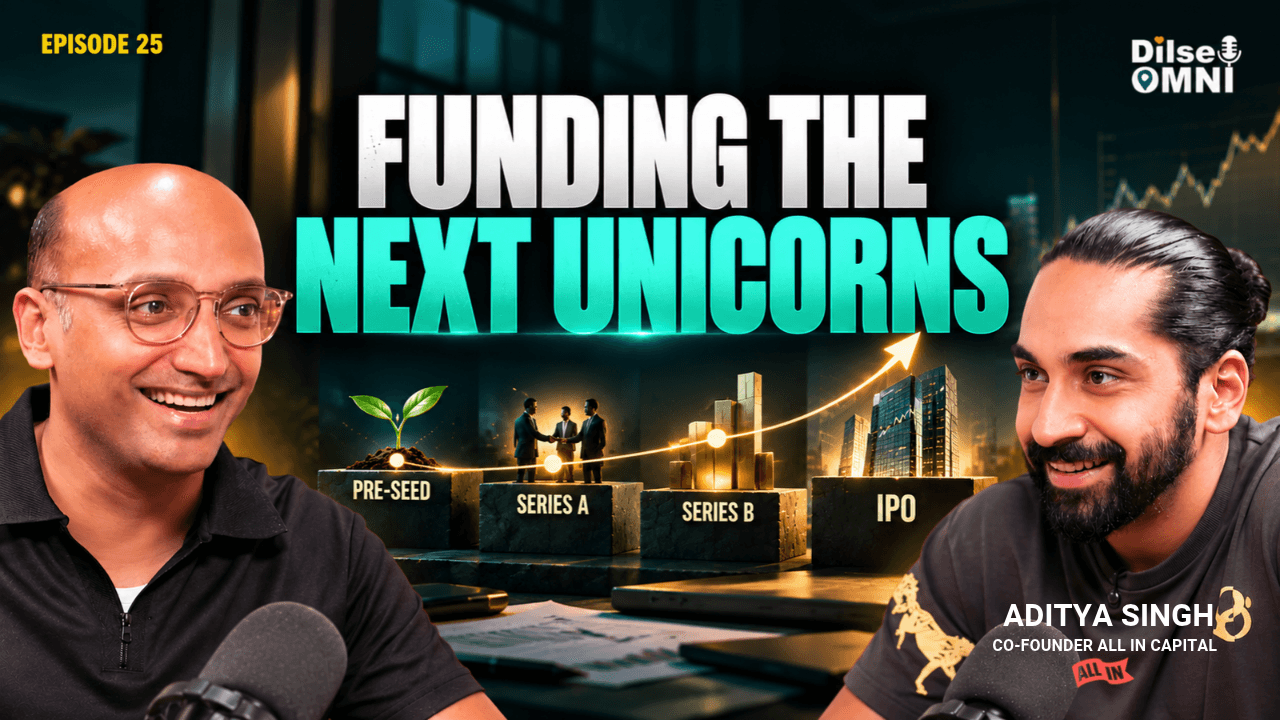
Funding The Next Unicorns
On this episode of Dilse Omni Talks, we covered how to read India's consumer market, what actually happens in a pre-seed pitch room, and why networking is the one compounding skill most founders radically underinvest in.

Future of Marketing is Conversational
Gupshup founder Beerud Sheth on why the click is dying, how conversational AI is rewriting marketing, and why context, not intelligence, is the real moat.
View More
Latest Episodes
How to Build a Winning Omnichannel Retail Business
The conversation explored “How Indian retail has changed over three decades, why the store still matters in an online world, and what it takes to build brands customers trust and teams that stay.
The Lead Management Playbook
Nilesh Patel, CEO of LeadSquared talks about the funnels, customer journeys and the lead management.
Decoding Personal AI Agents
On this episode of Dilse Omni Talks, Saurabh sat down with Swapnika to talk about what happens when you stop treating WhatsApp as a messaging app and start treating it as the operating system your entire business already runs on.
Funding The Next Unicorns
On this episode of Dilse Omni Talks, we covered how to read India's consumer market, what actually happens in a pre-seed pitch room, and why networking is the one compounding skill most founders radically underinvest in.
Future of Marketing is Conversational
Gupshup founder Beerud Sheth on why the click is dying, how conversational AI is rewriting marketing, and why context, not intelligence, is the real moat.
View More
Subscribe on your favourite platform



Subscribe on your favourite platform



Subscribe on your favourite platform

Subscribe for
insider insights
Subscribe
for insider insights
Subscribe for
insider insights



Nitin is a Design Entrepreneur and the founder of Indibni® Group. His mission is to foster a self-reliant India through exceptional Indigenous products that impact individuals worldwide.