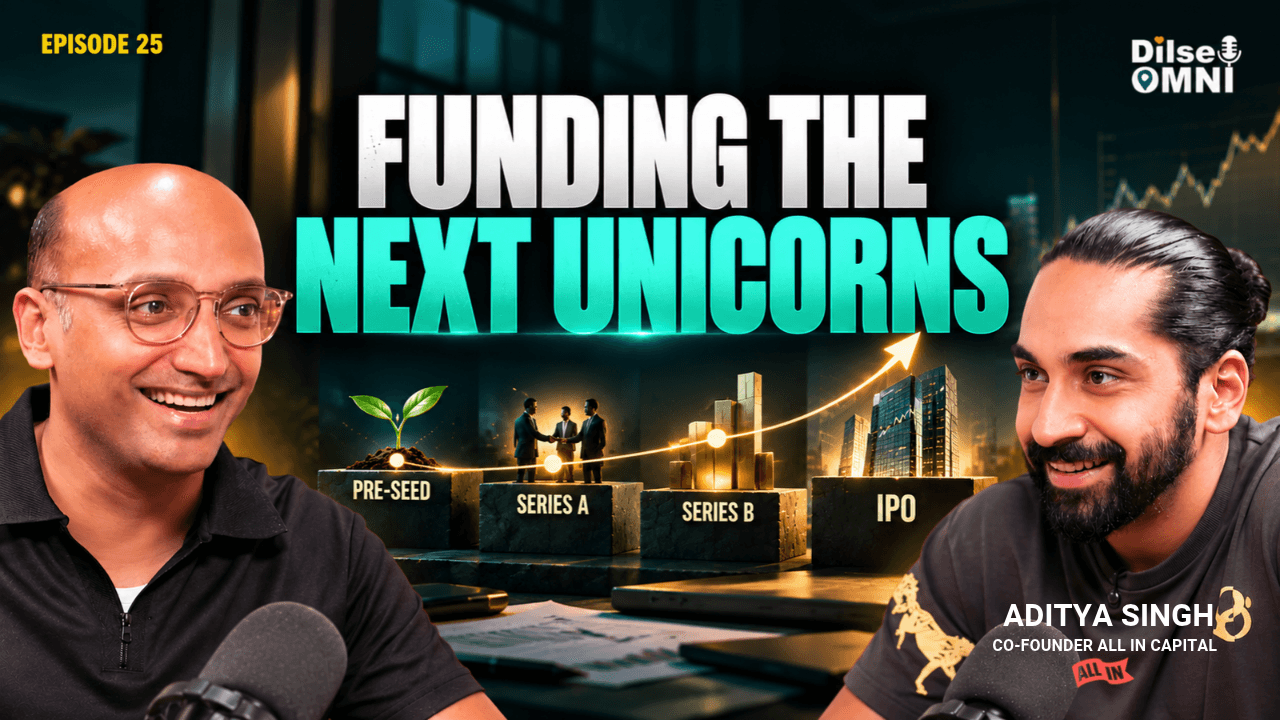
What changes between the first investor backing your idea and someone writing a ₹40 crore cheque to scale it? That was the question I put to Aditya Singh on Dilse Omni Talks. His answer became a masterclass in startup funding, investor psychology, and the uncertainty behind every early-stage bet.
Aditya is the Co-Founder and Founding Partner of All In Capital, an early-stage VC fund investing in Indian startups. He previously built BookMyForex, worked with AWS and Stride Ventures, and backed more than 50 early-stage companies as an angel investor. He understands both sides of the table: the founder trying to build something and the investor deciding whether to believe.
What stayed with me was his honesty. Funding stages have a logic. Outcomes are far less predictable. And sometimes, the most compelling business is a ₹10 protein bar that does not fit the fashionable distribution playbook.
Table of Contents
1. Startup Funding Is a Journey of Increasing Evidence
A Founder’s Funding Milestone Map
2. Why Aditya Chooses the Riskiest Stage
3. The Power Law: Most Bets Will Not Become Breakouts
4. The ₹10 Protein Bar That Challenged the Playbook
A Practical Framework: Customer, Price, Production, Channel
The Next Cheque Follows the Next Proof Point
1. Startup Funding Is a Journey of Increasing Evidence
I asked Aditya to decode pre-seed because funding labels can sound more complicated than the businesses behind them. His explanation was refreshingly straightforward: each round reflects a different level of understanding about the product, customer, and growth opportunity.

Pre-seed: Turn an idea into something testable
A founder identifies an opportunity, puts some personal money into developing it, speaks with potential customers, and prepares a pitch. Aditya described founders spending roughly ₹5 lakh to ₹10 lakh before approaching investors for their first institutional cheque.
In his illustrative funding journey, a pre-seed round is typically around ₹2 crore to ₹4 crore. These are reference points, not universal rules. The important distinction is that much of the business remains unproven.
My takeaway: the first cheque backs the possibility that the founder can turn an insight into a working business. It is not a reward for a polished deck or logo.
Seed: Show that customers will pay
At seed, the conversation changes. The company has used its early capital to establish some evidence of product-market fit.
Aditya described an ₹8 crore to ₹10 crore round, supported by a clearer understanding of the product, paying customers, and the price they will accept. He used ₹25 lakh to ₹30 lakh in revenue as an example of emerging traction, rather than a fixed qualification threshold.
The founder should now be able to explain: customers are buying this product at this price, and additional capital will help us grow in a specific way.
Series A and beyond: Scale what you understand
Aditya placed a typical Series A in his example at ₹20 crore to ₹40 crore. Here, investors expect much greater clarity about how the business works and what the money will accelerate.
Series B, C, and D bring larger pools of growth capital. The discussion increasingly becomes about how much value additional investment can create and whether the company can reach a substantial exit, potentially an IPO.
He contrasted the flexibility of entering very early with the larger eventual outcomes later-stage investors need. I took this as an explanation of return expectations, not a rule that every company must follow the same exit route.
A Founder’s Funding Milestone Map
I would translate Aditya’s explanation into this simple framework. The cheque sizes provide context; the evidence column is what founders should focus on.
Stage | Illustrative round | Evidence to build | Question to answer |
|---|---|---|---|
Pre-seed | ₹2 crore to ₹4 crore | A developed idea, customer conversations, and an initial plan | Why is this opportunity worth testing? |
Seed | ₹8 crore to ₹10 crore | Paying customers and early product-market fit | What have we learned that makes growth credible? |
Series A | ₹20 crore to ₹40 crore | A clearer business model and growth plan | What will this capital accelerate? |
Series B onward | Larger growth rounds | Evidence supporting expansion and a substantial outcome | Can this become large enough to justify the investment? |
Idea → customer evidence → business clarity → growth capital. That progression is more useful than treating the next funding round as the milestone itself.

Each step up the funding ladder brings a different expectation of business maturity.
2. Why Aditya Chooses the Riskiest Stage
Why operate at pre-seed when so little is certain? For Aditya, that uncertainty is part of the attraction.
He described backing a 10-minute medicine delivery business after others had passed. When the company subsequently raised a ₹100 crore round, it illustrated what early investing makes possible: supporting an unconventional idea before broader conviction develops.
His comparison was simple. An early-stage investor might put ₹4 crore each into 20 companies. A growth investor might commit ₹100 crore to one. The latter naturally requires deeper scrutiny, more numerical confidence, and potentially months of diligence.
“An investor has to match the stage they like.”
Aditya Singh
Aditya enjoys moving quickly and backing audacious possibilities. That is his temperament. For founders, the lesson is to understand an investor’s stage preference before interpreting their reaction. A business can be interesting and still be wrong for a particular fund.
This connects with the broader question of what investors look for before they invest: the assessment depends on what has been proven and what remains a bet.
3. The Power Law: Most Bets Will Not Become Breakouts
When I asked about success rates, Aditya did not dress up the answer. At pre-seed, getting one meaningful hit in five would be exceptional.
He explained the portfolio through an illustrative group of 100 companies:
About 50 fail: a large share of early bets simply do not work.
About 30 struggle or produce modest outcomes: some may be acquired or return limited capital.
The remaining 20 contain the stronger outcomes: a much smaller subset may deliver extraordinary returns.
This is the power law in venture capital. Returns are not evenly distributed. A rare, enormous outcome can outweigh many disappointments and potentially return multiple funds.
Aditya used Zepto to explain that scale of possibility. But he was equally clear that investors cannot reliably identify the eventual superstar at the beginning.
“You had no idea it would reach there.”
Aditya Singh, on the certainty investors can project after a breakout
That admission matters. Companies pivot. Co-founders leave. Businesses that appear strong can encounter serious problems much later. Aditya referenced DealShare and GoMechanic, and we also discussed the service gap left by BluSmart, as reminders that apparent momentum does not remove uncertainty.
My learning was not that judgement is irrelevant. It was that conviction and certainty are different things. An investor can make a considered decision without knowing how the story ends.
4. The ₹10 Protein Bar That Challenged the Playbook
The most memorable example came when Aditya described discovering Taqat at the Aahar food exhibition. He was visiting Master Chow’s stall and noticed a queue elsewhere.
The product was a mass-market protein bar, with price points of ₹10, ₹20, and ₹30. The ₹10 proposition immediately caught his attention.
Then came the complication: the founder intended to sell offline.

Aditya explained why quick commerce was not an obvious fit. A low-priced product offered limited margin and sat awkwardly with platforms seeking higher average order values. A ₹10 bar offering five grams of protein could appeal to value-conscious customers, but that did not automatically make it attractive to the channel.
That distinction is central to omnichannel strategy: a product customers want and a product a platform wants to sell are not necessarily the same thing.
The manufacturing challenge came before distribution
The founder also needed a specialised manufacturing process. Aditya described it as beginning like rusk production and ending like a biscuit. To make the product work at ₹10, the founder believed he had to establish his own factory.
He mortgaged his house and took a loan to build it. This is not a financing recommendation. It was a serious personal risk, and Aditya openly admitted that it worried him.
The team kept working. After roughly a year pursuing DMart, the product secured distribution there. At the time of our conversation, Aditya said the factory was operating at around two-thirds capacity and the business was generating approximately ₹2 crore a month in revenue, profitably.
The investor who had worried about putting in more money was now eager to invest again. That reversal captured early-stage investing better than any neat prediction could.
A Practical Framework: Customer, Price, Production, Channel
Here is my synthesis of the Taqat story, rather than a named framework Aditya presented:
Customer: Identify the mass-market need the product addresses.
Price: Establish the price that makes the proposition compelling.
Production: Build the capability needed to deliver at that price.
Channel: Choose distribution that supports the economics.
Customer need → viable price → production capability → channel fit. Starting with the trendiest channel could have pushed this business away from its core proposition. Offline distribution was not a compromise; it was integral to the model.
This is also why the relationship between digital and physical commerce deserves careful thought, as we explore in From Clicks to Footfall. Channel decisions should serve the business, not become its identity.
The Next Cheque Follows the Next Proof Point
I came away with a simple lesson: founders should focus less on earning the next funding label and more on resolving the next important uncertainty.
Do customers want the product? Will they pay the intended price? Can it be produced economically? Does the chosen channel support the business? Each answer makes the next conversation more grounded.
Aditya’s honesty made this masterclass valuable. Investors do not know everything in advance. Founders do not execute in straight lines. But meaningful evidence can turn an unlikely proposition into a business that even its earliest backer sees differently.
I am Saurabh Agrawal and we come with a new episode on Dilse omni talks every fortnight and cover different aspect of omnichannel with amazing speakers.