
K Ganesh, Co-Founder of GrowthStory, the Force Behind BigBasket, Bluestone, and More
K Ganesh is the co-founder of GrowthStory, the entrepreneurship platform he runs alongside his wife Meena Ganesh , not a fund, but a startup factory that takes ideas from zero and builds them into category-defining companies.
He is the promoter and co-founder behind some of India's most recognised consumer businesses: BigBasket, Bluestone, HomeLane, Portea Medical, and Musigma, among others. Each of these was built in a different sector, which makes his pattern recognition around building durable, scalable businesses unusually sharp.
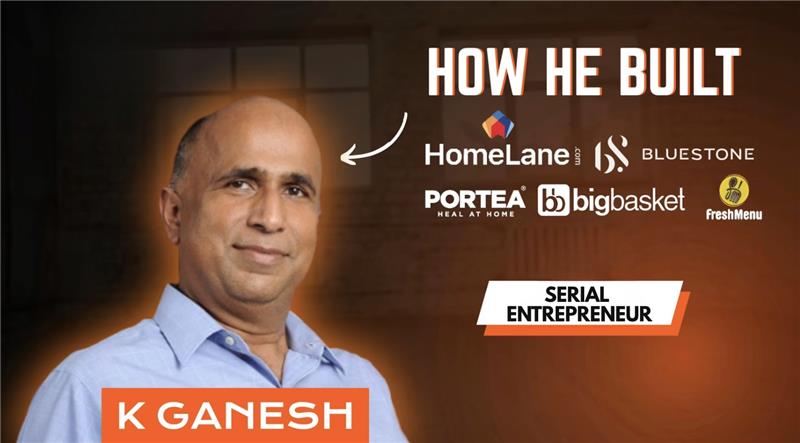
Today, K Ganesh remains one of India's most active early-stage builders in consumer, healthcare, and retail , and one of the most respected voices on what actually makes a business last rather than simply grow fast.
Background & Journey
K Ganesh's track record is defined by successful exits, not just launches. He founded IT&T, then CustomerAsset, which was sold to ICICI and later became Firstsource. He followed that with Marketics, an analytics business acquired by WNS, and then TutorVista, the online tutoring company acquired by Pearson in one of the earliest large Indian edtech exits. Each venture was built in a different sector , which is precisely what gives him an unusually broad ability to spot what works across industries.
He is also an author and a frequent commentator in the Indian startup ecosystem, known for his clear thinking on unit economics, category dynamics, and the difference between growth that compounds and growth that burns cash.

On Dilse Omni Talks
K Ganesh recently appeared on Dilse Omni Talks with host Saurabh Agrawal, where the conversation explored “How India's most successful consumer brands really scaled , and what the omnichannel disruption means for businesses today.”

3 Key Takeaways from the Episode
● Sustainable growth beats fast growth every time. K Ganesh explains why many consumer businesses look impressive on headline revenue while quietly failing on unit economics , and what founders should actually be measuring to know whether their growth is real.
● Category choice matters more than execution. Some markets are structurally easier for new entrants than others. Picking the wrong category cannot be fixed by working harder or spending more , which is why the most important decision a founder makes is often the first one.
● Omnichannel disruption is a business model question, not a channel question. The brands that survive major market shifts are the ones that rebuild how they operate , not the ones that simply add a new channel or a new app to what they were already doing.